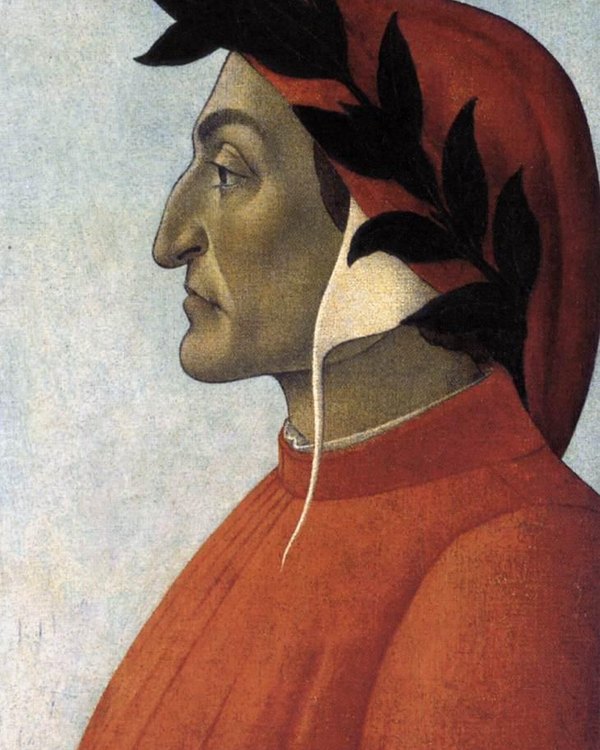
Who He Was
Florentine poet, born in 1265 and died in Ravenna in 1321, author of the Divine Comedy, the journey of a living man through Hell, Purgatory, and Paradise, written in Tuscan and in terza rima. A White Guelph and prior of Florence in 1300, banished from the city in 1301, he wrote the poem that gave Italian a literary form while in exile.
Life and Work
He studied the classics, fought at Campaldino, loved Beatrice and sang of her in the La Vita Nuova, entered the politics of Florence, and lost everything with the victory of the Blacks in 1301. In exile he wrote the Il Convivio, the De Vulgari Eloquentia, and the Comedy, in which Dante himself, lost in a forest in 1300, crosses Hell guided by Virgil, climbs Purgatory, and reaches Paradise, where Beatrice guides him and then Saint Bernard.
Why Read Him
Exile becomes architecture in the Comedy: Hell, Purgatory, and Paradise order everything that exists by guilt, purgation, and love, from the politics of Florence to philosophy, from the pope and the emperor to Beatrice. The poem is not only doctrine. The episodes of flesh and blood, such as Francesca, Ugolino, and Ulysses, are the ones readers remember, and allegory is the instrument that sustains them, not an ornament. In Hell, each punishment shows the sin instead of merely punishing it, and each of the three canticles ends on the same word, stars. The last closes with a line about love, the love that moves the sun and the other stars.
Family, Studies, and Beatrice
He was born in Florence in 1265, probably between May and June, into a family of means but without nobility, which claimed descent from one of the city's founding families, and he was baptized in the Baptistery of San Giovanni. He studied the trivium and quadrivium, read Virgil, Ovid, Lucan, Cicero, and Statius, and among his teachers was Brunetto Latini. In 1289, at twenty-four, he fought in the Florentine cavalry at Campaldino. According to tradition, he first saw Beatrice Portinari when he was nine; she died in 1290, at twenty-four. He married Gemma Donati, with whom he had several children, and his love for Beatrice went on inspiring his poetry.
The Priorate and the Exile
A White Guelph in a Florence divided between Whites and Blacks, he enrolled in the guild of doctors and apothecaries, which was required for public office, served as ambassador and councillor, and in 1300 became one of the six priors, the highest magistracy of the city. During that term the priors exiled leaders of both parties, among them his friend and poet Guido Cavalcanti, who contracted malaria and died. In October 1301, while Pope Boniface VIII kept a White embassy waiting in Rome, an embassy of which Dante possibly was a part, Charles of Valois handed the city to the Blacks, who banished the Whites. Dante was condemned to exile, to a heavy fine, and to the loss of his property.
Exile and the Comedy
He spent the rest of his life moving from city to city, serving various lords. He was welcomed in Verona by Bartolomeo della Scala in 1303 and was in Bologna, where he began, in Latin, the De Vulgari Eloquentia, a defense of the vernacular, the same language in which he wrote the Il Convivio. The Comedy was written in exile, and in it Dante places Florence and the enemies and friends he lost. He died in Ravenna on September 14, 1321, at fifty-six, and is buried there; the tomb in Florence is empty.