About the work
- Author
- Luigi Pirandello
- Original title
- Uno, nessuno e centomila
- Publication
- 1925 and 1926, in installments in the magazine La Fiera Letteraria; in book form in 1926
- Genre
- Novel
- Setting
- Richieri, an Italian provincial town, where the narrator is heir to a bank
- Narrator
- First person, Vitangelo Moscarda, who recounts the crisis after it has passed
- Structure
- Eight Books and 63 short chapters, each with a title by the author
- Protagonists
- Vitangelo Moscarda, his wife Dida, and Anna Rosa
About the author
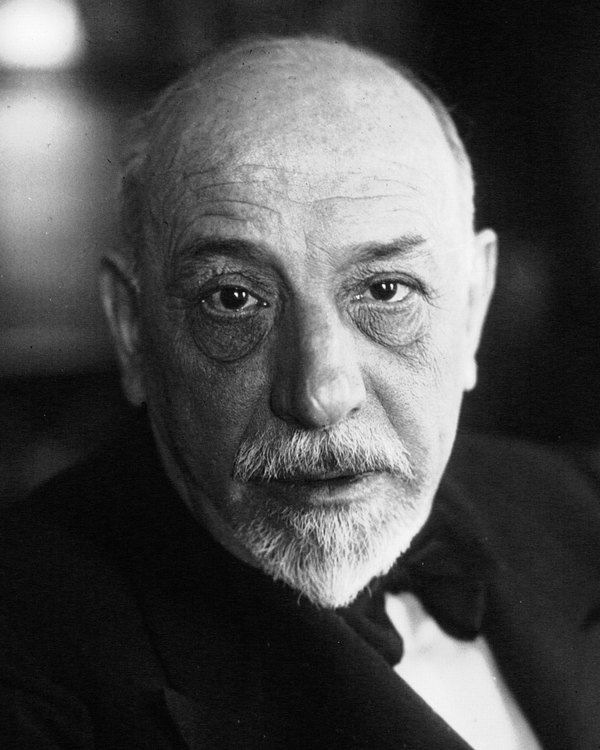
Sicilian novelist and playwright who made the question of who we are the sole subject of an entire body of work, from the regional novel to the theater and One, No One, and One Hundred Thousand. Read the profile of Luigi Pirandello
Central Theme
Vitangelo Moscarda is twenty-eight years old, heir to a bank in the provincial town of Richieri, and lives without examining himself, until one morning his wife, Dida, mentions in passing that his nose leans to the right. The flaw is small, and what he discovers through that remark is large: others see a Moscarda he has never seen, and a man who knew himself only from the inside suddenly has to deal with a stranger who walks around under his name. The book, which he tells after the crisis has passed, in the first person and speaking the whole time to a reader addressed as «gentlemen», follows the reasoning to the end. If others see him in a way he does not see himself, he is not one; if each person sees him in their own way, he is a hundred thousand; and if none of these Moscardas is what he feels himself to be inside, perhaps he is no one.
The question that organizes the novel is what to do with this discovery, and Vitangelo answers with experiments. He wants to destroy, one by one, the Moscardas his acquaintances have of him, and the first trial is giving a house to Marco di Dio, the man who hates him most: the crowd that called him a usurer starts calling him a madman. He has the bank closed so that he will no longer be, not even for others, the usurer he never was for himself, and his wife leaves him. He asks the bishop for protection, is shot by Anna Rosa, gives away everything he owns, and ends up in an almshouse, without a name and without a mirror. The book does not ask whether it is possible to be truly one; it asks what it costs to try, and what remains of someone who gives up trying.
Around Vitangelo are Dida, his wife, who truly loves a husband named Gengè whom she herself built; Quantorzo and Firbo, the two friends who have run the bank since the death of his father and who in practice give the orders, because the owner never took charge of it; Marco di Dio, a former sculptor's apprentice condemned for an act of a single instant, who lives off schemes for getting rich and hatred of Vitangelo's father; Anna Rosa, Dida's orphaned friend, who calls him to help her and ends up shooting him; and Canon Sclepis, who arranges the public penance that closes the story.
The Thread That Runs Through the Work
The novel does not ask who Vitangelo Moscarda is; it asks what remains of a man once the images others make of him are taken away, and it answers with a series of experiments that Vitangelo himself recounts from the almshouse where he ends up. Book I stages the discovery: his wife's remark about the nose turns into doubt about his whole body (chapter I of Book I), the stranger he catches in a mirror in the street is not recognized (chapter IV of Book I), and on the afternoon he stands alone before the wardrobe the body in the glass is no one (chapter VII of Book I). The three words of the title appear together for the first time in the chapter about the stranger, attached to the name he carries.
con la scoperta dei centomila Moscarda ch’io ero non solo per gli altri ma anche per me, tutti con questo solo nome di Moscarda, brutto fino alla crudeltà, tutti dentro questo mio povero corpo ch’era uno anch’esso, uno e nessuno ahimè, with the discovery of the hundred thousand Moscardas I was, not only to others but also to myself, all with this one name of Moscarda, ugly to the point of cruelty, all inside this poor body of mine, which was one too, one and no one, alas.
Book II takes the discovery out of the bedroom and hands it to the reader: each person's consciousness is not enough, because there is also that of others (chapter I of Book II), words are empty and each person fills them with their own meaning (chapter IV of Book II), and the man builds himself the way a house is built (chapter XI of Book II). The argument becomes a scene in the last chapter, when Vitangelo understands that Dida loves a husband she herself made, and feels jealous of him (chapter XII of Book II).
Ma sfido ch’ella conosceva quel suo Gengè più che non lo conoscessi io! Se l’era costruito lei! E non era mica un fantoccio. Se mai, il fantoccio ero io., but I bet she knew that Gengè of hers better than I did! She built him herself! And he was by no means a puppet. If anything, the puppet was me.
Book III shows that what others see in Vitangelo includes what he never chose: the name, the body, the father, a banker to the son and a usurer to the town (chapter V of Book III). In Book IV the thesis is put to the test. He goes into the office of the notary Stampa wanting to see how the other sees him, and concludes that, for someone who cannot see what the other sees, the blind one is the other (chapter III of Book IV); then he watches Marco di Dio being evicted, has a house of his own given to him, and the crowd that jeered at him as a usurer starts shouting «madman» (chapter VII of Book IV).
E quello no, non lo vede, perchè vede un’altra cosa lui, quando voi credete che debba vedere la vostra, come pare a voi. La vede invece come pare a lui, e per lui dunque il cieco siete voi., and that one does not see it, because he sees something else, when you think he should see yours, as it seems to you. He sees it as it seems to him, and so for him the blind one is you.
Book V is the center of the novel. Sitting in an empty lot, Vitangelo concludes that consciousness, which we take to be the most intimate thing we have, means the others within us (chapter IV of Book V).
Ove la vista degli altri non ci soccorra a costituire comunque in noi la realtà di ciò che vediamo, i nostri occhi non sanno più quello che vedono; la nostra coscienza si smarrisce, perchè questa che crediamo la cosa più intima nostra, la coscienza, vuol dire gli altri in noi; e non possiamo sentirci soli, where the sight of others does not come to our aid in constituting in us, somehow, the reality of what we see, our eyes no longer know what they see; our consciousness is lost, because this thing we believe to be most intimately ours, consciousness, means others within us; and we cannot feel alone.
Then he enters the sitting room of the house and counts eight people where the two who are waiting for him see three (chapter VI of Book V); and, in the longest chapter, Dida's laughter wounds him at a point no image reaches, and he has the bank closed (chapter VIII of Book V).
Fuori d’ogni immagine in cui potessi rappresentarmi vivo a me stesso, come qualcuno anche per me, fuori d’ogni immagine di me quale mi figuravo potesse essere per gli altri; un “punto vivo„ in me s’era sentito ferire così addentro, che perdetti il lume degli occhi, beyond every image in which I could picture myself alive to myself, as someone for myself too, beyond every image of me as I imagined I might be for others; a “vital point” in me had felt itself wounded so deeply that I lost the light of my eyes.
Book VI collects the price of the will he has just discovered. With Dida gone from the house, Vitangelo touches his own hands, says «I» and finds no one to say it to (chapter II of Book VI).
A chi dire “io„? Che valeva dire “io„, se per gli altri aveva un senso e un valore che non potevano mai essere i miei; e per me, così fuori degli altri, l’assumerne uno diventava subito l’orrore di questo vuoto e di questa solitudine?, to whom should I say “I”? What was the point of saying “I”, if for others it had a meaning and a value that could never be mine; and for me, so far outside the others, taking one on immediately became the horror of this emptiness and this solitude?
Book VII gives the vital point a name, God, and sends Vitangelo to ask the bishop for help (chapter V of Book VII). It is also the book in which he tells Anna Rosa that to know oneself is to die, and in which that lesson ends in a shot (chapter VIII of Book VII). Book VIII shows how society absorbs the experiment: the judge treats him as an incurable patient (chapter II of Book VIII), Sclepis turns him into an exemplary penitent (chapter III of Book VIII), and Vitangelo, who gave up only what he had, is left without a name, without a mirror, and without a conclusion (chapter IV of Book VIII).
Io non l’ho più questo bisogno, perchè muojo ogni attimo, io, e rinasco nuovo e senza ricordi: vivo e intero, non più in me, ma in ogni cosa fuori., I no longer have that need, because I die every instant, I, and am reborn new and without memories: alive and whole, no longer in myself, but in every thing outside.
The ending has two readings that the text leaves standing: one of liberation, in which the life without a name is complete in things, and one of dissolution, in which one is whole in everything only when no one is left to answer for anything. The path to that point shows why the novel does not choose. Each time Vitangelo manages to be «one», the act is read by others as yet another image, the madman's, the penitent's, the lover's, and the «one» he feels is, first of all, a refusal of two images (the usurer and the Gengè) rather than something he can show.