About the work
- Author
- Gustave Flaubert
- Original title
- Madame Bovary: mœurs de province
- Publication
- 1856, as a serial; 1857, as a book
- Genre
- Realist Novel
- Setting
- Tostes, Yonville-l'Abbaye, and Rouen, in Normandy
- Era
- Provincial France in the first half of the nineteenth century
- Narrator
- Third person, with free indirect style; the first chapter opens in a "we" of schoolmates
- Protagonist
- Emma Bovary
About the author
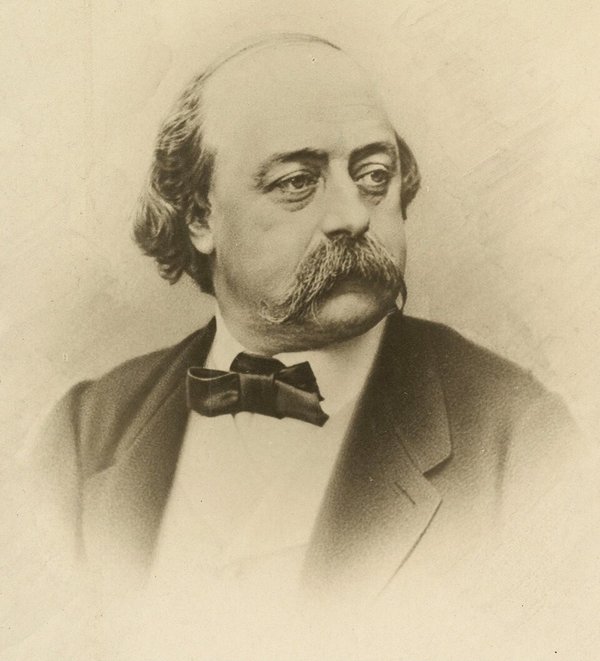
The writer who took almost five years to write Madame Bovary and was put on trial because of it. Read the profile of Gustave Flaubert
Central Theme
A woman educated by novels expects from life what exists only in novels, and the world charges her for the difference. What keeps the book alive is not the adultery, it is the mechanism: Flaubert shows that Emma's desire is not hers, it is copied from what she read and from what she saw in a single night, and that its price is not paid in morality, it is paid in money. The final irony punishes neither vice nor rewards virtue; it rewards whoever never risked anything for anyone.
Development: The Emptiness, and What Emma Puts in God's Place
Up to here the novel has been read from within. Now it is set before questions the work does not formulate and that other authors formulate for it.
Vice or Incontinence
The novel shows Emma on both sides of a distinction that Aristotle draws by choice:
Indeed, incontinence is contrary to choice, whereas vice follows what it has chosen.
And Thomas Aquinas gives the test that separates the two sides in practice:
intemperatus non est poenitivus [...] Omnis autem incontinens de facili poenitet(lib. 7 l. 8 n. 2) The intemperate man does not repent, but every incontinent man easily repents.
Malitia enim latet [...] Sed incontinentia non latet eum cui inest; scit enim per rationem malum esse id in quod a passione ducitur(lib. 7 l. 8 n. 4) Malice is hidden from the one who has it, but incontinence is not hidden from the one who has it, for he knows by reason that what the passion leads him toward is evil.
In adultery, Emma is on the side of vice: evil does not show itself to her as evil, because the vocabulary of novels has dressed it in virtue, and before the mirror she celebrates it.
I have a lover! A lover!
In the devotion after Rodolphe, in Chapter 14 of Part II, and in the moments when she recognizes her daughter, she repents and tries to return, which is the sign of the incontinent person by Aquinas's criterion. The two phases coexist, and neither explains the other.
There are also those who read the same pattern as illness, and the three readings weigh differently on Emma: if it is illness, she is a victim; if it is vice, she is responsible; if it is incontinence, she is both, at different moments.
The Cave
The ball does not take Emma out of the cave. It is the fire taken over by the Sun, a brighter shadow, and for that reason it poisons instead of freeing. Every time reality hurts, she makes the prisoner's gesture:
if someone forced him to look at the light itself, his eyes would hurt and he would turn away, seeking refuge in the objects he could look at, and would still judge these to be truly clearer than those shown to him(515e)
The scene that could turn Emma's gaze is the priest's, in Chapter 6 of Part II, and he returns her to the shadows by treating her anguish as hunger or cold. What is missing there is exactly what Plato calls education:
A crucial conceptual point, and less cited than the image itself.Education, then, would be the art of this desire, the easiest and most effective way to turn this organ around, not to make it obtain sight, since it already has it, but, since it is not in the right position and does not look where it should, to give it the means to do so(518c-d)
And the book ends by rewarding the best reader of shadows in the village, as the cave rewarded its own:
And the honors and praises, if any were then given among them, or prizes for whoever distinguished most sharply the objects that passed by(516c)
He has just received the Legion of Honor.
What Is Put in God's Place
By the criterion of Saint Augustine, Emma does not suffer from a lack of love; she suffers from love out of order. She puts concrete creatures, one lover after another, in the place that belonged to the absolute. It is the first of the three forms that the concept of the Order of Love separates, and the reason none of them fills up is the image Plato already gave of the intemperate soul:
the part of the soul of the uninitiated in which the passions are located, precisely because it is insatiable and retains nothing, he compared to a leaking cask, for the very reason that it never shows satiety