About the work
- Author
- Stendhal
- Original title
- Le Rouge et le Noir
- Publication
- 1830
- Genre
- Realist novel, chronicle of manners
- Setting
- Verrières (an invented town in Franche-Comté), Besançon and Paris
- Period
- The French Restoration, around 1830
- Narrator
- Third person, with ironic interventions by the narrator
- Protagonist
- Julien Sorel
About the author
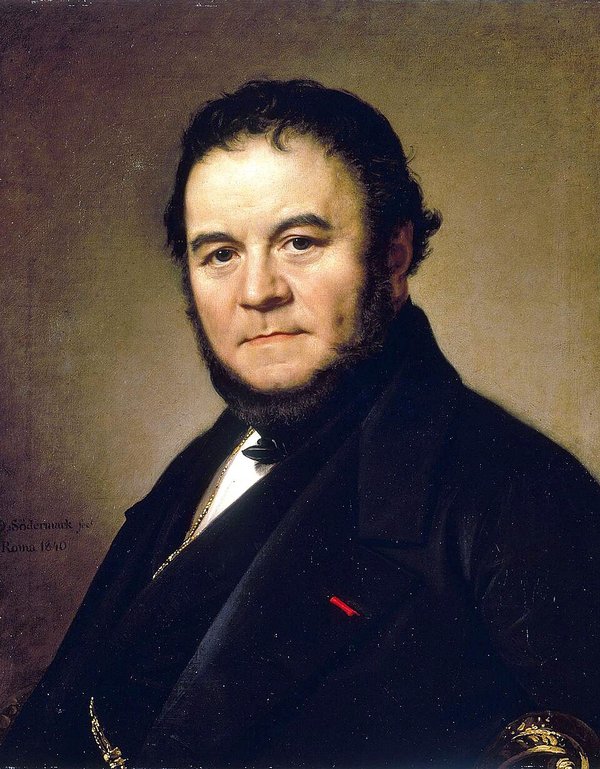
The Napoleonic soldier who became the coldest analyst of ambition and love in the France of the Restoration. Read the profile of Stendhal
The thesis, in one sentence
A poor and intelligent young man discovers that the age has shut the door through which he would have entered, and spends the whole book getting in through the window, until he finds out at the end that he was happy only in the few hours when he was not calculating.
The book does not explain its title; the reading that turns it into a map of a career is this: the red is the uniform, which in the time of Napoleon Bonaparte made a general by thirty, and the black is the cassock, which is what was left after the Restoration for anyone who wants to rise without being born into privilege. Julien states this as cold calculation, not as vocation.
The sentence that sums up the axis of the whole book does not use the words "red" and "black," but it embodies them:
Nowadays we see priests of forty drawing a salary of a hundred thousand francs, that is, three times more than Napoleon's famous division generals. [...] One must be a priest.
And the world he wants to climb is summed up in an expression that Stendhal sets in capitals right at the opening, because it is the yardstick of all Verrières.
The narrator hands over the key to the town in a single capitalized sentence, which works as an internal epigraph to chapter II:
Here is the great word that decides everything in Verrières: TO TURN A PROFIT. By itself it represents the habitual thought of more than three-quarters of the inhabitants.
The argument, part by part
Book I, chs. I to XV. Verrières, the Rênal house, Julien's education between the sawmill and the Memorial of Saint Helena. Love for Madame de Rênal is born as a conquest to be won, not as affection, and the whole house becomes a battlefield: when he wrings a raise out of his employer, it is Julien himself who calls the victory a battle.
Ch. X. After wringing out the raise, Julien goes into the woods and names what he has done in the vocabulary of the chief he admires, war:
I have won a battle, he said to himself as soon as he found himself in the woods, far from the eyes of men. I have won a battle!
Book I, chs. XVI to XXX. The anonymous letter, Julien's departure from Verrières and the seminary at Besançon, where merit is suspect and intelligence is a danger. The nickname his classmates give him says everything about what an institution does to someone who reasons.
they nicknamed him MARTIN LUTHER; above all, they said, because of that infernal logic he took such pride in.
Book II, chs. I to XV. Paris, the La Mole mansion, the discovery that there birth weighs more than any service rendered. It is the most political part of the novel.
Book II, chs. XVI to XXX. Mathilde, and love as a war of vanities, the exact opposite of what happened in Book I. Julien names the difference without mincing words, and it is the passage that sustains any discussion of the book's two loves.
Madame de Rênal found reasons to do what her heart dictated; this young lady of high society lets her heart be moved only after finding good reasons for being moved.
And the novel stops in the middle of the conspiracy to say what it is doing, in a fictitious dialogue between author and editor, which is the key that authorizes reading the whole book along its political axis.
"Politics," the author goes on, "is a stone tied around the neck of literature, which in less than six months makes it sink. Politics, among the interests of the imagination, is a pistol shot in the middle of a concert. That noise is dissonant without being forceful. It harmonizes with the sound of no instrument. This politics will mortally offend half the readers and bore the other half, who found it far more interesting and lively in the morning paper." "If your characters do not talk about politics," the editor goes on, "they will no longer be Frenchmen of 1830, and your book will no longer be a mirror, as you wished..."
The editor's argument wins, and the book carries it out: without politics the characters would cease to be Frenchmen of 1830, and the subtitle would no longer hold. Whoever reads the work only as a story of amorous ambition gets half of it, and it is the less original half, because Julien's ambition takes the shape it does only because of the doors that the Restoration closed.
Book II, chs. XXXI to XLV. Madame de Rênal's letter overturns everything on the eve of triumph, then comes the shot in the church, the trial and the prison. At the trial Julien stops defending himself and accuses, and it is the most quoted passage in the work.
Gentlemen, I do not have the honor of belonging to your class; you see in me a peasant who has rebelled against the baseness of his lot.
And the final inversion, which is what saves the book from being merely the chronicle of a social climber: imprisoned and without a future, he discovers that the only true thing he had was behind him, not ahead.
Could we not spend two months together in a delightful way? Two months are many days. I will never have been so happy.
A reading
The book does not judge Julien, and that is the difficulty of guiding it. Stendhal shows the calculation from within, with sympathy and without absolution, and the hasty reader comes away thinking the novel either defends hypocrisy or condemns it. It does something else: it shows the price of each path in a society that has closed the honest paths, and leaves the bill for the reader.
The two loves are the central experiment. Madame de Rênal loves without knowing that she loves, and Mathilde loves her own courage to love beneath her class. One is nature, the other is literature lived as a project, and the book only closes when Julien, in prison, chooses the first after a whole life betting on the second.
The subtitle is a reading instruction, not an ornament. "Chronicle of 1830" warns that the subject is the France of the Restoration, with the clergy, the Congregation and the nobility that came back pretending the Revolution never happened. Without this background, half the irony slips by, and that is why it asks for attention from the first reading.
What criticism has done with it
Erich Auerbach devotes the opening of his chapter on modern realism in Mimesis to this novel, and the chapter's title names Julien's address in Paris. His thesis is not aesthetic but biographical: Stendhal's realism is born of the friction between the writer and an age in which he found no place.
Stendhal's realist literature sprang from his unease in the post-Napoleonic world, as well as from the awareness of not belonging to it and of not having a fixed place within it.
And from this origin Auerbach draws the judgment that separates Julien from the entire next generation of French characters:
Julien Sorel is much more of a "hero" than the figures of Balzac or of Flaubert.
Auerbach calls Julien more of a hero than the figures of Balzac and Gustave Flaubert because he still confronts his age with an open chest.
The harshest test this novel has ever passed
Anne Applebaum records, in Gulag, that telling the plots of novels from memory was a survival strategy in the camps, and names this one among those that were told that way.
The titles Applebaum names in this practice are classics, and she records that they worked better than recent Soviet novels:
Aleksander Wat recounted The Red and the Black, by Stendhal, to a group of bandits while he was in prison.On the same page come Les Misérables, told by Alexander Dolgun, and The Three Musketeers, by Janusz Bardach, who says he felt his own status grow with each twist of the plot.
Without the text, without the style and without the narrator's irony, only the pure plot remains, and it still held the attention of an audience with no literary disposition at all. It is the most concrete argument against the idea that the book sustains itself through its discussions and its setting: what gripped them was the story of Julien rising and falling.