About the work
- Author
- Miguel de Cervantes
- Original title
- The Ingenious Gentleman Don Quixote de la Mancha (1605) and Second Part of the Ingenious Gentleman Don Quixote de la Mancha (1615)
- Publication
- In two parts, 1605 and 1615, ten years apart
- Genre
- Novel
- Setting
- La Mancha and the roads of Castile and Aragon to Barcelona, at the start of the seventeenth century
- Narrator
- A narrator who claims to follow the story written in Arabic by Cide Hamete Benengeli
- Structure
- Two parts, each with its own prologue: 52 chapters in the 1605 part and 74 in the 1615 part
- Protagonists
- Don Quixote and Sancho Panza
About the author
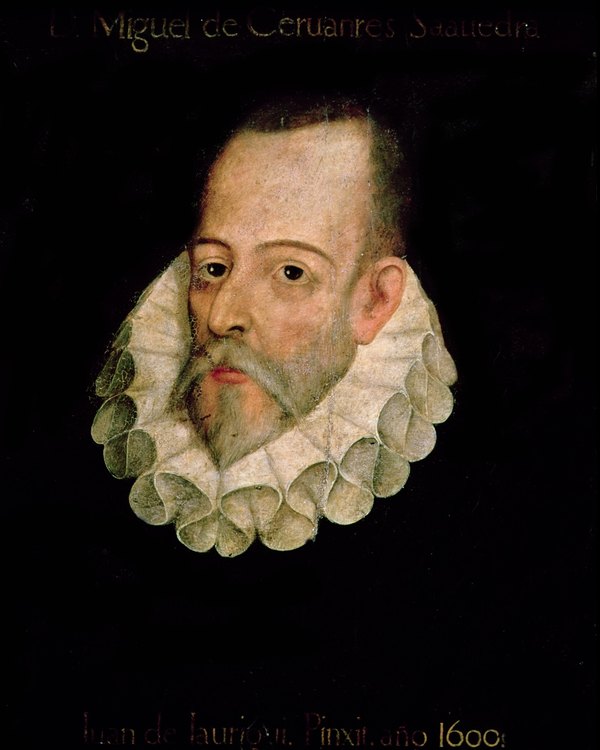
Soldier wounded at Lepanto, captive in Algiers, and tax collector jailed over his accounts, he published, after the age of fifty, the novel that founded the genre, Don Quixote, and continued it ten years later against a rival who had forged it. Read the profile of Miguel de Cervantes
Central Theme
In a village of La Mancha lives a gentleman of about fifty, thin, early to rise and fond of hunting, who from so much reading books of chivalry stops sleeping, dries out his brain and decides to live what he has read. He arms himself with what he finds at home, gives his nag the name Rocinante, takes for himself the name Don Quixote de la Mancha, and invents for his lady a farm girl from a neighboring village, whom he calls Dulcinea del Toboso. He leaves home three times, and from the second on he takes with him a poor farmhand, Sancho Panza, whom he promises an insula. The book does not ask whether he has gone mad, which the first chapters already say; it asks who decides what the scene is, and what it costs to disagree. Where he sees giants, Sancho sees windmills; where he sees a castle, there is an inn; and with each refutation the gentleman has at hand an enemy enchanter who explains the defeat without correcting the vision.
The Second Part changes the question. Ten years later, everyone has read the First: the bachelor Sansón Carrasco, the dukes, the inn guests, and even a false Quixote, Avellaneda's, whom Cervantes confronts in the prologue and within the story. It is no longer enough to know whether the gentleman sees what exists; one must know who fabricates what he expects to see. Sancho, who in the First Part was the measure of the real, becomes the author of the illusion: it is he who enchants Dulcinea, and who governs an insula set up as a mockery, with more wisdom than his deceivers. The ending undoes the name: defeated, the gentleman returns home, wakes sensible and dies as Alonso Quijano, the Good, with the laughter of the beginning giving way to disillusionment.
Around them are the village priest and barber, who want him back; the dukes, who make a spectacle of him; Cide Hamete Benengeli himself, the Arab historian of doubtful authority whom the narrator says he is translating; and a crowd of other people's stories that the book fits into the road: that of Marcela and Grisóstomo, that of Cardenio and Dorothea, that of the Curious Impertinent, that of the captive and Zoraida, that of Ricote. They do not let themselves be staged or refuted like the gentleman's adventures, and that is what the book sets beside him.
The Thread That Runs Through the Work
The book does not ask whether Don Quixote has gone mad; it asks who decides what the scene is, and what one pays for disagreeing. The First Part puts the price on stage. The gentleman shuts himself in during nights of reading until he loses his wits (chapter I of Part One), takes an inn for a castle and is made a knight by an innkeeper who goes along with the joke so as to have something to laugh at (chapter III of Part One), and, when the windmills refute him, has the explanation ready: the wise Frestón switched the giants to rob him of his glory (chapter VIII of Part One).
En resolución, él se enfrascó tanto en su letura, que se le pasaban las noches leyendo de claro en claro, y los días de turbio en turbio; y así, del poco dormir y del mucho leer, se le secó el celebro, de manera que vino a perder el juicio, in short, he immersed himself so deeply in his reading that his nights passed in reading from dusk to dawn, and his days from dusk to dark; and so, from little sleep and much reading, his brain dried up, so that he came to lose his wits.
Who pays, as a rule, is not he. Andrés pays, who is beaten again after the liberator leaves (chapter IV of Part One), the muleteer pays with his head split open during the vigil of arms (chapter III of Part One), Sancho pays, tossed into the air in a blanket (chapter XVII of Part One), and Sancho is the measure of what happened there: the master explains the beating by an enchanted Moor, and the squire answers that what hurt is what happened.
Si no se dejan ver, déjanse sentir -dijo Sancho-; si no, díganlo mis espaldas, if they do not let themselves be seen, they let themselves be felt, said Sancho; if not, let my back tell it.
None of this is the blindness of someone who does not know. In the Sierra Morena, the gentleman does the penance of Beltenebros without cause, on purpose, because he wants to imitate Amadis, and madness without cause is the kind that has merit; he confesses that the lady is an invention he paints in his imagination (chapter XXV of Part One).
Así que, Sancho, por lo que yo quiero a Dulcinea del Toboso, tanto vale como la más alta princesa de la tierra [...] píntola en mi imaginación como la deseo, así en la belleza como en la principalidad, so, Sancho, as much as I love Dulcinea del Toboso, she is worth as much as the highest princess on earth [...] I paint her in my imagination as I desire her, in beauty as in rank.
Others answer with fictions of their own. The priest and the barber copy the style of the books, with a princess and a cage, to take him home (chapter XXIX of Part One, chapter XLVII of Part One), and the discussion with the canon of Toledo shows what each one holds as proof: the canon asks for form and verisimilitude, while the gentleman answers with the king's license and the approval of all (chapter L of Part One).
¡Bueno está eso! -respondió don Quijote-. Los libros que están impresos con licencia de los reyes y con aprobación de aquellos a quien se remitieron, y que con gusto general son leídos y celebrados de los grandes y de los chicos, de los pobres y de los ricos, de los letrados e ignorantes, de los plebeyos y caballeros, finalmente, de todo género de personas, de cualquier estado y condición que sean, ¿habían de ser mentira? [...] y más llevando tanta apariencia de verdad, pues nos cuentan el padre, la madre, la patria, los parientes, la edad, el lugar y las hazañas, punto por punto y día por día, que el tal caballero hizo, o caballeros hicieron, that's a good one, replied Don Quixote. Books printed with the license of kings and the approval of those to whom they were submitted, and which are read and celebrated with general delight by great and small, by poor and rich, by the learned and the ignorant, by commoners and gentlemen, in short, by every kind of person, of whatever state and condition they may be, could they be lies? [...] and all the more so since they carry such an appearance of truth, for they tell us of the father, the mother, the homeland, the relatives, the age, the place and the deeds, point by point and day by day, that such a knight performed, or knights performed.
The Second Part begins because the book is already in circulation. The bachelor brings the news that the story has been printed (chapter III of Part Two), the dukes have read it (chapter XXX of Part Two) and receive the gentleman as a true knight (chapter XXXI of Part Two), and Sancho, who in Toboso invented the enchantment of Dulcinea to escape a message he never delivered (chapter X of Part Two), hears from the duchess that he is the one who was deceived (chapter XXXIII of Part Two): the lie now has another owner, and Merlin collects it in three thousand three hundred lashes (chapter XXXV of Part Two).
no será muy difícil hacerle creer que una labradora, la primera que me topare por aquí, es la señora Dulcinea, it will not be very difficult to make him believe that a farm girl, the first one I come across around here, is the lady Dulcinea.
The one who governs with wisdom is the one who was fooled. Sancho judges with what his master advised him, goes hungry under a comic doctor, and leaves Barataria as he entered it (chapter XLV of Part Two, chapter LIII of Part Two). When Cervantes brings the false Quixote into the story, the gentleman changes course to refute him (chapter LIX of Part Two), and a character from the rival book declares before an alcalde that this one is the true Don Quixote (chapter LXXII of Part Two).
Por el mismo caso -respondió don Quijote-, no pondré los pies en Zaragoza, y así sacaré a la plaza del mundo la mentira dese historiador moderno, y echarán de ver las gentes como yo no soy el don Quijote que él dice, for that very reason, replied Don Quixote, I will not set foot in Zaragoza, and so I will bring the lie of that modern historian out into the square of the world, and people will see that I am not the Don Quixote he describes.
The end settles the account for both. The bachelor wins on the beach at Barcelona in order to cure him (chapter LXIV of Part Two), the gentleman wakes sensible and ceases to be Don Quixote (chapter LXXIV of Part Two), and the historian hangs up his pen and claims the character against the false writer.
Dadme albricias, buenos señores, de que ya yo no soy don Quijote de la Mancha, sino Alonso Quijano, a quien mis costumbres me dieron renombre de Bueno. Ya soy enemigo de Amadís de Gaula y de toda la infinita caterva de su linaje, give me congratulations, good sirs, that I am no longer Don Quixote de la Mancha, but Alonso Quijano, to whom my customs gave the name of Good. I am now the enemy of Amadis of Gaul and of the whole infinite throng of his lineage.
Para mí sola nació don Quijote, y yo para él; él supo obrar y yo escribir; solos los dos somos para en uno, a despecho y pesar del escritor fingido y tordesillesco, Don Quixote was born for me alone, and I for him; he knew how to act and I how to write; we two alone are made to be one, in spite of and to the displeasure of the feigned writer from Tordesillas.
The ending has two strong readings. One sees in it the social defeat of a mystical worldview, which is still right from the standpoint of heaven, and a book that changes its tone like a symphony, from irony to bitterness.
Erich Auerbach, at the other end, rejects the symbolic or tragic reading: what there is in the scene of the enchanted Dulcinea is a game, and no one is condemned in the book, neither the gentleman nor those who fool him.
In place of the tragic and the symbolic, Auerbach proposes a category of its own: a game that illuminates everything it touches without judging, because in Cervantes the very process of judging never even opens.It is not enough to say that he issues no judgments and draws no conclusions; the process is not even begun, the questions are not even asked. No one and nothing (apart from bad books and bad plays) is condemned in this book [...]
The text leaves both readings standing, and what the path to the end shows is that whoever commands the scene changes hands with each Part: the gentleman in the First, the readers in the Second and, finally, the author, who, by hanging up his pen, claims the character. Each time someone seems to win the argument about what the scene is, the act is read by others as one more scene: the madman who laughs, the trickster who is tricked, the victor who cures. Only the one who writes closes the account.