About the work
- Original title
- Бесы (Besy)
- Publication
- Serialized in The Russian Messenger, 1871 to 1872; in book form in 1873
- Genre
- Novel
- Setting
- A Russian provincial town in the late 1860s, narrated by a chronicler who lives there
- Narrator
- First person: a chronicler who takes part in some of the events and reconstructs the rest
- Structure
- Three parts, plus the chapter "With Tikhon," which the magazine rejected and which was published separately
- Protagonists
- Stavrogin, Pyotr Stepanovich, and Stepan Trofimovich
About the author
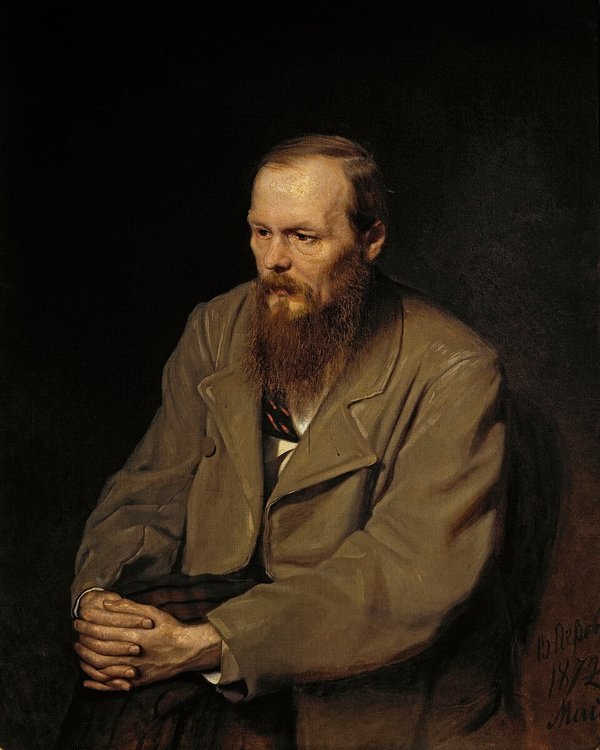
Orthodox Christian, condemned to death and pardoned on the scaffold, he returned from Siberia a critic of the socialism he had embraced and wrote the novels in which ideas are put to the test in the lives of those who defend them. Read the profile of Fyodor Mikhailovich Dostoevsky
Central Theme
In a provincial Russian town, a poorly organized quintet, which believes itself the tip of a worldwide revolutionary network, produces within a few days the disaster of an entire town: a fire that consumes a street, the Lebyadkins with their throats cut, Lizaveta Nikolaevna killed by the mob, Shatov murdered in the park, Kirillov a suicide. The book does not ask whether they will achieve the revolution. It asks how respectable, well-meaning people open the way for them without noticing, and the first answer is a lineage: Stepan Trofimovich Verkhovensky, the idealistic liberal of the 1840s, who spent twenty years in civic pose, living on an allowance and in hysterical friendship, educated Nikolai Vsevolodovich Stavrogin and fathered Pyotr Stepanovich, who organizes murders. That is why the novel opens slowly, like a provincial comedy of manners, and not as a political novel.
The second answer is the mechanism, and it is what gives the book its validity beyond the Russia of 1870: the group does not win by force, it wins because the town does not want to seem backward. The governor yields to the logic of liberalism itself, the salon acquits Stavrogin with a single phrase, the matinée audience discovers that it can answer back, and what binds it all together, Pyotr tells Stavrogin, is the shame of having an opinion of one's own. At the center of all of them stands Stavrogin himself, whom each one fights over like a banner: Kirillov and Shatov, his disciples, take seriously the ideas they received from him (the man-god, the people who carry God), Pyotr invented him abroad to make of him a hidden chief, and he refuses every request without finding where to spend his own strength. Shigalyov, author of a system that starts from unlimited freedom and arrives at unlimited despotism, comes from a different root. Pyotr is the only one who believes in no doctrine and makes use of all of them, and he is the only one who escapes.
The Thread That Runs Through the Work
The novel asks how a town disaster is manufactured with few people, little doctrine, and a great deal of exploitation of what was already there, and it answers through what each person hands over without knowing it. Everything begins with a father. Stepan Trofimovich Verkhovensky is the portrait of the idealistic liberal: he was never exiled nor under surveillance, did not write the work he promised, and the salon talk around him is called, by the chronicler, "superior liberalism" (Part One, Chapter I).
«Высший либерализм» и «высший либерал», то есть либерал без всякой цели, возможны только в одной России, "superior liberalism" and "superior liberal," that is, the liberal with no aim whatsoever, are possible only in Russia.
Two sons come out of him, though the father does not see them. Varvara Petrovna Stavrogina invented Stepan and was the first to believe in the invention; Stepan educated her son, Nikolai Vsevolodovich Stavrogin, and fathered Pyotr Stepanovich Verkhovensky, who appears only through a letter demanding money. When Pyotr enters Varvara's salon, he talks without stopping, recounts Nicolas's story before Nicolas returns, and reads aloud his father's letter about "other people's sins" (Part One, Chapter V). Nicolas describes him in a single sentence, in front of him, with the same coldness with which Pyotr speaks.
Петр Степанович — всеобщий примиритель; это его роль, болезнь, конек [...] в качестве реалиста он не может солгать и что истина ему дороже успеха… разумеется, кроме тех особенных случаев, когда успех дороже истины, Pyotr Stepanovich is the universal conciliator; that is his role, his sickness, his hobbyhorse [...] as a realist he cannot lie, and truth is dearer to him than success... except, of course, in those particular cases when success is dearer than truth.
The ideas that the others take seriously are Stavrogin's, and they return to his door in the form of a demand. In the night scene of Part Two (Part Two, Chapter I), Alexei Kirillov gives the name of what comes after God, and Ivan Shatov gives the name of the people who carry it.
Он придет, и имя ему человекобог, he will come, and his name is man-god.
Народ — это тело божие, the people are the body of God.
Neither of the two manages to live the doctrine he announces: Shatov, asked point-blank whether he believes in God, answers only in the future tense, and Kirillov, as will be seen, does not die as he teaches. Stavrogin goes through the visits without accepting any debt, and after the duel in which he fires into the air, he hears from Kirillov what no one else tells him (Part Two, Chapter III).
Я думал, вы сами ищете бремени, I thought you yourself were looking for a burden.
Pyotr, who has no doctrine, works on the beliefs of others and manages the size of the conspiracy that each listener must accept. To the governor he says the movement fits into three and a half men (Part Two, Chapter VI), and to Virginsky's quintet he leaves faith in a network no one has seen (Part Two, Chapter VII).
Да кто управляет-то? три человека с полчеловеком. Ведь, на них глядя, только скука возьмет, so who is running things, anyway? Three men and half a man. Just looking at them is enough to bore anyone.
Все эти пятеро деятелей составили свою первую кучку с теплою верой, что она лишь единица между сотнями и тысячами таких же пятерок, как и ихняя, разбросанных по России, и что все зависят от какого-то центрального, огромного, но тайного места, которое в свою очередь связано органически с европейскою всемирною революцией, all these five activists formed their first little circle with the warm faith that it was only one unit among hundreds and thousands of quintets just like theirs, scattered across Russia, and that all depended on some central, enormous but secret place, organically linked in turn to the European world revolution.
In the same room, Shigalyov reads the system he wrote alone: starting from unlimited freedom, he concludes with unlimited despotism. He reaches the conclusion against his will and suffers for it; Pyotr praises it and discards it within the same quarter of an hour, and when Stavrogin asks him what he wants power over him for, Pyotr loses his composure and says what moves him.
Выходя из безграничной свободы, я заключаю безграничным деспотизмом, starting from unlimited freedom, I conclude with unlimited despotism.
Я вас с заграницы выдумал; выдумал, на вас же глядя. Если бы не глядел я на вас из угла, не пришло бы мне ничего в голову!.., I invented you abroad; I invented you by looking at you. If I had not looked at you from a corner, nothing would have come into my head!..
The city does the rest of the work on its own. A remark from the governor's wife changes everyone's opinion of Stavrogin in a single afternoon (Part Two, Chapter IV), and on the day of the matinée the leading men, who until then had kept themselves on top, begin to listen and fall silent (Part Three, Chapter I).
Разве возможно удивление, что Ставрогин дрался с Гагановым и не отвечал студенту? Не мог же он вызвать на поединок бывшего крепостного своего человека, but how can anyone be surprised that Stavrogin fought with Gaganov and did not answer the student? He could hardly challenge to a duel a former serf of his own!
первейшие люди, до тех пор так благополучно державшие верх, стали вдруг их слушать, а сами молчать, the leading men, who until then had so comfortably kept the upper hand, suddenly began to listen to them, and fell silent themselves.
When the fire and the deaths come, no one decides alone. Stavrogin knew the Lebyadkins would be killed and did not stop the murderers, and the hand that knocks Lizaveta Nikolaevna down in the crowd is "someone's" (Part Three, Chapter III). Responsibility is spread so that it fits under no single name, and it is from this gap that Pyotr lives.
Я не убивал и был против, но я знал, что они будут убиты, и не остановил убийц, I did not kill, and I was against it, but I knew they would be killed, and I did not stop the murderers.
Вдруг я увидел, что над ее головой, сзади, поднялась и опустилась чья-то рука; Лиза упала, suddenly I saw that, from behind, over her head, someone's hand rose and came down; Liza fell.
When the body enters the scene, the doctrine falls apart. In the park, after the shot and the stones, it is Virginsky who cries out (Part Three, Chapter VI), and Pyotr, who had foreseen everything, is startled by what he sees.
Это не то, не то! Нет, это совсем не то!, It isn't that, it isn't that! No, it isn't that at all!
The most cited case of the book outside literature is Kirillov's, and it is also the most misread. His doctrine is cold and complete: if God does not exist, self-will is his, and its highest point is to kill oneself. Albert Camus takes him as the limit case of logical suicide in The Myth of Sisyphus, and the reading holds for the argument. The death scene shows something else.
Я хочу изругать… [...] Я хочу изругать…, I want to curse... [...] I want to curse... And, as Pyotr flees, the shouts come from inside the house:Сейчас, сейчас, сейчас, сейчас…, now, now, now, now...
Kirillov laughs, writes a jibe on the paper, hides in a corner, bites Pyotr's finger, and fires only after shouting "now" about ten times. The doctrine is cold; the death is not. Stavrogin performs the exact inversion. He dies without proclaiming any doctrine, and the scene shows premeditation: the soaped cord, the spare nail, the note that says only that no one is to blame, and doctors who, after the autopsy, reject madness (Part Three, Chapter VIII).
Никого не винить, я сам, nobody is to blame, I did it myself. And, after the autopsy,Наши медики по вскрытии трупа совершенно и настойчиво отвергли помешательство, our doctors, after the autopsy, completely and insistently rejected the hypothesis of madness.
The key to the title comes at the end and from a feverish character. Stepan Trofimovich, sick in an inn, asks Sofya Matveyevna for the passage of the pigs and applies it to Russia (Part Three, Chapter VII).
Эти бесы, выходящие из больного и входящие в свиней, — это все язвы, все миазмы, вся нечистота, все бесы и все бесенята, накопившиеся в великом и милом нашем больном, в нашей России, за века, за века, these demons that come out of the sick man and enter the swine are all the sores, all the miasmas, all the filth, all the demons and little demons accumulated over the centuries, over the centuries, in our great and dear patient, in our Russia.
And he includes himself in the reckoning, alongside his son.
Это мы, мы и те, и Петруша [...] и я, может быть, первый, во главе, и мы бросимся, безумные и взбесившиеся, со скалы в море и все потонем, и туда нам дорога, потому что нас только на это ведь и хватит, it is we, we and those others, and Petrusha [...] and I, perhaps the first, at the head, and we shall hurl ourselves, mad and raging, off a cliff into the sea and all drown, and that is where our road leads, because that is all we are equal to.
The common reading of the title says that the demons are ideologies, which enter men and drive them into the abyss. It is not false, but it stops short of the part the novel explains on its own. The interpreter names himself among the pigs, and the allegory stops being an accusation and becomes a confession. There is also a consequence for Stavrogin. The Gospel reserves "sound mind" for the healed man, seated at the feet of Jesus, and the novel gives it to Stavrogin without the cure: in the document he takes to Tikhon he says he is in full possession of his mind, in the letter to Darya he says he can never lose it, and the doctors confirm it after the autopsy. He has his sound mind and no cure, which makes him the carrier who never falls ill, not the one possessed. Two readings fit Stepan's speech: the lucidity of fever, which tells the truth because it no longer needs an audience, or the last speech of an orator, who still needs one.