About the work
- Original title
- Преступление и наказание (Prestuplenie i nakazanie)
- Publication
- 1866, serialized in The Russian Messenger; in book form in 1867
- Genre
- Psychological and philosophical novel
- Setting
- St. Petersburg, around Sennaya Square, in a July of the 1860s; in the epilogue, a prison in Siberia
- Narrator
- Third person, close to Raskolnikov and, in places, to other characters
- Structure
- Six parts and an epilogue, 41 chapters
- Protagonists
- Raskolnikov and Sonia
About the author
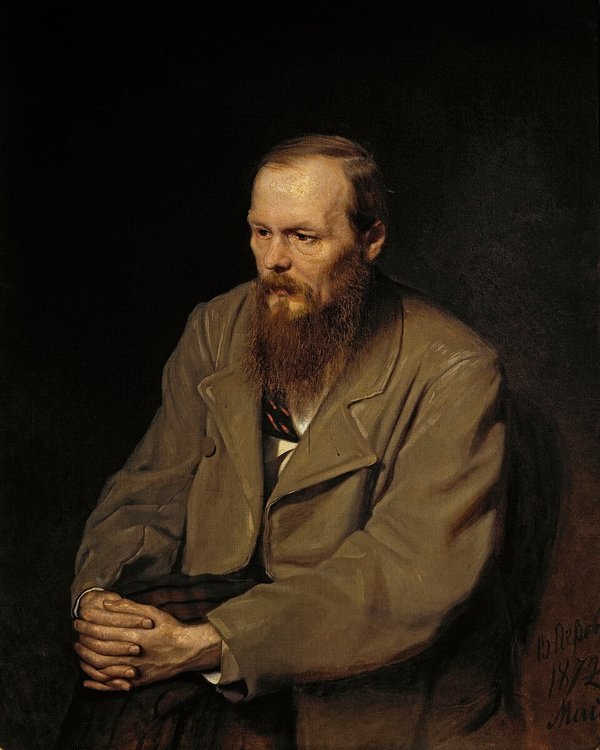
Orthodox Christian, condemned to death and pardoned on the scaffold, he returned from Siberia a critic of the socialism he had embraced and wrote the novels in which ideas are put to the test in the lives of those who defend them. Read the profile of Fyodor Mikhailovich Dostoevsky
Central Theme
A poor former student in St. Petersburg, Rodion Romanovich Raskolnikov, kills an old pawnbroker and her sister, who arrives at the wrong moment, with axe blows, in order to prove a theory to himself: that extraordinary men have the right to overstep the moral law when their idea demands it. The book does not ask whether he will be caught, it asks what the crime does to the one who committed it. The police have no proof, and the siege is carried out by his own conscience, by the examining magistrate who understands him before any evidence, and by a young woman who prostitutes herself to support her family and reads him the resurrection of Lazarus. The theory falls before the punishment, and the true punishment is not Siberia.
The story takes place during a July of stifling heat in the mid-1860s, in the streets around Sennaya Square, the poorest district of the capital, and ends in a prison on the banks of a Siberian river. Around Raskolnikov are the family that sacrifices itself for him (his mother and his sister Dunya, promised to a lawyer who wants her poor so that she will be beholden to him), his friend Razumikhin, the family of a drunken civil servant, Marmeladov, whose daughter is Sonia, and a landowner of ill repute, Svidrigailov, who pursues Dunya and proves to be too much like him.
The Thread That Runs Through the Work
The novel does not ask whether Rodion Romanovich Raskolnikov will be caught, it asks what drives a man to act, and it answers that reason alone is not enough. He arrives on the first page with the theory ready and the crime mulled over in his head for a month, and even so he needs a chain of coincidences for his body to carry out what his reason has already decided.
Точно он попал клочком одежды в колесо машины, и его начало в нее втягивать., it was as if he had caught a piece of his clothing in the wheel of a machine, and it had begun to draw him in.
From Part Two onward the order is reversed: the body surrenders what the mind still defends. He hides the objects, raves about the crime aloud, returns to the place where he killed, and escapes by chance, not by method.
Part Three is where the theory is finally stated in public, in the article and in the interrogation, and the test already contains the verdict: he upholds the thesis in the abstract, with Napoleon and Lycurgus, and draws back before its concrete consequence. Earlier, Razumikhin had already said against the socialists what the whole book is going to show:
Живая душа жизни потребует, живая душа не послушается механики, живая душа подозрительна, живая душа ретроградна!, a living soul will demand life, a living soul will not submit to mechanics, a living soul is suspicious, a living soul is reactionary!
Part Five undoes the easy reading that the confession springs from remorse. He confesses because he can no longer bear being alone with the theory, and what he asks of Sofya Semyonovna Marmeladova is not forgiveness.
мне надо было узнать тогда, и поскорей узнать, вошь ли я, как все, или человек? Смогу ли я переступить или не смогу! Осмелюсь ли нагнуться и взять или нет? Тварь ли я дрожащая или право имею…, I needed to know then, and to know quickly: am I a louse, like everyone else, or a man? Will I be able to step over or won't I! Do I dare to stoop down and pick it up or not? Am I a trembling creature or do I have the right…
Part Six sets the two possible answers side by side, and it is the cleanest design in the book: Arkady Ivanovich Svidrigailov, who never had any theory, only appetite, and Sonia, who had no theory either, only the other thing. The first kills himself; the second path leads to the square.
The siege that runs through the middle of the book is conducted by Porfiry Petrovich without a single piece of material evidence, and it is this deliberate scarcity that keeps the novel from resolving its own question through police work.
Against the reading that poverty explains the crime, the book keeps on stage, from Part One on, Dmitry Prokofich Razumikhin, who has the same poverty and the same interrupted studies and does not reach the same conclusion.
And the epilogue does not resolve the theory, it suspends it. Up to the penultimate page Raskolnikov does not repent of the murder: he is ashamed of having failed.
он не раскаивался в своем преступлении, he did not repent of his crime.
Three steps of the same staircase, which the character profiles separate: Pyotr Petrovich Luzhin has the theory without any greatness, Raskolnikov has the theory and the greatness, and Svidrigailov has no theory at all, only appetite.