About the work
- Author
- William Shakespeare
- Original title
- The Tragedy of Hamlet, Prince of Denmark
- Publication
- Written around 1600-1601; first published in 1603
- Genre
- Revenge tragedy in five acts
- Setting
- The castle of Elsinore, in Denmark
- Era
- A legendary Denmark, in latent war with Norway
- Narrator
- None: a play, in verse and prose
- Protagonist
- Hamlet, Prince of Denmark
About the author
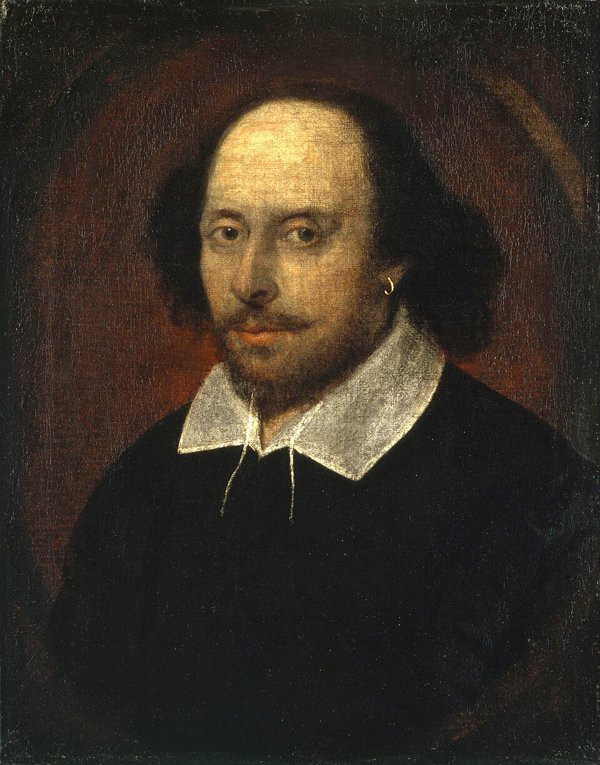
The provincial actor who, in London, wrote the tragedies by which the West still measures ambition, jealousy, revenge, and love. Read the profile of William Shakespeare
Central Theme
A prince receives from a ghost the accusation that his uncle murdered his father, along with the order to take revenge, and the play measures what one does with a truth whose source may be poisoned: act or not act? The question is not only whether the ghost's accusation is true, but what one does with it. Hamlet's hesitation comes from reasons the text stages: doubt about the ghost's nature, the demand for proof before a court where justice belongs to the king, and the revulsion at killing with his own hands. The result is a tragedy in which every trap closes on the one who set it, and revenge is carried out only when there is no longer time to choose.
Act II, scene 2: "What's Hecuba to him?"
In scene 2 of Act II, a troupe of actors arrives at Elsinore and Hamlet asks for a speech: the account of the fall of Troy and the death of Priam, in which the Player, evoking the grief of Hecuba, the Trojan queen, turns pale and sheds tears for a pain that is not his.
Alone, Hamlet berates himself. The soliloquy begins by marking his own solitude:
Now I am alone. / O what a rogue and peasant slave am I! / Is it not monstrous that this player here, / But in a fiction, in a dream of passion, / Could force his soul so to his own conceit(II.2)
And he reaches the question that gives this passage its name:
For Hecuba? / What’s Hecuba to him, or he to Hecuba, / That he should weep for her? What would he do, / Had he the motive and the cue for passion / That I have?(II.2)
If an actor, over a fiction, weeps for Hecuba, how can he, with a murdered father and a real cause, remain inert?
What nearly every reading cuts, and it comes at the end of the same soliloquy, is that Hamlet gives the reason he has not acted, and the reason is not weakness:
The spirit that I have seen / May be the devil, and the devil hath power / T’assume a pleasing shape, yea, and perhaps / Out of my weakness and my melancholy, / As he is very potent with such spirits, / Abuses me to damn me. I’ll have grounds / More relative than this.(II.2)
In other words, the play answers the question before the critics can ask it. The Mousetrap is not born of shame before the actor, it is born of the need for proof, and the act closes with the plan stated in two lines:
The play’s the thing / Wherein I’ll catch the conscience of the King.(II.2)
The Player's speech is precisely the material of Virgil (the fall of Troy and the flight of Aeneas, the account given to Dido): Shakespeare brings the Roman epic into the English tragedy through the mouth of an actor.
Act I, scene 5: the ghost beneath the stage
In scene 5 of Act I, after the apparition withdraws, the ghost's voice shouts from beneath the stage, ordering his companions to swear on the sword, and Hamlet answers from above, speaking to it as one speaks to a comrade in the cellar. Before any doctrine, the play tells us the nature of the ghost through a physical position in the theater, and it does not leave this to staging: Hamlet himself names the place from which the voice comes.
From below the stage, the voice orders the oath, and Hamlet confirms where it comes from:
Come on, you hear this fellow in the cellarage.(I.5)
The punishment the ghost describes is temporary, which is the whole argument of purgatory. It is not a damned soul from hell speaking, it is someone serving out a term:
I am thy father’s spirit, / Doom’d for a certain term to walk the night, / And for the day confin’d to fast in fires, / Till the foul crimes done in my days of nature / Are burnt and purg’d away.(I.5)
The two passages pull in opposite directions, and both are in the same text, a few lines apart, which is why the play's ambiguity is not resolved by choosing one. The stage's position says hell, the doctrine says purgatory. Whoever reads only the speech sees Greenblatt, whoever looks at the stage sees Prosser.
On the Elizabethan stage, the space beneath the stage was by convention hell, and the trapdoor functioned as the mouth of hell. The passage is known in the critical literature as the cellarage scene. Eleanor Prosser, in Hamlet and Revenge (1967), argues that the ghost is a tempting demon and that revenge is a moral trap. Stephen Greenblatt, in Hamlet in Purgatory (2001), reads the same apparition as a description of purgatory, a doctrine abolished in Protestant England, which shifts the key from demonic to confessional.
The two readings do not cancel each other out: the ambiguity seems deliberate, and Hamlet himself sets up The Mousetrap precisely because he does not trust what the ghost told him.
It is worth marking the reach of this, because it is what separates this reading from the Freudian one: if the hesitation is caused by doubt about the ghost's nature, it is a problem of discernment, and the delay is prudence, not symptom. The play supplies the motive on stage, in The Mousetrap, and needs no repressed content to explain it.
Catholic versus Protestant: the confessional lens
The ghost describes the temporary torment of one who was cut off without confession or last rites (scene 5 of Act I), that is, a purgatory of Catholic doctrine, spoken in a kingdom the play fills with Protestant signs: Hamlet and Horatio study at Wittenberg, Luther's university, and Claudius insists that the prince not return there (scene 2 of Act I). Claudius, kneeling, tries to pray and admits that prayer is worthless as long as he keeps what the crime gave him (scene 3 of Act III). Ophelia receives shortened funeral rites because the circumstances of her death are suspicious (scene 1 of Act V).
This is Greenblatt's line: the play lives on the friction between a Catholic eschatology that the English Reformation had just outlawed and a world that is already Protestant. As for Shakespeare himself being Catholic, an old and living hypothesis rather than a consensus: the usual arguments are the spiritual testament attributed to John Shakespeare, his father, and the Lancashire theory about the lost years. There is no documentary proof.
The three avenging sons: Hamlet, Laertes, and Fortinbras
Three sons of dead or humiliated fathers, and the play measures one against the other. Laertes returns from France and acts too quickly, and for that reason Claudius manipulates him all the way to the poisoned blade. Fortinbras marches without hesitation over a patch of Poland that is worth nothing, and it is watching that march that Hamlet accuses himself of inaction (scene 4 of Act IV).
Hamlet hesitates, and he is the only one of the three who questions his own role: what the expected conduct of a Danish prince would be when his father has been murdered and his throne taken.
In scene 2 of Act V, the final order comes from Fortinbras, not from Horatio, and this weighs on the debate over Hamlet's heroism:
Let four captains / Bear Hamlet like a soldier to the stage, / For he was likely, had he been put on, / To have prov’d most royally(V.2)
The difference changes the weight of the line: it is the active rival who has just claimed the throne, not the friend, who vouches for Hamlet's heroism by way of hypothesis, in the conditional. Horatio is given another task, to tell Hamlet's cause to those who do not know it. The one who judges is the victor, the one who tells the story is the survivor.
And the hero reaches the end having changed doctrine, which the reading that focuses on hesitation tends not to record. In Act V he already has the proof in hand, shows Horatio the king's letter, and reaffirms that it falls to him to kill Claudius, and it is at this point that he answers his friend's fear in a different language:
Not a whit, we defy augury. There’s a special providence in the fall of a sparrow. If it be now, ’tis not to come; if it be not to come, it will be now; if it be not now, yet it will come. The readiness is all.(V.2)
Hamlet's last words:
The rest is silence.(V.2)
Comparing the three avengers is a classic move in reading the play, and none of the three offers a clean answer: one acts too soon, another acts for nothing, and the third does not act.
To be or not to be: the soliloquy that changes subject
The soliloquy in scene 1 of Act III opens with the most quoted line in Western literature:
To be, or not to be, that is the question(III.1)
What stops him is no longer what stopped him before. In the first act, what barred suicide was the eternal punishment reserved for whoever takes his own life. Here the barrier has changed in nature, and it is deeper:
To die, to sleep. / To sleep, perchance to dream [...] ay, there’s the rub, / For in that sleep of death what dreams may come, / When we have shuffled off this mortal coil, / Must give us pause. There’s the respect / That makes calamity of so long life.(III.1)
The soliloquy closes with the formulation that gives the play its traditional name, the tragedy of hesitation:
Thus conscience does make cowards of us all, / And thus the native hue of resolution / Is sicklied o’er with the pale cast of thought(III.1)
The rat motif: The Mousetrap and Polonius
In scene 2 of Act III, Claudius asks the name of the play the actors are going to perform:
The Mousetrap. Marry, how? Tropically. [...] Your majesty, and we that have free souls, it touches us not.(III.2)
The title is the character's improvisation, not the name of the play being staged. Hamlet changes the title on the spot, in front of the king, and adds that the trap does not catch those with a clean soul.
Two scenes later, in scene 4 of Act III, Hamlet thrusts his sword into the arras:
How now? A rat?(III.4)
And the rat is Polonius.
The trap set to catch the king works, draws out Claudius's confession, and the first creature it actually catches is the wrong target, killed behind a curtain. It is the whole play in miniature: Hamlet's action strikes home, but never where he aimed.
The Mousetrap works twice, which almost no one mentions. It proves the guilt to Hamlet, and it also proves it to the audience, because shortly afterward Claudius confesses alone, with no one listening (scene 3 of Act III):
O, my offence is rank, it smells to heaven; / It hath the primal eldest curse upon’t, [...] A brother’s murder!(III.3)
From there on the play has no more doubt about the crime, only about what to do with it. This is the exact point where the tragedy stops being about discernment and becomes about action.
And the same scene holds the play's cruelest irony. Hamlet passes behind the kneeling king, decides not to kill a man who is praying so as not to send him to heaven, and goes away. A moment later, Claudius says what he needed to have heard:
My words fly up, my thoughts remain below. / Words without thoughts never to heaven go.(III.3)
The prayer did not rise. Hamlet spared a man who was in no state of grace whatsoever, and he spared him because of a theology that the scene itself had just refuted, without staying to hear it.
The tragedy of the spectators
The tragedy stacks up spectators (Pyrrhus suspended in the air without striking, and Hecuba looking on, in scene 2 of Act II, the Player weeping for someone else's pain, Hamlet watching the kingdom rot) and then judges the spectator.
Counterargument: is the play an artistic failure?
T. S. Eliot, in Hamlet and His Problems (1919), calls the play an artistic failure because Hamlet's emotion exceeds the facts the play offers, without finding what he named the objective correlative.
Before him, Johann Wolfgang von Goethe, in Wilhelm Meister's Apprenticeship (1795), with the image of the oak planted in a precious vase that shatters, and Coleridge, with the man in whom thought devours action. A. C. Bradley, in Shakespearean Tragedy (1904), corrects both: the problem is not weakness of will, it is melancholy.
The point of friction is always the same phenomenon with the sign reversed: the character does not fit the play. The debate is whether this is a flaw or a device.