About the work
- Original title
- Белые ночи (Belye nochi)
- Publication
- 1848, in the journal Notes of the Fatherland (Otechestvennye zapiski)
- Genre
- Sentimental novella, with the subtitle «Sentimental Romance. From the Recollections of a Dreamer»
- Setting
- St. Petersburg, on the white nights of early summer, on the embankment of a canal in the most remote part of the city and in the Dreamer's room
- Narrator
- First person: the Dreamer, who recounts the four nights and the morning in which he lived the encounter
- Structure
- Four nights and one morning
- Protagonists
- The Dreamer and Nastenka
About the author
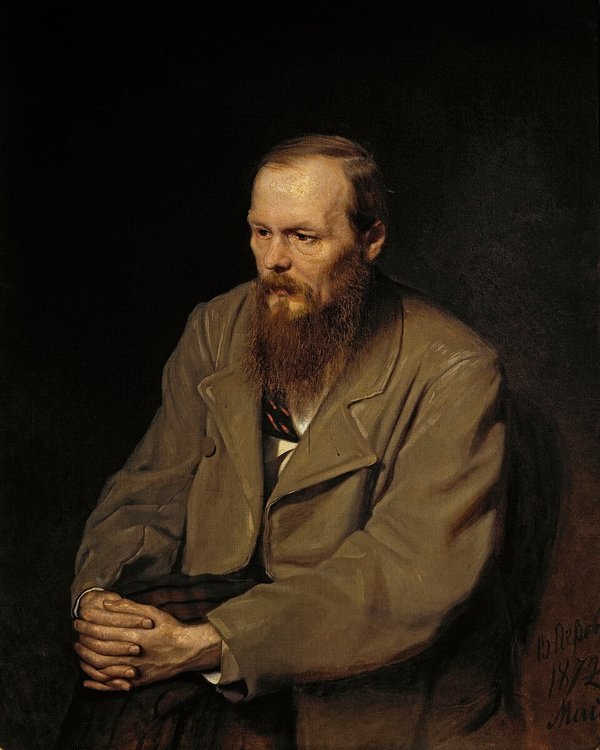
Orthodox Christian, condemned to death and pardoned on the scaffold, he returned from Siberia a critic of the socialism he had embraced and wrote the novels in which ideas are put to the test in the lives of those who defend them. Read the profile of Fyodor Mikhailovich Dostoevsky
Central Theme
A man of twenty-six, nameless, who has lived for eight years in St. Petersburg without making a single acquaintance and lives on daydreams in a room with a cobwebbed ceiling, meets on a night at the start of summer a young woman crying against the railing of a canal. For four nights the two see each other on the same embankment bench: he tells her the life he has not lived, she tells him about the love she has waited for a year, for a lodger who left for Moscow promising to return. He helps her call the other man back, falls in love against the condition she imposed on the first night, is accepted for a few hours and loses everything when the other man appears in the street. The book does not ask whether he will be loved, it asks how much a minute of happiness is worth to someone who has known only the imagined kind.
The story takes place on the bright nights of early summer, when the city empties toward the country houses, and it is told by the Dreamer himself, who writes already knowing the end. Around him are Nastenka, seventeen years old, pinned to her blind grandmother's dress by a pin; the grandmother, who lives on the old days; the lodger, who exists only through Nastenka's voice until the end of the fourth night; Matryona, the maid with no imagination; and, in a single paragraph, the little old man of the Fontanka, the stranger the Dreamer meets every day without ever speaking to him.
The Thread That Runs Through the Work
The book does not ask whether the Dreamer will end up with Nastenka. It asks what a man who lives by daydreams does with a real encounter, and answers that he turns it into a memory before it is over. On the First Night, the encounter has barely begun and he already asks to return to the place just to remember it:
Я мечтатель; у меня так мало действительной жизни, что я такие минуты, как эту, как теперь, считаю так редко, что не могу не повторять этих минут в мечтаньях, I am a dreamer; I have so little real life that moments like this one, like this very moment, are so rare that I cannot help repeating them in my daydreams.
On the Second Night he diagnoses himself, in the third person and with irony, and reaches the point where even memory has lost its substance:
я уже принужден справлять годовщину своих ощущений, годовщину того, что было прежде так мило, чего в сущности никогда не бывало, I am already obliged to celebrate the anniversary of my sensations, the anniversary of what used to be so dear and that, in essence, never happened.
The diagnosis does not cure him. On the Third Night he takes the joy of someone waiting for another man for tenderness aimed at him, and calls himself alone right after she promises him company:
О! Настенька, Настенька! Если б ты знала, в каком я теперь одиночестве!, Oh, Nastenka, Nastenka! If you only knew what solitude I am in now!
The Fourth Night gives him, for a few hours, the life he had only imagined, with rent, pension and maids, and undoes it with a man who passes in the street and calls out a name. Nastenka also dreamed, pinned to her grandmother's dress by the pin, but her dream had a face that could arrive from the street, and it is the difference between the two daydreams that decides the end.
The Morning returns the Dreamer to his room and his maid, and his last daydream invents no palace, it repeats the present:
я увидел себя таким, как я теперь, ровно через пятнадцать лет, постаревшим, в той же комнате, так же одиноким, с той же Матреной, I saw myself as I am now, exactly fifteen years from now, aged, in the same room, as lonely as I am now, with the same Matryona.
And the book ends in a question, not a sentence:
Боже мой! Целая минута блаженства! Да разве этого мало хоть бы и на всю жизнь человеческую?.., My God! A whole minute of bliss! Is that little, even for an entire human life?...
The epigraph and the last sentence are the same question asked twice, a moment in the vicinity of a heart, and both admit the complaint and the consolation. The whole book is the written memory of that moment, and so it cannot condemn daydreaming without condemning itself: the Dreamer does with the four nights what he did with everything, and this time what he remembers actually happened.