About the work
- Original title
- Записки из подполья (Zapiski iz podpolya)
- Publication
- 1864, in the journal Epoch (Epokha), run by the Dostoevsky brothers
- Genre
- Novella
- Setting
- Saint Petersburg: the underground from which the narrator writes, around 1864, and the city of the 1840s that he recalls
- Narrator
- First person, a forty-year-old former clerk who writes his own notes
- Structure
- Two parts: "The Underground" (11 chapters) and "Apropos of Wet Snow" (10 chapters)
- Protagonists
- The Underground Man and Liza
About the author
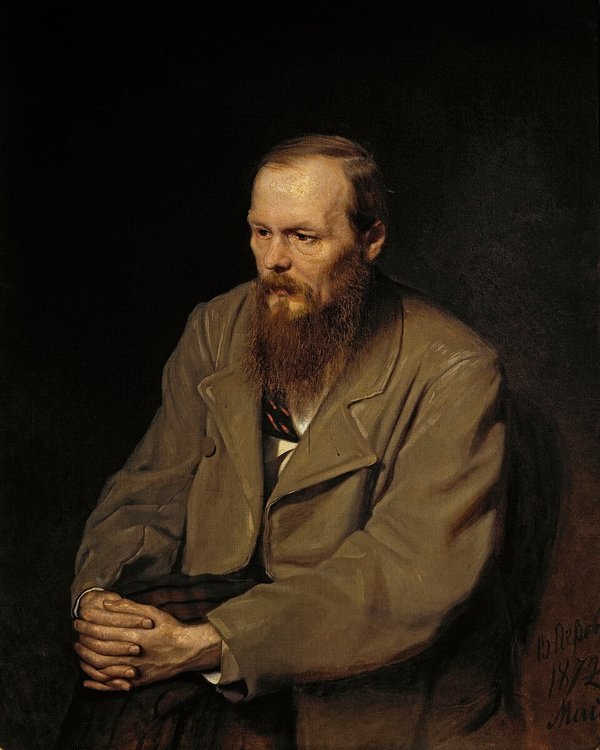
Orthodox Christian, condemned to death and pardoned on the scaffold, he returned from Siberia a critic of the socialism he had embraced and wrote the novels in which ideas are put to the test in the lives of those who defend them. Read the profile of Fyodor Mikhailovich Dostoevsky
Central Theme
A retired civil servant, forty years old and nameless, writes from a corner of Saint Petersburg for readers he invents himself, and what he does throughout Part One is refuse everything: the calculation of interest, the idea that it would be enough to show man his advantage to make him good, the crystal palace that promises a life without doubt. He has lucidity, argument and occasion to spare, yet he does not act, because every cause he finds drags behind it another, earlier one. What he offers in place of advantage is independent will, caprice, and the book asks what remains of a man who can assert himself only in reverse.
In Part Two the question takes on flesh. At twenty-four, the same man tries three times to enter other people's lives, and in all three shame comes disguised as power: he bumps into an officer who brushes him aside without seeing him, forces himself on a dinner of colleagues who do not want him, and unloads on Liza, a young woman from a brothel, the sermon and cruelty his colleagues dealt him. It is Liza who makes the gesture he had not written into any plan, and the book ends without redress, with him saying he has carried to the extreme what readers do not carry even halfway.
The Thread That Runs Through the Work
The book does not ask whether the underground man is right; it asks what a man does with a lucidity that does not let him act, and it answers in two stages. In Part One, the underground man presents himself by what he has not managed to be, and the consolation he takes from it, that only the fool becomes anything, is the one he himself calls spiteful and useless (ch. I of Part One).
Я не только злым, но даже и ничем не сумел сделаться: ни злым, ни добрым, ни подлецом, ни честным, ни героем, ни насекомым., I have not managed to become not only wicked, but anything at all: neither wicked nor good, neither a scoundrel nor honest, neither a hero nor an insect.
The argument passes through the stone wall, before which the man of action yields and he does not (ch. III of Part One), and reaches the objection to the calculation: the list of advantages leaves out the most advantageous of all, the will that is his alone, even when it goes against his own interest (ch. VII of Part One).
Человеку надо — одного только самостоятельного хотенья, чего бы эта самостоятельность ни стоила и к чему бы ни привела., Man needs one thing only: independent willing, whatever that independence may cost and wherever it may lead.
The price of this defense appears next. If reason is only reason and will is the whole of life, man proves that he is a man, and not a piano key, by an act the table does not foresee (ch. VIII of Part One), and suffering, which does not fit in the crystal palace, becomes the sole cause of consciousness (ch. IX of Part One).
Страдание — да ведь это единственная причина сознания., Suffering, after all, is the only cause of consciousness.
At the end of the part he denies almost everything, and that is where the thesis becomes a question: he admits that he does not believe a word of what he wrote and that the accuser's lines were composed by himself (ch. XI of Part One).
Разумеется, все эти ваши слова я сам теперь сочинил. Это тоже из подполья., Of course, all those words of yours I have just now composed myself. This, too, comes from the underground.
Part Two takes the argument off the page and puts it into three scenes, and all three repeat the same design: a book-script rehearsed in advance (the bump into the officer, the slap at Zverkov, the rescue of Liza) and a body that carries it out worse than the script. The bump costs a great deal of preparation, a beaver collar and a withdrawal the day before, and the officer walks on without looking back (ch. I of Part Two). At dinner he wants his colleagues' respect and manages to be treated as someone who cannot even be insulted (ch. IV of Part Two).
Обидели? В-вы! Ми-ня! Знайте, милостивый государь, что вы никогда и ни при каких обстоятельствах не можете меня обидеть!, Offended? Y-you! M-me! Know, dear sir, that you can never, under any circumstances, offend me!
With Liza, the book-script meets someone who unmasks it: she says he talks as if from a book, and he hears only the mockery (ch. VI of Part Two).
Что-то вы… точно как по книге, You sound... just as if from a book.
The gesture he had not written comes from her. Liza understands that he is unhappy and embraces him (ch. IX of Part Two), and his answer is to pay her, out of spite, with the only banknote he has at home; she leaves it on the table, and he runs after her, stops at the corner and comes back (ch. X of Part Two).
Но я не хочу лгать и потому говорю прямо, что я разжал ей руку и положил в нее… со злости, But I do not want to lie, and so I say plainly that I opened her hand and put it into hers... out of spite.
The two parts read against each other. Part One defends the freedom to will what reason would call an error, and Part Two shows a man who uses that freedom for little more than wounding whoever is within reach. Two readings: Part Two contradicts Part One, or shows it from the inside, with the price the argument did not reckon.
Reading with knowledge of the censor's cut in ch. X of Part One changes the weight of what is missing. The narrator's psychological portrait is exact and survives without the religious thesis that Dostoevsky's letter says was cut, and at the same time the book was written as an argument and had its argument mutilated. Both readings coexist, and the honest reader holds on to both.