About the work
- Original title
- Братья Карамазовы (Bratya Karamazovy)
- Publication
- 1879 to 1880, serialized in The Russian Messenger; in book form in 1880
- Genre
- Novel
- Setting
- Skotoprigonyevsk, a Russian provincial town, and the neighboring monastery, around 1866
- Narrator
- First person, a chronicler of the town who recounts the events thirteen years later
- Structure
- A preface, four parts in twelve books, and an epilogue
- Protagonists
- Alyosha, Mitya, and Ivan Karamazov
About the author
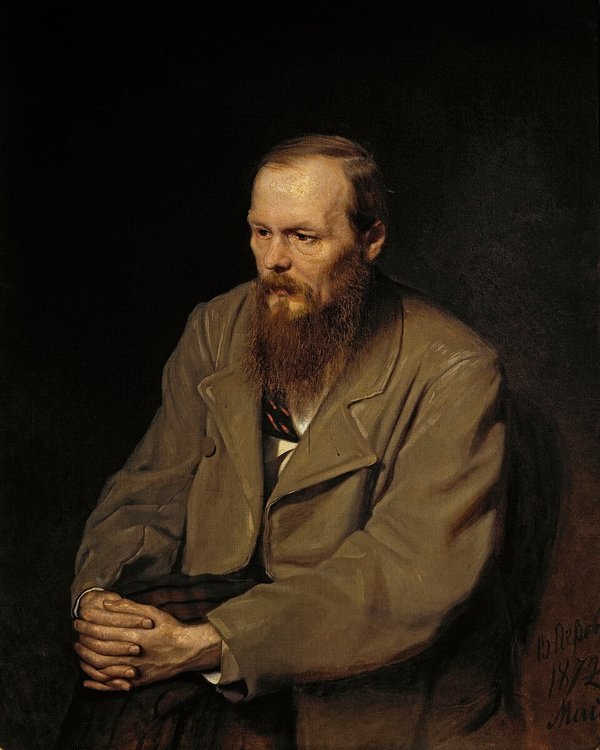
Orthodox Christian, condemned to death and pardoned on the scaffold, he returned from Siberia a critic of the socialism he had embraced and wrote the novels in which ideas are put to the test in the lives of those who defend them. Read the profile of Fyodor Mikhailovich Dostoevsky
Central Theme
The novel does not ask who killed Fyodor Pavlovich Karamazov, it asks who answers for a parricide that no one commits alone, and it answers with what happens to each one who desired it, prepared it, overheard it from afar, or judged it. The father, a landowner, usurer, and buffoon, lets three sons grow up in other people's hands: Mitya, the sensualist, who challenges him over money and over Grushenka; Ivan, the intellectual, for whom without immortality everything is permitted; and Alyosha, the novice of the monastery, disciple of Elder Zosima. The meeting in the cell to divide the inheritance turns into a scandal, and from then on each brother carries to the father's house a different answer to the same question, which sustains a moral life when a child's suffering has no meaning. Ivan respectfully returns his entry ticket, Zosima tells one to choose humble love and to recognize oneself guilty before all, Mitya runs after honor and money until prison, and Smerdyakov, the fourth son whom no one calls a son, does what he heard.
The action runs from late August to November, among the monastery cell, the old man's house, the Mokroye inn, the jail, the court, and the cemetery of a provincial town. Around the brothers are Grushenka, whom the father and son both want, and Katerina Ivanovna, Mitya's proud fiancée, whom Ivan loves; Grigory, the servant who raised the boys; Rakitin, the seminarian who makes faith a career; Lise Khokhlakova, who gets engaged to Alyosha and wants to be tortured; Kolya Krasotkin and the boy Ilyusha, son of the captain whom Mitya humiliated; and the two orators of the trial, the prosecutor Hippolyte Kirillovich and the lawyer Fetyukovich, who explain the same crime with the same facts and neither of them hears the accused. The book ends without resolving the fate of Mitya nor that of Ivan: it resolves only what twelve boys can do together beside a stone.
The Thread That Runs Through the Work
The novel does not ask who killed the father, it asks what sustains a moral life when no one is obliged to look and when a child suffers without meaning, and it answers with what each son does with that. Book II stages both answers: Fyodor Pavlovich tells the elder that he is a buffoon out of shame, and Zosima does not correct him, but tells him to stop lying to himself (chapter II of Book II).
Главное, самому себе не лгите., Above all, do not lie to yourself.
Zosima's second answer goes to the lady who doubts the life to come: the proof is the experience of active love, which is work and perseverance, and dreamed love is the kind that wants an audience (chapter IV of Book II).
Любовь мечтательная жаждет подвига скорого, быстро удовлетворимого и что бы все на него глядели. Тут действительно доходит до того, что даже и жизнь отдают, только бы не продлилось долго, а поскорей совершилось, как бы на сцене, и чтобы все глядели и хвалили. Любовь же деятельная — это работа и выдержка, а для иных так, пожалуй, целая наука., Dreaming love thirsts for a swift deed, quickly satisfied, and for everyone to look on. One even comes to give up one's life, provided it does not last long, and is accomplished quickly, as on a stage, with everyone looking on and praising. Active love, by contrast, is work and perseverance, and for some, perhaps, a whole science.
The family, however, does not live by doctrine. Mitya describes it to Alyosha as a blood inheritance, that of the insects, for whom beauty is terrible because in it the devil wrestles with God (chapter III of Book III), and Ivan, at his father's table, answers that God does not exist, while Alyosha answers that he does (chapter VIII of Book III).
Потому что я Карамазов. Потому что если уж полечу в бездну, то так-таки прямо, головой вниз и вверх пятами, и даже доволен, что именно в унизительном таком положении падаю и считаю это для себя красотой., Because I am a Karamazov. Because if I am to fly into the abyss, I'll fly straight, head first and heels up, and I am even pleased to fall in just such a humiliating position, and I consider that beauty for myself.
Book V gives the question its hardest form. Ivan accepts God and does not accept the world He created, gathers cases of tortured children, and returns his entry ticket over a harmony paid for with the tears of a single child (chapter IV of Book V).
свой билет на вход спешу возвратить обратно [...] Не бога я не принимаю, Алеша, я только билет ему почтительнейше возвращаю., I hasten to return my entry ticket [...] It is not God that I do not accept, Alyosha; I only return the ticket to Him with the utmost respect.
The poem of the Grand Inquisitor develops the refusal into a system: Christ refused the miracle, the mystery, and the authority, the Church took them up again to make men happy, and the prisoner answers with a kiss (chapter V of Book V).
Есть три силы, единственные три силы на земле, могущие навеки победить и пленить совесть этих слабосильных бунтовщиков, для их счастия, — эти силы: чудо, тайна и авторитет., There are three forces, the only three forces on earth able to conquer and hold captive forever the conscience of these weak rebels, for their happiness: these forces are miracle, mystery, and authority.
он вдруг молча приближается к старику и тихо целует его в его бескровные девяностолетние уста. Вот и весь ответ., he suddenly approaches the old man in silence and softly kisses his bloodless ninety-year-old lips. That is the whole answer.
Book VI answers with a life and not with an argument. Zosima tells how the saying of his brother Markel, that each is guilty before all, came back to him on the morning of the duel, and he commands us always to choose humble love (chapter II of Book VI, chapter III of Book VI).
воистину всякий пред всеми за всех и за всё виноват. Не знаю я, как истолковать тебе это, но чувствую, что это так до мучения., truly each is guilty before everyone, for everyone and for everything. I do not know how to explain this to you, but I feel that it is so, to the point of torment.
Взять ли силой али смиренною любовью?» Всегда решай: «Возьму смиренною любовью». Решишься так раз навсегда и весь мир покорить возможешь. Смирение любовное — страшная сила изо всех сильнейшая, подобной которой и нет ничего., "Take by force, or by humble love?" Always decide: "I will take by humble love." If you decide so once and for all, you may conquer the whole world. Humble love is a terrible force, the strongest of all, and nothing is like it.
Zosima's death proves the doctrine from the other side: the body gives off its smell before the hour, the monastery rejoices at the fall of the just man, and Alyosha does not rebel against God, he only does not accept His world. What brings him back to measure is Grushenka, with the onion, and the dream of the wedding at Cana (chapter I of Book VII, chapter II of Book VII, chapter III of Book VII, chapter IV of Book VII).
Я против бога моего не бунтуюсь, я только «мира его не принимаю», I do not rebel against my God, I only "do not accept His world."
луковку я тебе подал, одну самую малую луковку, только, только!.., It was an onion I gave you, one single onion, the smallest of all, only that, only that!..
Mitya learns the same lesson by the opposite road. He runs after money, is arrested, and on the night of the inquiry says it is impossible to live as a scoundrel and impossible to die as a scoundrel (chapter VII of Book IX); he falls asleep and dreams of the child who is cold in the arms of a peasant woman whose home burned down (chapter VIII of Book IX).
Узнал я, что не только жить подлецом невозможно, но и умирать подлецом невозможно… Нет, господа, умирать надо честно!.., I have learned that it is not only impossible to live as a scoundrel, it is impossible to die as a scoundrel… No, gentlemen, one must die honorably!..
почему не кормят дитё?, why don't they feed the little child?
Book XI shows the cost of the other answer. Smerdyakov gives back to Ivan, in the form of an act, his lesson that without God there is no virtue, says that he wanted another to kill, and the devil who visits Ivan recites back the article in which conscience becomes habit (chapter VII of Book XI, chapter VIII of Book XI, chapter IX of Book XI).
Это вы вправду меня учили-с, ибо много вы мне тогда этого говорили: ибо коли бога бесконечного нет, то и нет никакой добродетели, да и не надобно ее тогда вовсе., It was you who really taught me that, for you told me so many times back then: for if there is no infinite God, then there is no virtue at all, and none is needed.
А не ты, не ты?, And not you, not you?
The trial in Book XII makes these answers meet the law. The prosecutor reads the Karamazovs as a mirror of Russia, capable of contemplating both abysses, and the lawyer replies that psychology is a stick with two ends; neither of the two hears what the accused says of himself (chapter VI of Book XII, chapter X of Book XII).
способные вмещать всевозможные противоположности и разом созерцать обе бездны, бездну над нами, бездну высших идеалов, и бездну под нами, бездну самого низшего и зловонного падения, capable of containing every kind of contrast and of contemplating at once both abysses, the abyss above us, of the highest ideals, and the abyss beneath us, of the lowest and most foul fall.
Но ведь психология, господа, хоть и глубокая вещь, а все-таки похожа на палку о двух концах, but psychology, gentlemen, however profound a thing, is nonetheless like a stick with two ends.
The Epilogue does not resolve Ivan's question; it answers with what twelve boys can do. Alyosha, beside the stone, says that the strongest thing for life is a good memory and that they will rise from the dead to tell one another what happened (chapter III of the Epilogue).
Знайте же, что ничего нет выше, и сильнее, и здоровее, и полезнее впредь для жизни, как хорошее какое-нибудь воспоминание, и особенно вынесенное еще из детства, из родительского дома, Know, then, that there is nothing higher, stronger, healthier, or more useful for life hereafter than some good memory, especially one carried from childhood, from the parental home.
Непременно восстанем, непременно увидим и весело, радостно расскажем друг другу всё, что было, certainly we shall rise, certainly we shall see one another, and joyfully, gladly tell one another everything that happened.
The book puts a price on each answer. Ivan's is lucid and ends in a vulgar devil, Mitya's is disordered and ends in a sentence that teaches him, Zosima's is a life and ends in a smell, and Alyosha's holds only by what he does afterward, with an onion and a circle of boys. The text leaves two readings standing: that the Epilogue's good memory is the answer to Ivan's revolt, and that it runs alongside that revolt without touching it, a doubt the narrator leaves open by presenting Zosima's manuscript as a disciple's recollection and not as minutes (chapter I of Book VI).