About the work
- Author
- Machado de Assis
- Publication
- Serialized in the Revista Brasileira from March 1880; in book form in 1881
- Genre
- Novel
- Setting
- Rio de Janeiro, with the stay in Coimbra and in Europe
- Period
- From 1805, when Brás is born, to 1869, when he dies: from colony to the Second Reign
- Narrator
- First person: Brás Cubas himself, after death, talking with the reader
- Protagonist
- Brás Cubas, son of a wealthy family from Rio de Janeiro
About the author
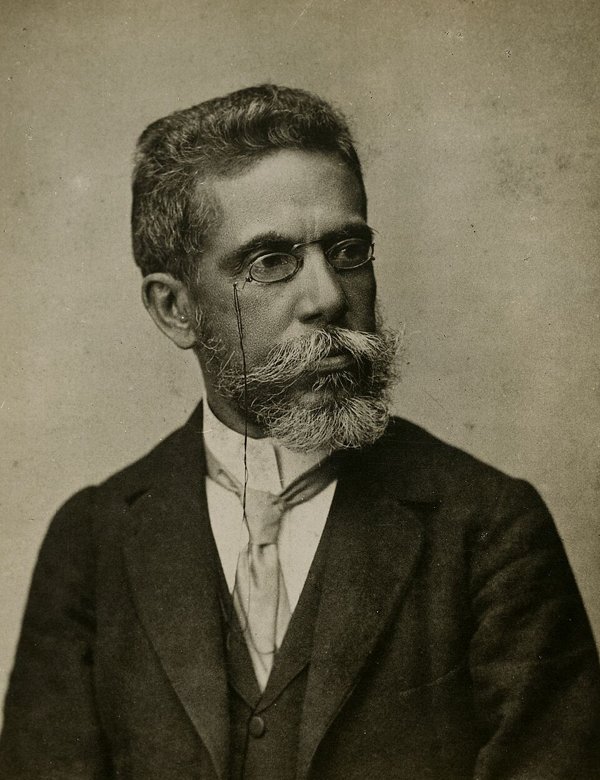
The poor boy from the Morro do Livramento who, almost without leaving Rio, wrote the novels in which the Brazil of the Empire sees itself from within, with irony and without consolation. Read the profile of Machado de Assis
Central Theme
A dead man writes his own memoirs and, because he is dead, says what the living keep silent about. Brás Cubas, son of a wealthy family from Rio de Janeiro, born in 1805 and dead in 1869, recounts a life without achievement: paid or hidden loves, a candidacy another man takes from him, a deputy's seat he loses, a newspaper that dies within months, and a single grand project, a plaster against the melancholy of humanity, that kills him before it exists. What makes the book last is the voice. The narrator interrupts the story, talks with the reader, male or female, mocks himself and others, corrects earlier chapters, writes chapters of a single line, and exposes, with the frankness he says is the first virtue of a dead man, the self-interest that drives people of his class, beginning with himself. Slavery runs through this world without the narrator lingering on it: the boy who rides the enslaved boy Prudêncio like a horse, the same Prudêncio, now freed, whipping on the street the enslaved man he bought. In the last chapter, the balance of a life is made of negatives, and the small remainder is that he passed on to no one the legacy of our misery.
a franqueza é a primeira virtude de um defunto, frankness is the first virtue of a dead man
Dedication
Ao verme que primeiro roeu as frias carnes do meu cadáver dedico como saudosa lembrança estas Memórias Póstumas
, To the worm that first gnawed the cold flesh of my corpse I dedicate these Posthumous Memoirs as a fond keepsake
The dedication is already the dead man's: the first reader he acknowledges is the worm, and the "fond keepsake" is of the body that served as food. The book opens with a joke about its own decomposition, and this is the tone the reader should expect.
Prologue to the third edition
Machado, signing, responds to two remarks about the book: Capistrano de Abreu had asked whether it was a novel, and Macedo Soares had recalled the Travels in My Homeland. He answers with the words of Brás himself, who calls himself the heir of the free form of Sterne and Xavier de Maistre, and marks the difference.
Há na alma deste livro, por mais risonho que pareça, um sentimento amargo e áspero, que está longe de vir de seus modelos
, There is in the soul of this book, however cheerful it may look, a bitter and harsh feeling, one that is far from coming from its models
The author speaks over the narrator only once, to say what separates the book from its models: the form is that of the humorists who traveled around their room or their own land, the substance is bitter. And he closes by refusing to enter "the criticism of a dead man," which already treats Brás as someone who painted his own portrait.
Laurence Sterne is the author of Tristram Shandy and A Sentimental Journey; Xavier de Maistre, of A Journey Around My Room (1794); Almeida Garrett, of Travels in My Homeland (1846). These are the journeys the prologue alludes to: "Xavier de Maistre around his room, Garrett in his own land, Sterne in other people's lands."
To the reader
Brás Cubas opens the book by foreseeing very few readers, fewer than Stendhal's hundred, and describing the work as rambling and the work of a dead man.
Escrevi-a com a pena da galhofa e a tinta da melancolia, e não é difícil antever o que poderá sair desse conúbio
, I wrote it with the pen of jest and the ink of melancholy, and it is not hard to foresee what may come of this union
The formula describes the whole book: laughter is the instrument, melancholy is the material. Brás warns in advance that neither the serious nor the frivolous will be satisfied, and in doing so places himself above both.
A obra em si mesma é tudo: se te agradar, fino leitor, pago-me da tarefa; se te não agradar, pago-te com um piparote, e adeus
, The work in itself is everything: if it pleases you, discerning reader, I am paid for my labor; if it does not, I pay you with a flick, and goodbye
The flick is the first of the many times the narrator treats the reader with intimacy and disdain at once. He refuses to explain how he wrote "in the other world here," and the refusal is the first chapter of the relationship: whoever reads learns that he will not be spared.
The Thread That Runs Through the Work
Three threads run through the book from beginning to end, and each can be followed through the chapters where it appears.
The first is the fixed idea of glory. The plaster that kills him is born of the pleasure of seeing his name printed in newspapers, placards, and pamphlets (ch. II). His father wants him a deputy and arranges a fiancée and a candidacy at once (ch. XXVI, ch. XXVIII), and Lobo Neves carries off both in a few weeks (ch. XLIII). On seeing a minister pass by in a chaise, Brás wonders why he should not be one too (ch. LIX). He reaches the Chamber years later, but what he holds back, in front of his former lover's husband, is the wish to be a minister (ch. CXXVIII, ch. CXXIX). The ministry never comes (ch. CXXXIX), he loses his seat, founds an opposition newspaper that dies within months (ch. CXLVII, ch. CL), and ends up in the Third Order, in the phase he calls the most brilliant of his life (ch. CLVII). Among the negatives of the last chapter is that of not having been a minister (ch. CLX).
o que me influiu principalmente foi o gosto de ver impressas nos jornais, mostradores, folhetos, esquinas [...] estas três palavras: Emplasto Brás Cubas, what influenced me most was the pleasure of seeing printed in newspapers, shop signs, pamphlets, street corners [...] these three words: Emplasto Brás Cubas
Mas eu não tenho aparelhos químicos, como não tinha remorsos; tinha vontade de ser ministro de Estado, But I have no chemical apparatus, just as I had no remorse; I had the desire to be a Minister of State
The second is love and its price. Marcela loves him "for fifteen months and eleven contos de réis" (ch. XVII); Eugênia, pretty and lame, is left behind in Tijuca (ch. XXXIII, ch. XXXV). With Virgília married, love begins in a waltz (ch. L) and is organized in a little house in Gamboa kept by Dona Plácida (ch. LXVII, ch. LXX), to whom Brás gives the five contos found on the beach, and his conscience accuses him of having reduced her to a go-between (ch. LXXVI). Virgília does not separate love from public regard (ch. LXVII), and public opinion, which Brás calls the good solder of domestic institutions, prevents both separation and revenge (ch. CXII, ch. CXIII). In the end, she mourns her husband sincerely, and Brás, who on the way back cannot reconcile betrayal with weeping, ends up finding the combination possible, and even easy (ch. CLII).
Marcela amou-me durante quinze meses e onze contos de réis; nada menos., Marcela loved me for fifteen months and eleven contos de réis; no less.
Vi que era impossível separar duas coisas que no espírito dela estavam inteiramente ligadas: o nosso amor e a consideração pública., I saw it was impossible to separate two things that were entirely linked in her mind: our love and public regard.
The third is the law of the victor. In the delirium, Nature or Pandora explains that the jaguar kills the young bull because the jaguar's reasoning is that it must live, and if the young bull is tender, so much the better (ch. VII). The boy Brás rides Prudêncio like a horse (ch. XI), and the same Prudêncio, freed, whips in the street the man he bought, passing on to another the blows he received (ch. LXVIII). Quincas Borba gives this a doctrine, Humanitism, in which war, hunger, and crime are necessary functions and pain is an illusion (ch. CXVII); the same law appears in the cockfight that absorbs Damasceno (ch. CXXI), and Quincas contemplates it in ecstasy in the two dogs fighting over a bone with no meat (ch. CXLI), and dies demented, repeating that pain is an illusion (ch. CLIX).
A onça mata o novilho porque o raciocínio da onça é que ela deve viver, e se o novilho é tenro tanto melhor: eis o estatuto universal, The jaguar kills the young bull because the jaguar's reasoning is that it must live, and if the young bull is tender, so much the better: such is the universal statute
Era um modo que o Prudêncio tinha de se desfazer das pancadas recebidas, [...] transmitindo-as a outro., It was a way Prudêncio had of ridding himself of the blows he had received, [...] passing them on to another.
Humanitas, dizia ele, o princípio das coisas, não é outro senão o mesmo homem repartido por todos os homens, Humanitas, he said, the principle of things, is none other than the same man divided among all men