About the work
- Author
- Machado de Assis
- Publication
- In book form in 1899, by Garnier
- Genre
- Novel
- Setting
- The Rio de Janeiro of the Second Reign: Matacavalos Street, the seminary of São José, Glória and Engenho Novo
- Era
- From 1857, when Bentinho is fifteen, to the return of Ezequiel as an adult, many years after 1872, told by Bentinho near the end of the century
- Narrator
- First person: Bento Santiago, now old, who recounts his own life and is the interested party
- Protagonist
- Bento Santiago, Bentinho, and Capitu, the childhood neighbor he marries
About the author
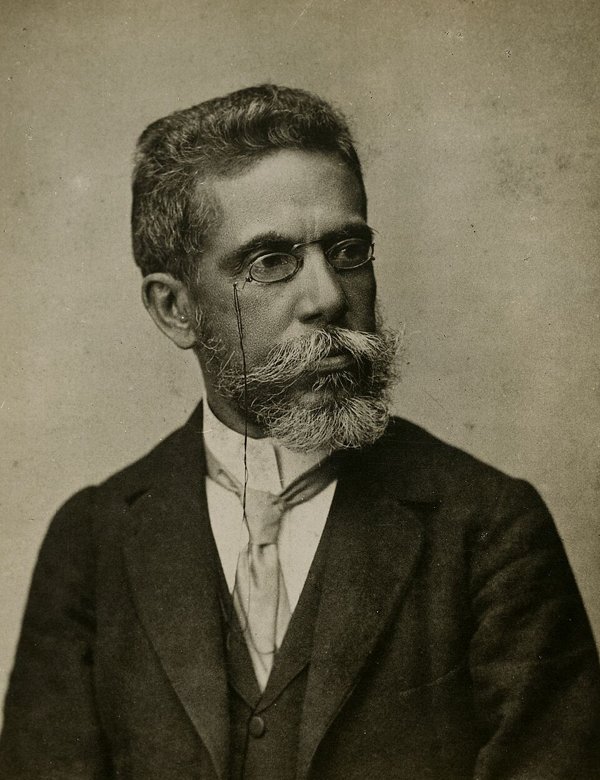
The poor boy from the Morro do Livramento who, almost without leaving Rio, wrote the novels in which the Brazil of the Empire sees itself from within, with irony and without consolation. Read the profile of Machado de Assis
Central Theme
Bento Santiago, old and alone in a house in Engenho Novo, writes his own life to answer a question he never quite formulates: whether his wife, Capitu, betrayed him with his best friend, Escobar. The book is not about Capitu's adultery; it is about the construction of an accusation. The reader receives all the material from the hands of the accuser, and the novel is built so that this condition becomes visible without ever being stated.
What makes the piece work is that Bentinho is not a liar. Right at the start he confesses that the project of the house failed and warns that he is selecting what he tells, and it is precisely this partial honesty that lends authority to the rest. It is the same mechanism as in The Alienist: there, the good faith of the man who defines madness is what makes the result frightening, not hypocrisy.
Confissão de crianças, tu valias bem duas ou três páginas, mas quero ser poupado., Children's confession, you were worth a good two or three pages, but I want to be spared.
The Thread That Runs Through the Work
Does the distance between the reported fact and the narrator's reading of it support the novel's thesis, or is it already retroactive contamination by someone writing decades later, convinced? There is no way to separate the two things, and that is what the book is demonstrating. The proof is not in any single chapter: it is in the course of the two images that decide Capitu's reputation.
The Two Images of the Eyes
The first is born in chapter XXV, from the mouth of José Dias, in the same meeting in which he changes his position on the seminary out of self-interest.
Capitu, apesar daqueles olhos que o diabo lhe deu... Você já reparou nos olhos dela? São assim de cigana oblíqua e dissimulada., Capitu, in spite of those eyes the devil gave her... Have you noticed her eyes? They are like those of an oblique and dissembling gypsy.
The second is born in chapter XXXII, from the pen of the old Bentinho, who looks for the comparison for what he felt as a lover, at fifteen, between fascination and threat, right after he examines her eyes for the dissembling that José Dias had pointed out and finds nothing extraordinary.
Olhos de ressaca? Vá, de ressaca. É o que me dá ideia daquela feição nova. Traziam não sei que fluido misterioso e enérgico, uma força que arrastava para dentro, como a vaga que se retira da praia, nos dias de ressaca., Undertow eyes? Very well, undertow. That is what gives me an idea of that new look. They carried some mysterious and energetic fluid, a force that dragged you inward, like the wave that withdraws from the beach on days of heavy undertow.
Ninety-one chapters later, at the wake, the second image returns, now applied to the wife's gaze upon her friend's corpse.
os olhos de Capitu fitaram o defunto, quais os da viúva, sem o pranto nem palavras desta, mas grandes e abertos; como a vaga do mar lá fora, como se quisesse tragar também o nadador da manhã, Capitu's eyes gazed at the dead man, like the widow's, without her weeping or her words, but large and open; like the sea wave out there, as if she wished to swallow the morning's swimmer too
And the two, which were born in different mouths and for different reasons, and which in chapter L the narrator himself had denied together ("they were neither oblique nor undertow"), return side by side at the end of the book, in chapter CXLVIII, as if they were a permanent trait of a person.
Talvez porque nenhuma tinha os olhos de ressaca, nem os de cigana oblíqua e dissimulada., Perhaps because none of them had undertow eyes, or those of an oblique and dissembling gypsy.
The two visual proofs that condemn Capitu in every reader's memory have, within the text itself, a dated origin, an identified speaker and a motive. The novel gives these facts away for free. The one who joins them as a trait of character is the narrator, on the last page, and with the conclusion already in hand.
The Resemblance the Book Had Already Explained
In chapter LXXXIII, Gurgel, Sancha's father, shows Bentinho the portrait of his late wife and says that Capitu resembles her, in features and in temperament, with the book giving no kinship at all between the two.
Na vida há dessas semelhanças assim esquisitas., In life there are such odd resemblances.
In chapter CXL, with the separation already decided, Bentinho himself remembers these words, and even so reads Ezequiel's features as proof.
Reduzem-se a dizer que há tais semelhanças inexplicáveis..., They amount to saying that there are such inexplicable resemblances...
The book places, some fifty-five chapters before the accusation (from LXXXIII to CXXXVIII), the case of a resemblance with no guilt at all, and the narrator recalls it at the moment of deciding. He has not forgotten the argument against himself: he recalls it in chapter CXL and, in the same stretch, lets the memories of Escobar and Capitu run him over.
In Favor of the Reading of Betrayal
Four elements support it, and none is negligible: Ezequiel's resemblance to Escobar, first remarked at the table by Capitu; her silence before the photograph; the separation proposed by her own self; and the image of the fruit inside the rind, which denies a change of character.
Alguns dos gestos já lhe iam ficando mais repetidos, como o das mãos e pés de Escobar; ultimamente, até apanhara o modo de voltar a cabeça deste, quando falava, e o de deixá-la cair, quando ria, Some of his gestures were becoming more and more repeated, like those of Escobar's hands and feet; lately, he had even picked up the way Escobar turned his head when speaking, and the way of letting it fall when laughing
Against Her
Each of the four admits the opposite reading with equal force. And there is an asymmetry of standard, which appears only by crossing the seminary years with the married ones: the same narrator who absolves himself in a few lines of the desire he himself confesses to feeling for his friend's wife does not grant his own wife the equivalent doubt in the face of a look.
Foi um instante de vertigem e de pecado., It was a moment of vertigo and sin.
And the coldest line in the book is the one that dismantles the inquiry itself, because it reveals that proving was never the goal.
pagaria o triplo para não tornar a vê-lo, I would pay triple not to see him again
Othello, Named and Refused
The common question about the book is whether Capitu cheated, and it seems that the well-trained reader is the one who knows how to answer with grounds. The question is a trap set by the novel itself, and answering is already falling into it: the tribunal is not convened to judge Capitu, it is convened to see what the reader does with a dossier assembled by one of the parties.
The novel names its own model and diverges from it at the decisive point. In Othello the spectator knows that Desdemona is innocent, and the tragedy lies in watching the error; here that certainty is never granted, and the tragedy passes outside the book. Bentinho sees the whole play and leaves it with the decision made, not the suspicion.
O último ato mostrou-me que não eu, mas Capitu devia morrer, The last act showed me that not I, but Capitu, ought to die
Machado puts in one handkerchief fewer than Shakespeare: Othello's proof is flimsy, Bentinho's is the resemblance between a child's face and a dead man's, and the sentence comes out the same all the same.
Whoever Defines Decides What Others See
It is the bridge to The Alienist. There it is Simão Bacamarte who states the criterion of madness and no one feels authorized to examine it; here it is José Dias who states, in passing and out of self-interest, the first criterion about Capitu's eyes, and the narrator, decades later, examines it in chapter XXXII without finding anything, denies it in chapter L and in the end inherits it. In both cases the definition arrives before the examination, and whoever pronounces it is never neutral.
The Problem Always Solved by Someone Else
Dona Glória's promise is not broken, it is paid off by proxy, and the one who formulates the way out is Escobar, in two lines of dialogue that the text does not mark as a turning point. Before him, José Dias had already offered the trip to Rome; none of the ways out is Bentinho's.
Sua mãe fez promessa a Deus de lhe dar um sacerdote, não é? Pois bem, dê-lhe um sacerdote, que não seja você. Ela pode muito bem tomar a si algum mocinho órfão, fazê-lo ordenar à sua custa, está dado um padre ao altar, sem que você..., Your mother made a vow to God to give him a priest, didn't she? Well, give him a priest, who needn't be you. She can very well take in some orphan boy, have him ordained at her expense, a priest is given to the altar, without you...
It counts against the common reading of Bentinho as a passive victim of circumstances: he is passive, but the book shows this by construction, not by complaint.
The Memory That Does Not Close the Circle
In chapter II, the declared project of the house fails in the very next sentence, and the narrator says so himself before narrating anything.
O meu fim evidente era atar as duas pontas da vida, e restaurar na velhice a adolescência., My evident aim was to tie the two ends of life together, and to restore adolescence in old age.
In the end, the same rule he applies to Capitu, the fruit inside the rind, is the one he had applied to himself in chapter CXL, when he asked himself whether he was not "merely a man in disguise."