About the work
- Author
- Dante Alighieri
- Original title
- Paradiso, the third canticle of the Commedia
- Genre
- Narrative poem in interlocking tercets (terza rima)
- Setting
- The heavens, from sphere to sphere, from the Moon to the Empyrean
- Narrator
- First person, Dante himself, who recounts the journey after making it
- Structure
- 33 cantos, through the nine heavens to the Empyrean
- Protagonists
- Dante and Beatrice; at the end, Saint Bernard
About the author
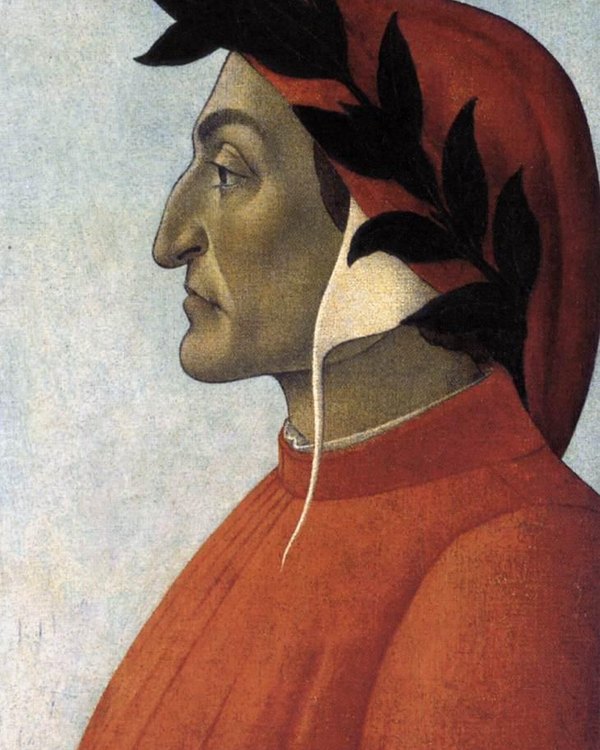
Florentine poet, White Guelph and prior of Florence in 1300, banished from the city in 1301 and died in exile, in Ravenna, after writing the Comedy, the journey of a living man through Hell, Purgatory, and Paradise. Read the profile of Dante Alighieri
Central Theme
Dante leaves the summit of Purgatory with Beatrice and rises without noticing the movement: Moon, Mercury, Venus, Sun, Mars, Jupiter, Saturn, the Fixed Stars and the Primum Mobile, up to the Empyrean, which is pure light and where the rose of the blessed opens. The rule that clears up the most common confusion is that no one lives on the planets. The souls appear in each heaven so that Dante may understand the degrees, as Beatrice says in canto IV, and all have their place in the rose, near God, as he sees in canto XXX and in canto XXXII.
The matter of the canticle changes. In the Inferno there was body, blood and weight; here there is light, music, dance and number, and almost no plot. In its place, a sequence of Dante's questions and Beatrice's lessons: the order of the universe, the spots of the Moon, the worth of a vow, the cross, the resurrection of bodies, justice that cannot be measured from afar. And there is a technical problem that the poem faces head on: how to say what exceeds sight and memory. At each height Dante confesses that language does not reach, and the confession becomes the subject. He does not describe the ineffable; he describes what happens to whoever tries.
The thread of the canticle, however, is not doctrine. It is the measure of what a man can bear to see, and of what he can tell of what he saw. Beatrice does not laugh, and the heaven does not sing, so that Dante's mortal hearing may endure; the poem warns that it will leap, the pen leaps, and in the end the seeing is greater than the telling. What remains in the last tercet is a motion: Dante's desire and will turn, moved by the Love that moves the sun and the other stars, and the canticle closes on the word that also closes the other two: stars.
The Thread That Runs Through the Work
Paradise does not ask what each soul deserves; it asks what a man can see, and what he can say of what he saw. The ascent is a sight that grows, and each canto measures what it can already bear.
At the start, the ascent is explained as order. Dante asks how he passes through light bodies and receives from Beatrice a thesis on the universe (canto I); the spots of the Moon show that the difference in light comes from form, and not from matter (canto II); Piccarda shows that the rung does not measure the happiness of the one who occupies it (canto III), and Beatrice separates the will that does not consent from the one that yields out of fear (canto IV).
Le cose tutte quante / hanno ordine tra loro, e questo è forma / che l’universo a Dio fa simigliante, all things have order among themselves, and this is the form that makes the universe resemble God.
In Mercury and Venus order becomes an account. The vow is worth what the freedom offered in it is worth (canto V), Justinian weighs the eagle and does not decide which of the two sides errs more (canto VI), Beatrice weighs the cross in two ways (canto VII), and the spirit of Venus weighs lineage (canto VIII).
Lo maggior don che Dio per sua larghezza / fesse creando, e a la sua bontate / più conformato, e quel ch’e’ più apprezza, / fu de la volontà la libertate; / di che le creature intelligenti, / e tutte e sole, fuoro e son dotate, the greatest gift that God, in his largesse, made in creating, and the one most conformed to his goodness, and the one he most prizes, was the freedom of the will, with which intelligent creatures, all and only they, were and are endowed.
In the Sun, knowledge appears praised and criticized by those who are not its own. Cunizza forgives herself without pain, and Folquet says that there one does not repent but laughs (canto IX); Thomas names and describes the twelve wise men, and Siger among them (canto X); each founder is praised by the rival order, and each praise ends in censure of the house of the speaker (canto XI, canto XII).
Non però qui si pente, ma si ride, / non de la colpa, ch’a mente non torna, / ma del valor ch’ordinò e provide. / Qui si rimira ne l’arte ch’addorna / cotanto affetto, e discernesi ’l bene / per che ’l mondo di sù quel di giù torna, not, however, does one repent here, but one laughs, not at the fault, which does not return to the mind, but at the worth that ordained and provided. Here one contemplates the art that adorns such affection, and one discerns the good through which the world above turns the world below.
From there, judgment becomes the subject. Thomas bids him put lead on his feet before affirming or denying (canto XIII), Cacciaguida praises ancient Florence for its absences and sees it die of pride (canto XV, canto XVI), and the prophecy of exile comes with the command to tell everything (canto XVII). Soon after, the Eagle denies mortals the judge's seat (canto XIX).
Or tu chi se’, che vuo’ sedere a scranna, / per giudicar di lungi mille miglia / con la veduta corta d’una spanna?, now, who are you, who wish to sit upon the bench to judge from a thousand miles away with the short sight of a span?
In Saturn and the Fixed Stars, the heaven moderates itself for the body that rises. Beatrice does not laugh, and the saints do not sing, because Dante's hearing is mortal, as his sight is (canto XXI); in the triumph of Christ the poet confesses that the poem must leap (canto XXIII), and in Peter's examination the pen leaps again (canto XXIV).
«Tu hai l’udir mortal sì come il viso», / rispuose a me; «onde qui non si canta / per quel che Bëatrice non ha riso., you have hearing as mortal as sight, she answered me; therefore here one does not sing, for the same reason that Beatrice did not laugh.
Però salta la penna e non lo scrivo: / ché l’imagine nostra a cotai pieghe, / non che ’l parlare, è troppo color vivo., therefore the pen leaps and I do not write it: for our imagination, not only speech, is too vivid a color for such folds.
Before the last heaven, James and John examine Dante's hope and charity (canto XXV, canto XXVI), and Peter makes the entire heaven blush against the papacy (canto XXVII). In the Primum Mobile, Dante sees God as a point, and Beatrice gives the rule from on high: beatitude is born of seeing, and loving comes after (canto XXVIII).
Quinci si può veder come si fonda / l’esser beato ne l’atto che vede, / non in quel ch’ama, che poscia seconda; / e del vedere è misura mercede, / che grazia partorisce e buona voglia: / così di grado in grado si procede, from here one can see how beatitude is founded in the act of seeing, and not in the act of loving, which follows afterward; and from seeing the measure is the merit that grace and good will bring forth: thus one proceeds from degree to degree.
In the Empyrean, speech yields to sight, and sight yields to memory. The poet gives up following Beatrice's beauty in verse (canto XXX), she answers his last prayer with a smile and returns to the fountain (canto XXXI), Bernard asks Mary for the last step, and Dante sets down what remains of what he saw (canto XXXIII).
Da quinci innanzi il mio veder fu maggio / che ’l parlar mostra, ch’a tal vista cede, / e cede la memoria a tanto oltraggio. / Qual è colüi che sognando vede, / che dopo ’l sogno la passione impressa / rimane, e l’altro a la mente non riede, from here on my seeing was greater than speech can show, which yields to such a sight, and memory yields to so great an excess. Like one who sees in a dream, and after the dream the emotion impressed on him remains, while the rest does not return to the mind.
The poem does not conclude with a thesis; it concludes with a wheel that keeps turning. The incapacity Dante confesses at each height has two readings. In the first, it is true humility of one who lacks the word and prepares the reader for a sight that does not fit in verse. In the second, it is method: what the poem can offer of a vision is the emotion it left, and so the confession of limit is the only possible proof that there was a vision. The text sustains both, and what they have in common is that the reader knows, from canto II, that the sea is deep and that no one forces him to follow.