About the work
- Author
- Dante Alighieri
- Original title
- Purgatorio, the second canticle of the Divine Comedy
- Genre
- Narrative poem in linked tercets (terza rima)
- Setting
- The mountain of Purgatory, in the opposite hemisphere, from the shore to the Earthly Paradise at the summit
- Narrator
- First person, Dante himself, who recounts the journey after it has been made
- Structure
- 33 cantos: Ante-Purgatory, the seven ledges and the Earthly Paradise
- Protagonists
- Dante, Virgil and, at the end, Beatrice
About the author
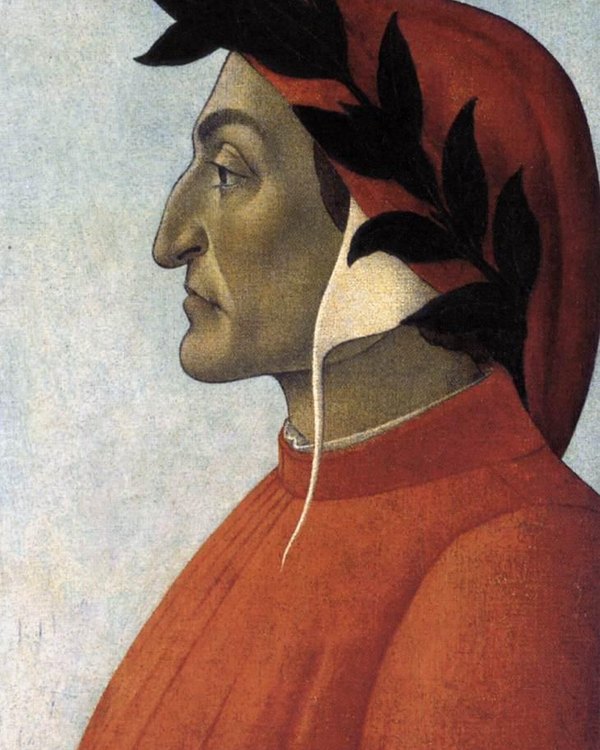
Florentine poet, White Guelph and prior of Florence in 1300, banished from the city in 1301 and died in exile, in Ravenna, after writing the Comedy, the journey of a living man through Hell, Purgatory, and Paradise. Read the profile of Dante Alighieri
Central Theme
Dante and Virgil leave the dead air of Hell and, at dawn, reach a deserted shore on the hemisphere opposite Jerusalem, at the foot of a mountain. This is the second realm, and the first canto defines it by two actions of the spirit: to purge oneself and to become worthy of climbing to heaven. At the base, in Ante-Purgatory, wait those who converted late; above a gate guarded by an angel, who marks seven P's on Dante's forehead, rise the seven ledges; at the summit lies the Earthly Paradise, where Virgil withdraws and Beatrice arrives to accuse. The mountain weighs heavily at the beginning and eases with each step, and the rule of the place is that one does not climb at night.
What orders the ascent is a thesis that Virgil expounds in canto XVII, the central canto of the central canticle: neither creator nor creature was ever without love, and natural love does not err, but love of the mind errs through a bad object, through too little vigor, or through too much vigor. Hence the seven ledges: pride, envy and wrath love the evil of one's neighbor; sloth loves the good with slackness; avarice, gluttony and lust love lesser goods too much. Sin, in this reckoning, is nothing other than love gone astray, and for that reason it can be corrected. In Hell the souls are what they did; here they are ceasing to be so, and that is why here one sings.
The thread of the canticle, however, is not the catalogue of vices. On each ledge the punishment and the examples teach the opposite of the vice: the weight that bends the proud, the iron thread through the eyes of the envious, the smoke of the wrathful. And what is purged, in the end, is the will: the soul that, after five hundred years, feels its will free makes the mountain tremble, and Virgil hands Dante a judgment "free, upright and whole". The canticle ends on the word that also closes the other two: stars.
The Thread That Runs Through the Work
Purgatory does not ask what each vice deserves; it asks what a man learns to will. The realm is defined at the very first canto by two actions of the spirit, and the canticle is the story of a will being set straight along the way.
e canterò di quel secondo regno / dove l’umano spirito si purga / e di salire al ciel diventa degno, and I shall sing of that second realm where the human spirit purges itself and becomes worthy of climbing to heaven.
The first lesson concerns Time. Cato yields only to the name of the lady of heaven, and not to the affection of Marcia (Canto I); the song of Casella, which consoles Dante, makes everyone forget the way until a rebuke for the delay (Canto II); Manfred measures the wait at thirty times the length of his presumption (Canto III); and Belacqua knows the rule of waiting exactly and keeps sitting (Canto IV). Virgil had already given the measure of the effort: the mountain weighs at the beginning and eases.
Ed elli a me: «Questa montagna è tale, / che sempre al cominciar di sotto è grave; / e quant’ om più va sù, e men fa male. / Però, quand’ ella ti parrà soave / tanto, che sù andar ti fia leggero / com’ a seconda giù andar per nave, this mountain is such that it is always hard at the beginning, from below; and the more one climbs, the less it hurts. So, when it seems to you so gentle that climbing will be as light for you as going down a river is for a boat with the current.
Whoever waits depends on the living. A dead man asks for prayers in Fano, Buonconte notes that neither Giovanna nor others take care of him, and Pia asks only to be remembered (Canto V); Nino wants his daughter to pray for him (Canto VIII). Dante asks Virgil whether prayer bends the decree of heaven, and the answer is that the fire of love accomplishes in an instant what satisfaction demanded (Canto VI).
Ed elli a me: «La mia scrittura è piana; / e la speranza di costor non falla, / se ben si guarda con la mente sana; / ché cima di giudicio non s’avvalla / perché foco d’amor compia in un punto / ciò che de’ sodisfar chi qui s’astalla, my writing is clear; and the hope of these souls does not fail, if one looks at it with a sound mind; for the height of judgment is not lowered because the fire of love fulfills in an instant what those who are settled here must satisfy.
The night sets another limit on the will: without light, what is lacking is power, not will (Canto VII). On the first ledge the remedy passes through the eyes. The gate opens with a warning not to look back, the marble returns Dante's own face to him, images of humility can be read in the stone as if spoken, and the floor of the proud forces one to look down (Canto IX, Canto X, Canto XII). Oderisi confesses that in life he would not have given his rival the honor he now gives (Canto XI), and Dante discovers with his fingers that one of the seven P's has been erased.
e con le dita de la destra scempie / trovai pur sei le lettere che ’ncise / quel da le chiavi a me sovra le tempie: / a che guardando, il mio duca sorrise., and with the fingers of my right hand spread I found only six of the letters that he who held the keys had carved on my temples; seeing this, my guide smiled.
The envious and the wrathful repeat the method with other senses, eyes sewn shut and smoke, and the question shifts from who sins to where the cause of evil lies. Virgil shows the eye that looks only at the earth (Canto XIV), and then says that divine good grows as it is shared (Canto XV), and Marco Lombardo refuses to let heaven be the cause:
Lo cielo i vostri movimenti inizia; / non dico tutti, ma, posto ch’i’ ’l dica, / lume v’è dato a bene e a malizia, / e libero voler; che, se fatica / ne le prime battaglie col ciel dura, / poi vince tutto, se ben si notrica., heaven starts your movements; I do not say all of them, but, granting that I say it, light is given to you for good and for evil, and free will; which, if in the first battles with heaven it suffers hardship, afterward conquers everything, if it is well nourished.
At the center of the poem lies the doctrine of love and Dante's objection to it: if love comes from outside and the soul goes only on that foot, there is no merit or fault (Canto XVII, Canto XVIII). Virgil answers as far as reason sees and leaves the rest to Beatrice.
Quanto ragion qui vede, / dir ti poss’ io; da indi in là t’aspetta / pur a Beatrice, ch’è opra di fede, as far as reason sees here, I can tell you; from there on, wait only for Beatrice, for it is a work of faith.
The will then appears in different states: the siren whom Dante's gaze adorns and God's lure undoes; the pope (tradition reads him as Adrian V) who wanted another life only when the summit of power wore him out (Canto XIX); the she-wolf whom Dante curses, and the avarice of the kings of the house of Hugh Capet (Canto XX). Statius makes the will the proof of cleansing.
E io, che son giaciuto a questa doglia / cinquecent’ anni e più, pur mo sentii / libera volontà di miglior soglia: / però sentisti il tremoto e li pii / spiriti per lo monte render lode / a quel Segnor, che tosto sù li ’nvii, and I, who have lain in this pain five hundred years and more, only now felt free will of a better threshold; therefore you felt the trembling and the pious spirits across the mountain rendering praise to that Lord who soon sends them up.
Next the will shows itself in the body. Forese calls the punishment a consolation, the will that led Christ to cry Eli (Canto XXIII), and Statius explains that the shade takes its form from the desires and affections that afflict it (Canto XXV).
E non pur una volta, questo spazzo / girando, si rinfresca nostra pena: / io dico pena, e dovria dir sollazzo, / ché quella voglia a li alberi ci mena / che menò Cristo lieto a dire ‘Elì’, / quando ne liberò con la sua vena, and not only once, circling this space, does our pain refresh itself: I say pain, and should say solace, because that will leads us to the trees, the same will that led Christ joyfully to say Eli, when with his blood he freed us.
At the top of the stairs reason withdraws. Virgil, who got Dante into the fire only by Beatrice's name, declares that Dante's pleasure must be his guide (Canto XXVII).
Tratto t’ho qui con ingegno e con arte; / lo tuo piacere omai prendi per duce; / fuor se’ de l’erte vie, fuor se’ de l’arte, I have brought you here with wit and with art; now take your pleasure for your guide; you are out of the steep paths, you are out of the narrows.
The surrendered will is again called to account by the one Dante loved most. Beatrice does not console, she accuses, and Dante answers that present things turned his steps aside as soon as her face was hidden (Canto XXXI).
Le presenti cose / col falso lor piacer volser miei passi, / tosto che ’l vostro viso si nascose, present things, with their false pleasure, turned my steps as soon as your face was hidden.
And the Lethe, which erases the memory of sin, serves her as proof of guilt (Canto XXXIII).
E se tu ricordar non te ne puoi», / sorridendo rispuose, «or ti rammenta / come bevesti di Letè ancoi; / e se dal fummo foco s’argomenta, / cotesta oblivïon chiaro conchiude / colpa ne la tua voglia altrove attenta, and if you cannot remember it, she answered smiling, now recall how today you drank of Lethe; and if fire is inferred from smoke, that forgetting clearly concludes fault in your will, which was attentive elsewhere.
The poem does not say whether a straightened will is enough or whether it still needs shame and forgetting. In Canto XXVII, Virgil gives Dante the freedom of his choice as settled; in Canto XXX, Beatrice accuses him as if there were still something to accuse. The text sustains both readings. On the first, the freedom Virgil hands over is real, and Beatrice's accusation is the price of using it: whoever governs himself answers for himself. On the second, the will that reason straightens is completed only when someone from outside accuses it and washes it, and that is why reason must leave the scene. What both have in common is that the canticle does not end on a thesis; it ends on an ascent that it does not show.