About the work
- Author
- Dante Alighieri
- Original title
- Inferno, the first canticle of the Commedia
- Genre
- Narrative poem in linked tercets (terza rima)
- Setting
- The Inferno, from the dark wood to the center of the Earth, in Holy Week of 1300
- Narrator
- First person, Dante himself, who recounts the journey after it has been made
- Structure
- 34 cantos: one introductory and 33 on the journey through the nine circles
- Protagonists
- Dante, the pilgrim, and Virgil, the guide
About the author
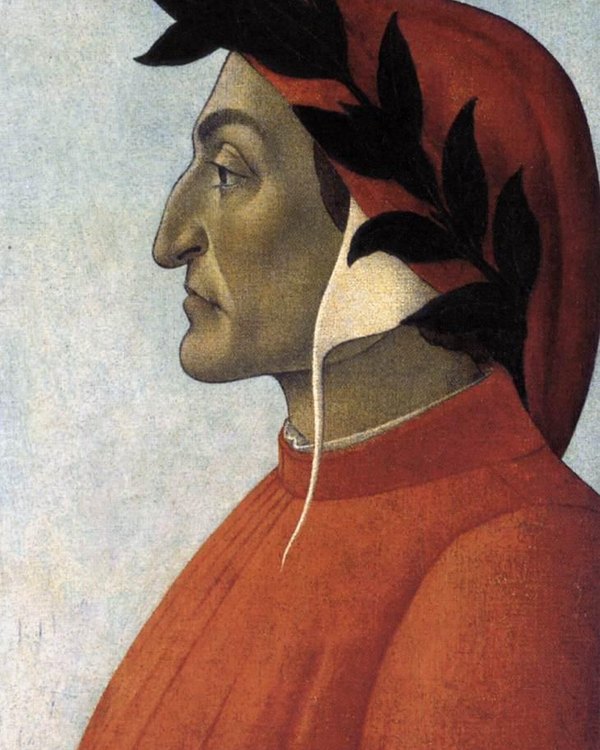
Florentine poet, White Guelph and prior of Florence in 1300, banished from the city in 1301 and died in exile, in Ravenna, after writing the Comedy, the journey of a living man through Hell, Purgatory, and Paradise. Read the profile of Dante Alighieri
Central Theme
Midway through the journey of life, Dante finds himself in a dark wood without knowing how he entered it, is blocked by three beasts on the climb toward a sunlit mountain, and is rescued by the shade of the poet Virgil, who proposes another way: to descend through the Inferno, see those who sinned and, coming out the other side, climb up. The Inferno is a funnel dug beneath Jerusalem, which descends in nine circles to the center of the Earth, where Lucifer is trapped in the ice. The canticle is this descent, which Dante recounts in the first person and which the poem dates to Holy Week of 1300.
What he sees is ordered by a thesis that Virgil sets out in canto XI: all malice aims at injustice, injustice is done by force or by fraud, and fraud, which is the evil proper to man, displeases God more. That is why the sins of desire, in which appetite has overcome reason (lust, gluttony, avarice, wrath), lie near the entrance; violence lies in the middle; and fraud and betrayal, which use intelligence to undo trust among people, lie at the bottom. The punishment is not decorative: it describes the sin. Those swept away by desire are carried off by a gale, the soothsayers walk with their heads turned backward, and that is why no one there repents, because each damned soul goes on wanting exactly what brought him there.
The thread of the book, however, is not the catalogue of punishments. Dante does not only look, he reacts: he is afraid in the wood, faints from pity before Francesca, wishes to see Filippo Argenti sunk in the mud, listens with too much pleasure to the quarrel of two forgers, and in the ice treats the traitors harshly. The poem never says outright whether it approves what the pilgrim feels, and the question that organizes the descent is what a man learns to feel before the sin of others. The canticle ends with the exit through the body of Lucifer himself and with the word that closes the other two canticles too: stars.
The Thread That Runs Through the Work
The Inferno does not only ask what each sin deserves; it asks what a man feels while looking at the sins of others, and it gives Dante, at each circle, a different reaction, which the poem itself examines.
Fear opens the canticle. Dante finds himself in a wood without knowing how he entered it (canto I), is pushed back by a she-wolf, and agrees to follow Virgil only after learning that it was Beatrice who sent him, sent by Lucia and by a lady of heaven (canto II). Virgil gives Dante's doubt the name of cowardice, and the word returns at the gate, where all cowardice must be dead for one to enter, and in the act of him who made the great refusal (canto III). In Limbo the error is inverted: Dante takes for fear the pity Virgil feels for those who suffer there (canto IV).
l’anima tua è da viltade offesa; / la qual molte fïate l’omo ingombra / sì che d’onrata impresa lo rivolve, / come falso veder bestia quand’ ombra, your soul is wounded by cowardice, which often so encumbers a man that it turns him from an honorable undertaking, as a false vision makes a beast balk at a shadow.
In the second circle fear turns into pity, and pity is put to the test. Dante falls like a dead body on hearing Francesca attribute to Love everything she did (canto V), weeps for Ciacco but asks about Florence (canto VI) and, in the Styx, curses Filippo Argenti and says he would like to see him sunk in the mud, which Virgil praises and the poem does not disavow (canto VIII).
Maestro, molto sarei vago / di vederlo attuffare in questa broda / prima che noi uscissimo del lago, Master, I would dearly love to see him dipped in this broth before we leave the lake.
Inside Dis, sin ceases to be weakness and becomes choice, and the question is what can be seen. Dante has to close his eyes before Medusa and open them to the doctrine hidden beneath the veil of the verses (canto IX); the damned see the distant future and lose the present, and it is this that brings down the shade the tradition calls Cavalcante, because of a verb in the past tense (canto X); and, while the stench of the abyss forces them to wait, Virgil draws the map of what is still to be seen (canto XI).
In the seventh circle almost every damned soul who speaks asks Dante to remember him. The trunk that the tradition calls Pier delle Vigne wants his memory defended against the envy that ruined him (canto XIII), Brunetto Latini, the former master, hands over the Tesoro as the only good left to him (canto XV), and the three Florentine knights ask that people speak of them when Dante sees the stars again (canto XVI). In four of the five cantos the subject is Florence, and the listener is a Florentine who, in the year of the journey, has not yet been banished.
In Malebolge what is punished is the selling of what should not be sold, and the tone changes with each ditch: disgust, invective, tears that are rebuked and, at the end, farce. Dante may fly into a rage at the simoniacs, and Virgil embraces him (canto XIX); he weeps before the soothsayers, and Virgil rebukes him (canto XX); he fears the demons' hooks and looks anyway, and no one corrects him (canto XXI, canto XXII). What decides the crossing is not Virgil's strength; it is the will from on high that he invokes before the guards.
sanza voler divino e fato destro? / Lascian’ andar, ché nel cielo è voluto / ch’i’ mostri altrui questo cammin silvestro, without divine will and a favorable fate? Let us go on, for it is willed in heaven that I show another this wild path.
In the ditches that follow, the relation is among what is shown, what is possessed, and what is known: hypocrites with gilded cloaks on the outside and lead within (canto XXIII), thieves who lose the body that was theirs (canto XXV), and counselors who each burn inside their own flame. Before listening to Ulysses, the most ingenious of the damned, the poet reins in his own ingenuity (canto XXVI).
No one speaks without wanting something. Guido da Montefeltro answers only because he thinks no one returns from the depths to repeat what he has heard (canto XXVII), Mosca and Bertran de Born ask that their names be remembered along with the phrase that condemned them (canto XXVIII), and Dante, who listened with too much pleasure to the quarrel of Master Adam and Sinon, is rebuked by Virgil and feels a shame greater than the fault (canto XXX).
Maggior difetto men vergogna lava», / disse ’l maestro, «che ’l tuo non è stato; / però d’ogne trestizia ti disgrava, a greater fault is washed away with less shame, said the master, than yours was; so unburden yourself of all sadness.
In the ice, betrayal is the opposite of bond, and the punishment is the immobility of one who has undone it. In Antenora, Dante pulls Bocca's hair to tear his name out of him (canto XXXII); in the next canto, the pity Ugolino arouses coexists with the harshness of refusing Fra Alberigo what Dante had promised him (canto XXXIII). The exit passes through the body of Lucifer and ends, as in the other two canticles, in stars (canto XXXIV).
Ma distendi oggimai in qua la mano; / aprimi li occhi». E io non gliel’ apersi; / e cortesia fu lui esser villano, but now stretch your hand this way; open my eyes. And I did not open them for him, and it was courtesy to be rude to him.
The pity that felled Dante in canto V no longer appears at the bottom, and the poem does not say whether this is what the descent teaches or what it exacts. The text sustains both readings. In the first, the pilgrim learns not to confuse compassion with approval, and the harshness toward Bocca and Alberigo is the measure of that learning. In the second, the bottom of the Inferno hardens even those who pass through it, and the shame of canto XXX is the last sign that this still troubles him. What the two have in common is that the canticle does not end in a thesis; it ends in an exit.