About the work
- Original title
- Идиот (Idiot)
- Publication
- 1868 to 1869, serialized in The Russian Messenger
- Genre
- Novel
- Setting
- St. Petersburg and the summer resort of Pavlovsk, from late November to early July, in the 1860s
- Narrator
- Third person, a chronicler who sometimes admits he does not know everything
- Structure
- Four parts, 50 chapters (the last is the Conclusion)
- Protagonists
- Prince Myshkin and Nastasya Filippovna
About the author
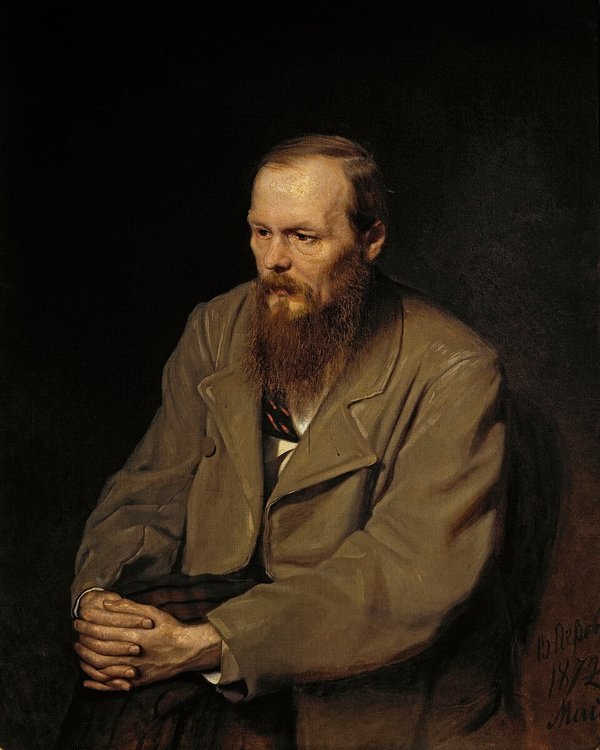
Orthodox Christian, condemned to death and pardoned on the scaffold, he returned from Siberia a critic of the socialism he had embraced and wrote the novels in which ideas are put to the test in the lives of those who defend them. Read the profile of Fyodor Mikhailovich Dostoevsky
Central Theme
Prince Lev Nikolayevich Myshkin, of an old princely family in decline, returns to Russia after more than four years in a sanatorium in Switzerland, where he was treated for a nervous illness similar to epilepsy, and arrives in Petersburg one morning at the end of November, without money, without a post, and without guile. In a single day he enters three houses (those of General Epanchin, of the Ivolgins, and of Nastasya Filippovna Barashkova), and in all of them he is called an idiot. In all of them, too, he finds a negotiation in progress: the rich Totsky wants to buy his freedom to marry for seventy-five thousand rubles, Ganya accepts a bride he despises in exchange for her dowry, the merchant Rogozhin raises the bid from eighteen to a hundred thousand, and Myshkin is the only one who puts no price on anything. The book does not ask whether goodness is desirable; it asks whether it survives where everything has a price, whether the compassion of someone who asks for nothing can save someone who considers herself guilty, and what it costs the one who offers it. The prince disarms almost everyone who approaches him and saves no one, and the story ends with him back in the sanatorium, recognizing no one.
The action runs from the end of November to the beginning of July of the following year, between Petersburg and the summer resort of Pavlovsk. Around the prince are Rogozhin, the son of a merchant who inherits more than two million and pursues Nastasya Filippovna; Nastasya, twenty-five years old, an orphan raised by Totsky and then supported by him, who considers herself guilty of what was done to her and therefore flees from those who treat her as innocent; the Epanchin family, with the youngest daughter, Aglaya, whom the prince goes so far as to ask in marriage before everyone; Ganya Ivolgin, a clerk who wants to make his way through money; the young consumptive Hippolyte, who reads aloud his farewell to the world; and General Ivolgin and the clerk Lebedev, who lie, confess, and lie again before a prince who takes them in.
The Thread That Runs Through the Work
The novel does not ask whether Lev Nikolayevich Myshkin is good; it asks what goodness without calculation achieves in a world where everything has a price, and it answers through what happens to each person he touches. The First Part puts the price on stage: in twenty-four hours nearly everyone appears with a figure in hand, and the woman everyone bargains over is the only one who knows her own worth, because she fixed it by the contempt she feels for herself (Part One, ch. IV, Part One, ch. XV).
Во сто тысяч меня оценил! [...] Да неужто ты меня в свою семью ввести хотел? Меня-то, Рогожинскую!, he valued me at a hundred thousand! [...] Did you really mean to bring me into your family? Me, Rogozhin's woman!
In the middle of this market the prince has no bid. What he has is a habit of looking, that of seeing the suffering in a face before the guilt, which he practiced with Marie in the Swiss village (Part One, ch. VI), and which is the only form of compassion the book shows working in full, among children.
Через них, уверяю вас, она умерла почти счастливая. Через них она забыла свою черную беду, как бы прощение от них приняла, потому что до самого конца считала себя великою преступницей, thanks to them, I assure you, she died almost happy. Thanks to them she forgot her black misfortune, as if she had received forgiveness from them, because to the very end she considered herself a great criminal.
Part Two shows what happens when that compassion meets adults. Rogozhin hears it as superiority (Part Two, ch. III), Burdovsky's group hears it as alms (Part Two, ch. VIII), Hippolyte hears it as an insult (Part Two, ch. X), and the prince names it without circumlocution: he loves Nastasya Filippovna with pity, not with love (Part Two, ch. III).
я ее «не любовью люблю, а жалостью», I love her not with love but with pity.
At the center of the part is the copy of Holbein's Dead Christ, before which, the prince says, someone may lose their faith (Part Two, ch. IV).
на эту картину! Да от этой картины у иного еще вера может пропасть! — Пропадает и то, at this painting! Why, this painting can make someone lose his faith! And Rogozhin: and indeed he does lose it.
Part Three gives this painting to the word of someone who does not believe: in the Explanation, Hippolyte reads in the same dead Christ a nature that grinds up the best it has created (Part Three, ch. VI), and the beauty of the world shows him only the feast from which he is excluded (Part Three, ch. VII). The book does not refute the argument (the shot fails on a technical detail, and the guests laugh), and the only response that suggests itself is the prince's, who recognizes in Hippolyte's fly his own weeping in Switzerland (Part Three, ch. VII).
Природа мерещится при взгляде на эту картину в виде какого-то огромного, неумолимого и немого зверя [...] в виде какой-нибудь громадной машины новейшего устройства, которая бессмысленно захватила, раздробила и поглотила в себя [...] великое и бесценное существо — такое существо, которое одно стоило всей природы и всех законов ее, всей земли, looking at this painting, nature appears as an enormous, implacable, mute beast [...] as some gigantic machine of the latest design, which senselessly seized, crushed and swallowed up [...] a great and priceless being, a being that alone was worth all of nature and all its laws, the whole earth.
Part Four settles the account. Evgeny Pavlovich Radomsky tells the prince that he never loved either of the two women, and the narrator does not contradict him (Part Four, ch. IX); the prince agrees to marry Nastasya Filippovna because, without him, she would die, and loses Aglaya Ivanovna Epanchina at the moment he hesitates before his rival (Part Four, ch. VIII).
Аглая Ивановна любила как женщина, как человек, а не как… отвлеченный дух. Знаете ли что, бедный мой князь: вернее всего, что вы ни ту, ни другую никогда не любили!, Aglaya Ivanovna loved as a woman, as a human being, and not as... an abstract spirit. Do you know what, my poor prince? Most likely you never loved either one of them!
On the last night, compassion no longer has any words, only a hand that strokes the murderer's head (Part Four, ch. XI).
князь протягивал к нему тогда свою дрожащую руку и тихо дотрогивался до его головы, до его волос, гладил их и гладил его щеки… больше он ничего не мог сделать!, the prince then held out to him his trembling hand and gently touched his head, his hair, stroking it and stroking his cheeks... he could do nothing more!
The prince's compassion is well received where those who receive it have nothing at stake against it: the children in Switzerland (Part One, ch. VI), the servant in the antechamber (Part One, ch. II). Where there is a price (Ganya, Rogozhin, the two women), it is read as superiority, as alms or as weakness, and the novel leaves two readings standing: that goodness is defeated by the social machine without being disproved, and that it sees everything and chooses no one, as Radomsky accuses.