About the work
- Author
- Machado de Assis
- Publication
- Serialized in the magazine A Estação (1886-1891); published as a book in 1891
- Genre
- Realist novel
- Setting
- Barbacena, in Minas Gerais, and Rio de Janeiro
- Period
- The Second Reign, from 1867 to the early 1870s
- Narrator
- Third person, with a narrator who comments and talks with the reader
- Protagonist
- Pedro Rubião de Alvarenga, schoolteacher of Barbacena
About the author
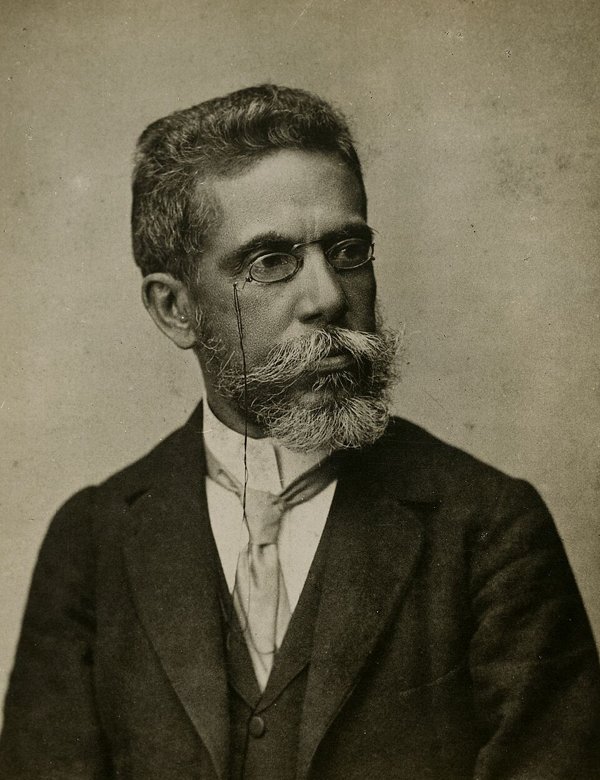
The poor boy from the Morro do Livramento who, almost without leaving Rio, wrote the novels in which the Brazil of the Empire sees itself from within, with irony and without consolation. Read the profile of Machado de Assis
Central Theme
A provincial schoolteacher inherits a fortune and a philosophy he does not understand, and the book shows what money does to him: it gives him a house at Court, dinner guests who eat at his table, a passion for the wife of the friend who guided him, a political ambition he had never had and, finally, the delusion of being Napoleon III. What makes the book last is the way the philosopher's doctrine follows the heir: Rubião does not understand it when he hears it, understands it upon inheriting, and repeats it senselessly as he dies. Between one end and the other, those who make use of him (the partner, the partner's wife, the politician, the dinner guests) abandon him once the money and his reason are gone, and only the dog stays with him to the end. The narrator laughs at these people with a wit that spares no one, and the last chapter invites the reader to choose between weeping and laughing.
The novel is set between 1867, when Rubião, a schoolteacher from Barbacena, nurses the dying philosopher, and the early 1870s, when the Franco-Prussian War brings down Napoleon III, the emperor whose reincarnation Rubião comes to believe himself to be. The philosopher Quincas Borba had already appeared in the Posthumous Memoirs of Brás Cubas, and it is Brás Cubas who writes to Rubião to tell him of the philosopher's death (chapter XIII). On the way to the Court, Rubião meets, on the train that boards at Vassouras station, Cristiano Palha, thirty-two years old, and his wife, Sofia, twenty-seven or twenty-eight (chapter XXI), and it is to this couple that, throughout the book, much of the heir's money and desire goes.
The Thread That Runs Through the Work
Three threads run through the novel from beginning to end, and each can be followed through the chapters in which it appears.
The first is Humanitas and the motto "to the victor, the potatoes." Quincas Borba sets out the doctrine through the death of his aunt, run over by a carriage whose owner was hungry, and Rubião agrees to become a disciple without understanding it (chapter VI). Only on inheriting does he grasp the allegory of the starving tribes and see himself as the victor, to the point of thinking of a signet ring bearing the motto (chapter XVIII). At the end the motto returns without the allegory: Rubião shouts it on arriving in Barbacena (chapter CXCV), repeats it in the sunny morning after the storm (chapter CXCVIII), and dies with his last words leaving it unfinished (chapter CC).
Ao vencido, ódio ou compaixão; ao vencedor, as batatas, To the defeated, hatred or compassion; to the victor, the potatoes
The second is Rubião's money passing to the Palhas. The inheritance arrives through the will (chapter XIV), and Palha, who hears the confidence on the train and, on learning the sum, reflects and asks for discretion (chapter XXI). Rubião puts five contos into the Atalaia (chapter LXI), becomes Palha's partner (chapter LXIX), asks Palha for ten contos, which Palha, holding his securities, yields to (chapter CVIII), and sees Palha dissolve the partnership on the pretext of a bank that did not exist (chapter CXXVIII, chapter CXXIX). While he is confined, Palha collects three contos and two hundred from his assets (chapter CXCI), and Sofia opens the Botafogo salons with a necklace from Rubião's first gifts (chapter CXCII).
assistia aos rombos feitos na caravela, sem temporal, mar de leite, watched the holes made in the caravel, with no storm, sea of milk
The third is the desire for Sofia turning into imperial delirium. The temptation begins in the Botafogo garden (chapter XXVIII) and reaches its declaration under the moon of Santa Teresa (chapter XXXIX, chapter XL). Rubião dreams of a triumphal carriage beside Sofia (chapter CIX), and Sofia recalls the phrase in which he promised to make her empress (chapter CXXV). With Napoleon III's beard (chapter CXLVI), he gets into Sofia's coupé, speaks to her as a lover, and asks her to call him Luís (chapter CL, chapter CLIII). The desire ends in the street, where he walks past gesturing to an invisible empress (chapter CLXXXII), and in death, with the crown only he can see (chapter CC).
espere que ainda a farei imperatriz, I will still make you empress