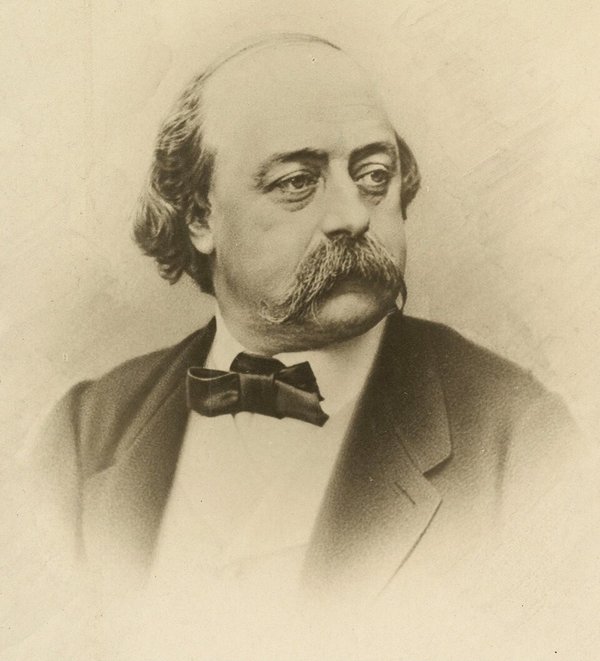
Who He Was
French novelist, son of the chief surgeon of the Rouen hospital. He grew up inside the hospital, abandoned his law studies in Paris after a nervous crisis, and spent most of his life in Croisset, on the banks of the Seine, writing slowly and rewriting endlessly.
Life and Work
Madame Bovary took almost five years of work. It was serialized in the Revue de Paris in 1856, and the author and the editors were prosecuted for offending public morality and religion. Acquitted in early 1857, the book came out in volume form the same year, and the scandal made it a success.
Then came Salammbô (1862), set in ancient Carthage, Sentimental Education (1869), The Temptation of Saint Anthony (1874), and Three Tales (1877). Bouvard and Pécuchet was left unfinished and came out after the author's death, in 1881. Flaubert searched for the exact word, and read his sentences aloud to test them.
Why Read Him
In Flaubert, the narrator disappears and the style does the work. Madame Bovary shows a provincial life from inside the head of someone who dreams of another, and it is from the distance between the dream and the life that the tragedy is born.
Life and Times
Rouen and the Crisis of 1844
Gustave Flaubert was born in Rouen on December 12, 1821, the son of Achille-Cléophas Flaubert, chief surgeon of the city hospital, where the family lived. He studied at the school in Rouen, where he made friendships that lasted his whole life, among them that with the future poet Louis Bouilhet. In 1841 he went to study law in Paris, a course he detested. In January 1844, near Pont-l'Évêque, he had a violent nervous crisis, of a nature that doctors and biographers still debate, and he abandoned the course. From then on he lived on his income from his father's estate, devoted to writing.
The death of his father and of his sister Caroline, in 1846, led him to move with his mother to the house at Croisset, by the Seine, which would be his refuge and his workplace until the end. Between 1849 and 1851 he traveled through Egypt, Palestine, Syria, Turkey, and Greece with his friend Maxime Du Camp. Before leaving, he read the first version of The Temptation of Saint Anthony to Bouilhet and Du Camp; the two found the text excessive and advised him to choose a banal subject and to tell it with discipline.
Madame Bovary and the Trial
Flaubert began Madame Bovary in September 1851 and finished it in April 1856. He worked at night, wrote and rewrote, measured his sentences aloud, and could spend a whole day on a single page. The Revue de Paris serialized it at the end of 1856, with cuts made by the editors. The government of Napoleon III prosecuted the author, the director, and the printer of the magazine for offending public morality and religion. The prosecutor Ernest Pinard made the charge, the lawyer Jules Senard defended, and the court acquitted the defendants in February 1857, with a rebuke to the tone of the book. That same prosecutor had acted that year in the case that convicted Baudelaire for The Flowers of Evil.
His Last Years
Salammbô, a novel of Carthage, came out in 1862, and Sentimental Education in 1869. That year Bouilhet died. In 1870 the Franco-Prussian War brought German soldiers to Croisset, and his mother died in 1872. In 1875 the husband of his niece, also named Caroline and the daughter of the sister he had lost, went bankrupt; Flaubert, who looked after her, sold property to save the family, and he went on living with difficulty. He kept up a friendship and a long correspondence with George Sand, Turgenev, Zola, and the young Maupassant. Three Tales came out in 1877. He died in Croisset on May 8, 1880, of a cerebral hemorrhage, with Bouvard and Pécuchet still unfinished. The book was published in 1881.