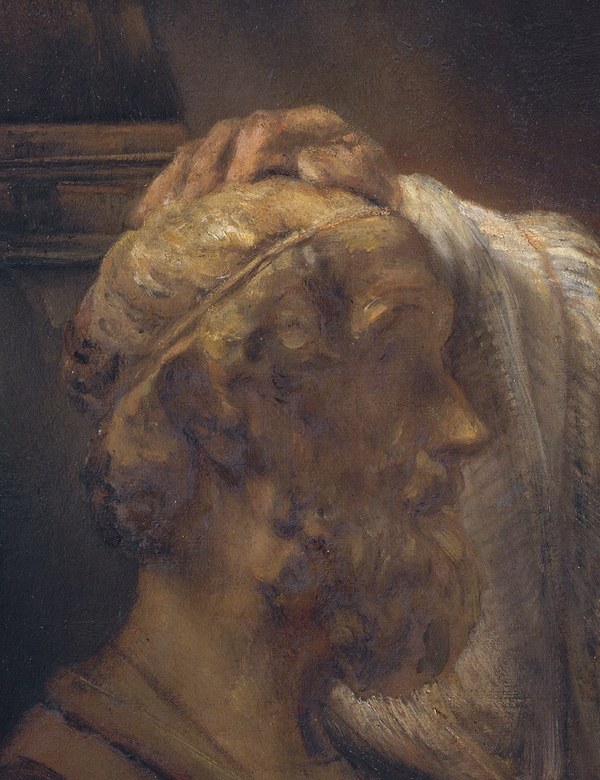
Homer is the name the Greeks gave to the poet of the Iliad and the Odyssey, the two oldest poems in European literature. Almost nothing is known about the person: tradition made him blind and several cities of Asia Minor and the islands, such as Smyrna and Chios, disputed his birthplace, and scholars place him around the eighth century BCE, several centuries after the war the poems narrate. Both poems are composed in hexameters, in a literary language that mixes dialects, above all Ionic, and that nobody spoke in everyday life, and they bear the marks of a long tradition of oral poetry: repeated epithets, typical scenes, whole lines that return unchanged. Whether they are the work of one poet, of two, or the written close of centuries of recitation is the so-called Homeric question, which remains open. For the Greeks, what mattered less was who he had been than the use made of him: Homer was the schoolbook, the source of the myths that tragedy rewrote, and the model Virgil imitated to give Rome its epic. According to Plato, Homer's admirers said he had educated Greece, and it was because of that power that Plato left him outside his ideal city.
Who He Was, and When: The Homeric Question
Aristotle: The Divine Poet, Through the Unity of Action
The Poetics uses the two poems as example material throughout the treatise. The central praise concerns construction: Homer did not try to tell the whole war, he carved out a single action.
διὸ ὥσπερ εἴπομεν ἤδη καὶ ταύτῃ θεσπέσιος ἂν φανείη Ὅμηρος παρὰ τοὺς ἄλλους, τῷ μηδὲ τὸν πόλεμον καίπερ ἔχοντα ἀρχὴν καὶ τέλος ἐπιχειρῆσαι ποιεῖν ὅλον(1459a), so, as we said already, Homer would seem divine in comparison with the others, for not attempting to compose the whole war, even though it had a beginning and an end.
It is the same carving that the reading of the Iliad takes as its thesis, the wrath of Achilles in the tenth year, and not the war (Iliad). And the virtue Aristotle names as his alone is that of disappearing as a narrator:
αὐτὸν γὰρ δεῖ τὸν ποιητὴν ἐλάχιστα λέγειν· οὐ γάρ ἐστι κατὰ ταῦτα μιμητής(1460a), for the poet himself should say as little as possible; in that respect he is not an imitator.
In the opening chapters, Homer is still the hinge of the genres: the Iliad and the Odyssey stand to tragedy as the Margites, a comic poem now lost, stands to comedy (Aristotle, Poetics, chs. 1-5). But the divine loses at the end of the book, and this is often forgotten:
φανερὸν ὅτι κρείττων ἂν εἴη μᾶλλον τοῦ τέλους τυγχάνουσα τῆς ἐποποιίας(1462b), it is evident that it would be superior, by achieving its end more fully, to epic.
Plato: The Lawgiver Who Never Legislated
In the Republic, Homer is the target of the educational reform. Books II and III cut the gods who change shape and lie, the heroes who weep, and the terrifying Hades; Book X returns with the underlying argument, first confessing a childhood affection for the poet. The accusation is not aesthetic but one of competence: if Homer had known about war and government, some city would owe him its laws.
That is, he imitates the appearance of an appearance, not the thing itself, and so "does not know" what he represents, unlike the craftsman (who knows how to make) and the user (who knows how to use and is the one who truly understands the object). Socrates challenges Homer's prestige directly: if he had truly known about war, government, and education, he would have left some city better governed (as Sparta owes to Lycurgus) or disciples who inherited his method (as Pythagoras had). None of this exists.What state names you as a good lawgiver who came to its aid?(599d-e)
Plato did not invent the complaint. The pre-Socratic philosopher Xenophanes had already accused Homer of attributing theft, adultery, and deceit to the gods (Tom Holland, Dominion, ch. I).
Auerbach: The Style Without a Background
In the first chapter of Mimesis, the scene in which the nurse recognizes Odysseus by his scar, in Book XIX of the Odyssey, is set against the sacrifice of Isaac in Genesis 22. Homer illuminates everything:
Homer, however, and we shall have to come back to this, knows no background. What he narrates is for the time being the only present, and fills both the stage and the reader's mind completely.[p. 11]
And the consequence that matters here is that of the claim to truth. Homer wants to please; the biblical text wants to be believed, and excludes any rival:
The claim to truth of the two texts also diverges: Homer seeks to please, the Bible demands belief, because the sacred order of life rests on the truth of that story.The Bible's claim to truth is not only far more urgent than Homer's, it is tyrannical; it excludes every other claim[p. 19]
Carpeaux: The Bible That Became Literature
The critic Otto Maria Carpeaux supplies the missing piece to put the three at the same table: for the Greeks, Homer was not a debatable poem, he was what the Bible would later be for Christians.
For the ancient Greeks, Homer was not a debatable literary work but a closed norm:
For the ancients, Homer was not a literary work, required reading for students and an object of critical discussion among men of letters. [...] Homer was beyond dispute: but not as an epic, rather as a Bible. He was a Code.
Only for the modern reader does Homer become, on the contrary, a "symbol of a great literary work":
For the rest of us, Homer can be nothing other than a symbol of a great literary work, purely literary and open to discussion.