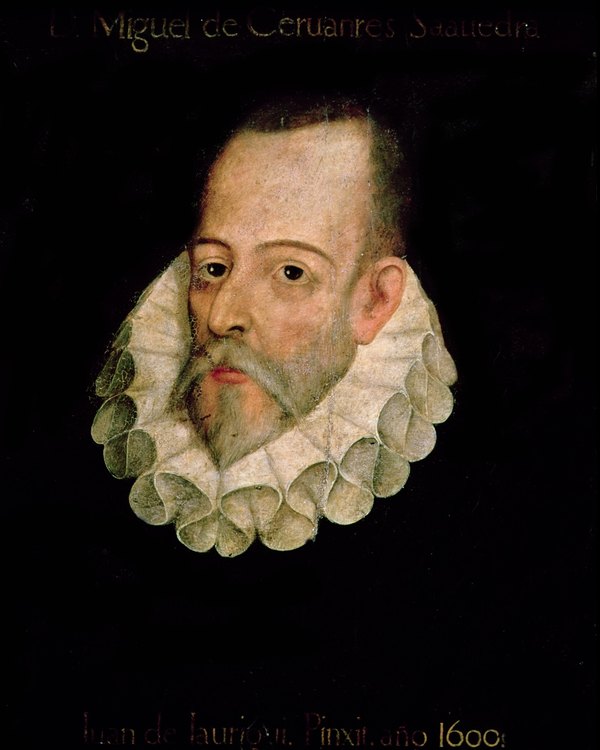
Who He Was
Spanish novelist, playwright, and poet, most likely born in 1547 and died in Madrid in 1616, author of Don Quixote de la Mancha, published in two parts, in 1605 and 1615. A soldier wounded at Lepanto, a captive in Algiers, and always short of money, he wrote the book after turning fifty and made it the landmark of the modern novel.
Life and Work
He served Philip II in Italy, lost the use of his left hand at Lepanto (1571), and was a slave in Algiers from 1575 to 1580. He returned to a life of hardship, tax collecting, and prison. He wrote plays and Galatea, but he only achieved success in 1605, with the First Part of the Quixote. The Exemplary Novels date from 1613, and the Second Part, from 1615, was written partly against the forgery by Avellaneda.
Why Read Him
Cervantes is read as the last of the Spanish Erasmians, a "miles christianus" out of his time, in a Spain that had already traded the universalism of Erasmus for the Machiavellianism of the state. His book has been called the "novel of novels" because the contrast between appearance and reality is the very substance of the genre. The reader's sympathy for a gentleman who is wrong cannot be explained by satire alone, and that is why the Quixote won two families of readers: children, who do not yet know life, and others, harshly tested by it. Whoever reads it to the end sees the tone change, from the irony of the first chapters to the disillusion of the last.
The Soldier and the Captive
The son of a poor surgeon, he was most likely born in 1547 and spent his childhood moving from city to city, among Valladolid, Córdoba, Seville, and Madrid. He was a soldier for Philip II, served in Italy in 1570, and in 1571 fought in the naval battle of Lepanto, from which he emerged wounded, with his left hand disabled for the rest of his life and the nickname "the One-Handed Man of Lepanto." In 1575, on his return from Italy, Algerian pirates captured him, and he spent five years as a captive in Algiers, until his ransom in 1580, paid, like that of so many other Christian prisoners, by one of the religious orders that lived by freeing captives. He tried to escape several times and did not succeed.
Debts, Tax Collection, and Prison
Back in Spain, he spent the rest of his life struggling with money, and he was imprisoned twice. He had written some plays and Galatea, a pastoral novel, when in 1592 he offered to deliver six plays for fifty ducats each. He worked as a tax collector and was jailed in Seville in 1597 and 1598 for mismanagement of that office. In the prologue to the First Part, he says his book was "engendered in a prison," and it is likely that he is referring to that confinement.
The Book, the Rival, and Death
Don Quixote was published in Madrid between late December 1604 and early 1605, in a hurried printing, and it was an immediate popular success. In 1613 came the Exemplary Novels. In the autumn of 1614, while he was writing chapter LIX of the sequel, a second, forged volume was published in Tarragona, signed by Alonso Fernández de Avellaneda, the name of a writer who never identified himself. Cervantes answered him in the prologue and inside the story itself, where the gentleman changes course only to disprove him. The Second Part appeared in 1615, dedicated to the Count of Lemos, who protected him, with the promise of a new novel, The Trials of Persiles and Sigismunda. He died in Madrid in 1616.