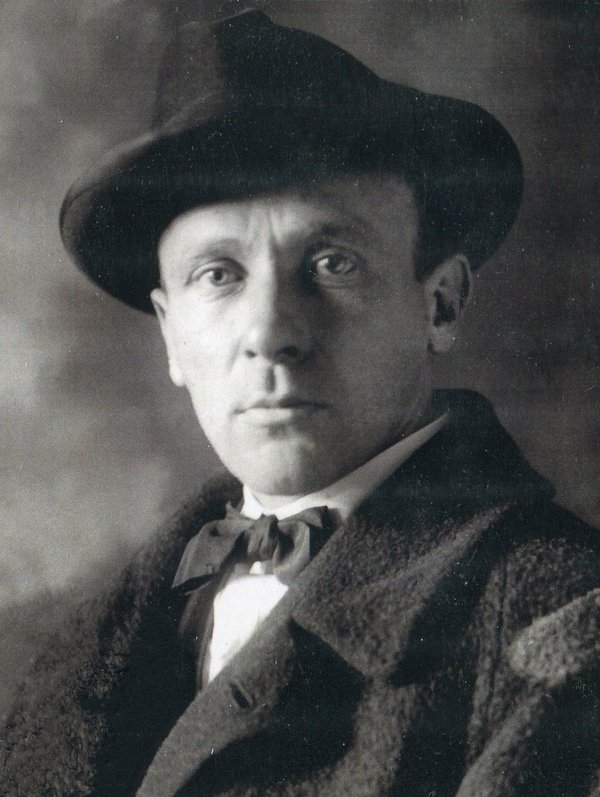
Who He Was
Russian writer and playwright, born in Kiev, son of a professor of theology. He trained in medicine and worked as a country doctor before giving up the profession for literature. He lived and wrote under the Soviet regime, which never let him publish what he considered his main work.
Life and Work
In the 1920s he published The White Guard, about Kiev during the civil war, and wrote Heart of a Dog, a satire that would only be published in the Soviet Union in 1987. The stage adaptation of The White Guard, The Days of the Turbins, was a success at the Moscow Art Theatre. At the end of the decade his plays were taken off the stage. In 1930 he wrote to the government asking either to emigrate or to be given work; he received a telephone call from Stalin himself and obtained a post at the theater.
He worked on The Master and Margarita from 1928 until his death, dictating the final corrections to his wife, Elena Sergeyevna, who was already ill. The novel only came out in 1966 and 1967, in a Moscow magazine and with cuts; the full version appeared years later.
Why Read Him
Bulgakov combines satire, fantasy, and tragedy in the same book. The devil visits the Moscow of the 1930s and only exposes what was already there, while the novel within the novel returns to Jerusalem, to Pilate, and to cowardice.
Life and Times
Kiev, Medicine, and the Civil War
Mikhail Afanasyevich Bulgakov was born in Kiev on May 15, 1891 (May 3 by the Russian calendar of the time), the eldest of seven children. His father, Afanasy Ivanovich, taught at the city's theological academy and died in 1907. Bulgakov studied medicine at the University of Kiev and graduated in 1916, in the middle of the First World War. He served in field hospitals and then as the only doctor in a village in the province of Smolensk, in western Russia, an experience that later became the stories of A Young Doctor's Notebook. In those years he became dependent on morphine, an addiction he overcame.
The Revolution of 1917 found him still a doctor in the province of Smolensk. In 1918 he returned to Kiev, and the civil war caught him there, in a city that changed hands several times between 1918 and 1920. He was mobilized as a doctor by the White Army, which fought the Bolsheviks, and fell ill with typhus in the North Caucasus; when the Bolshevik regime took hold, he decided to give up medicine. This world of Kiev in upheaval, seen by a cultured family of teachers, gave rise to The White Guard.
Moscow, Censorship, and Stalin
He arrived in Moscow in 1921, penniless, and for years lived in a communal apartment on Bolshaya Sadovaya Street, an address that reappears in the novel. He supported himself as a journalist, above all for the railway newspaper Gudok. In 1925 The White Guard came out in a magazine, along with the novella The Fatal Eggs. In 1926 the political police searched his apartment and confiscated his diaries and the manuscript of Heart of a Dog. That same year The Days of the Turbins, the stage adaptation of The White Guard, premiered, and Stalin saw it several times. From 1929, as censorship over theater and literature tightened, all his plays were banned.
In March 1930 he wrote a letter to the Soviet government: either they let him leave the country, or they gave him work in the theater. Stalin telephoned him in April, and Bulgakov began to work at the Moscow Art Theatre, later as a librettist for the Bolshoi, without publishing again what mattered most to him. In 1932 he married Elena Sergeyevna.
A Novel of a Lifetime
He began The Master and Margarita around 1928. In March 1930, at the worst moment of the bans, he burned the manuscript, and from 1931 he rewrote it, revising it until the end of his life. The hereditary kidney disease that had killed his father was diagnosed in 1939. Ill, he dictated the final corrections to Elena. He died in Moscow on March 10, 1940, at the age of 48, and was buried in the Novodevichy Cemetery. The first publication was in 1966 and 1967, in the magazine Moskva, with cuts by the censors, more than a quarter of a century after the author's death.