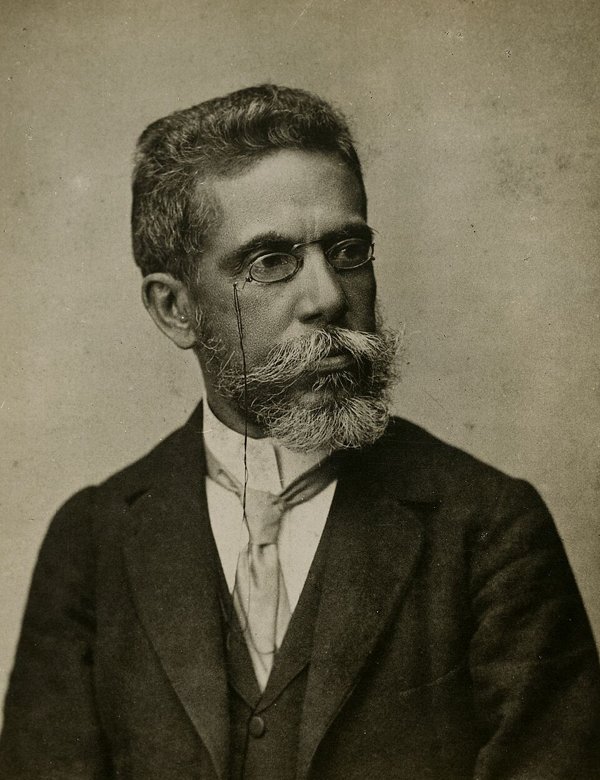
Who He Was
He was born in the Morro do Livramento, in Rio de Janeiro, the son of a house painter and of a washerwoman from the Azores, and he lost his mother as a boy. He did not attend university: he learned the trade of typesetter, moved on to proofreading and journalism, and built a career as a civil servant in the Ministry of Agriculture. He married Carolina Augusta Xavier de Novais in 1869, a companion of thirty-five years. In 1897 he founded the Brazilian Academy of Letters and was its first president. He died in Rio in 1908, four years after his wife, having scarcely ever left the city.
The Work
He wrote everything: poetry, theater, chronicles, criticism, about two hundred stories and nine novels. The first novels follow the taste of the time; from The Posthumous Memoirs of Brás Cubas, of 1881, comes the phase that made him famous, with Quincas Borba, Dom Casmurro, Esau and Jacob, and Counselor Ayres' Memorial, along with the stories and novellas such as The Psychiatrist.
Why Read Him
Machado writes about the society of Rio in the Second Reign, but what interests him is what moves people beneath good manners: interest, vanity, the fear of losing one's place. The narrator talks with the reader, uses irony, interrupts himself, and leaves to each reader the task of judging what he has seen. Quincas Borba shows an honest and naive man who inherits money and a philosophy and is devoured by his friends; The Psychiatrist shows a science that, confident in its own method, ends up committing the whole town to an asylum.
Life and Times
Morro do Livramento and Printing
Joaquim Maria Machado de Assis was born on June 21, 1839, in the Morro do Livramento, in Rio de Janeiro, then the capital of the Empire and a slaveholding city. His father, Francisco José de Assis, was a painter and gilder, a descendant of freed people. His mother, Maria Leopoldina Machado, was Portuguese, from the Azores. She died when the boy was small, and he had little formal schooling and made his way largely on his own. He worked as an apprentice typesetter and in the world of bookshops, in particular at the printing house of Francisco de Paula Brito, where a group of young writers gathered. His first printed poem came out in 1854, when he was fifteen.
He moved on to proofreading and writing for newspapers such as the Rio de Janeiro Daily, and wrote criticism, theater, chronicles, and poetry. He published Crisálidas in 1864, the Contos fluminenses in 1870, and his first novel, Resurrection, in 1872, followed by The Hand and the Glove, Helena, and Iaiá Garcia. In 1867 he received a public post. In 1869 he married Carolina, a Portuguese woman born in Porto. In 1873 he began to serve in the Secretariat of Agriculture, a career he continued under the Republic.
The Change of 1880 and the End of the Empire
At the end of the 1870s an illness kept him away from work for months. He returned with a different kind of writing. The Posthumous Memoirs of Brás Cubas came out in the Revista Brasileira in 1880 and in book form in 1881, with a dead narrator who mocks the reader and his own class. The same register runs through the stories of Loose Papers (1882), among them The Psychiatrist, and through Quincas Borba, published in serial form in the magazine The Season between 1886 and 1891, with Humanitism, the philosophy invented by the character who gives the book its name, and the fate of Rubião, the provincial who inherits money and is devoured by his friends.
The country was changing around him. The Free Womb Law came in 1871, the abolition of slavery on May 13, 1888, and the proclamation of the Republic on November 15, 1889. Machado, a discreet civil servant, dealt with slavery and politics mainly through the irony of his chronicles and novels, not through speeches. He preferred to record, with irony, what people do to keep their place and their good image.
The Last Years
In 1897 he led the creation of the Brazilian Academy of Letters and presided over it until his death. He published Dom Casmurro in 1899, Esau and Jacob in 1904, and Counselor Ayres' Memorial in 1908. Carolina died on October 20, 1904, almost thirty-five years after the marriage, and he wrote a farewell poem to her. He died in Rio on September 29, 1908, with public tributes.