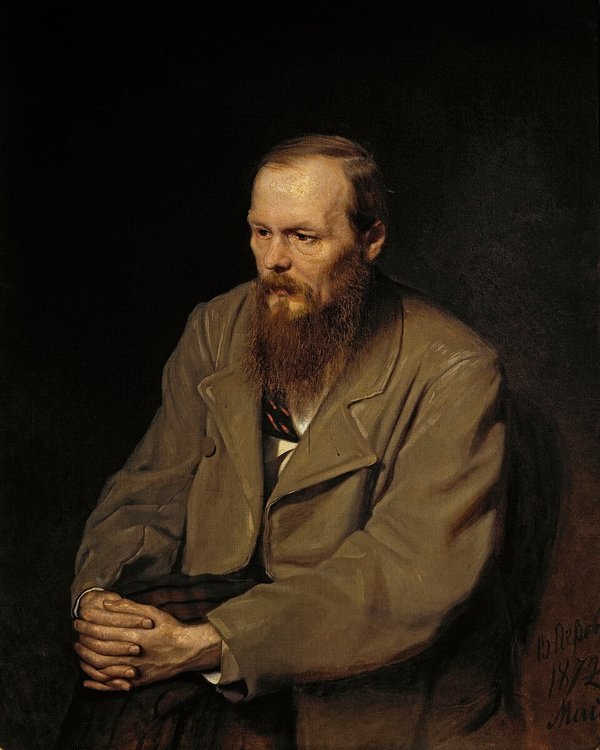
Who He Was
Russian novelist and Orthodox Christian, the son of a doctor from Moscow. In his youth he took part in the circle of Petrashevsky, which discussed French socialism and the emancipation of the serfs, and for that reason he was sentenced to death in 1849; the sentence was commuted at the last moment to four years of hard labor in Siberia. From 1849 on he became a critic of the socialism and rationalism he had embraced, returned from Siberia with his faith reaffirmed, and lived the rest of his life in debt, epileptic, and writing against the clock.
Life and Work
After a celebrated debut with Poor Folk (1846), he lived through prison, Siberia, and military exile until 1859. In the 1860s he ran magazines with his brother, lost his first wife and his brother in the same year, and wrote Notes from Underground (1864). The great novels came next: Crime and Punishment (1866), The Idiot (1868-1869), Demons (1871-1872), The Adolescent (1875), and The Brothers Karamazov (1879-1880). His second wife, Anna Grigoryevna, pulled him out of debt and saw him give up gambling. He died in 1881, celebrated as the moral voice of the country.
Why Read Him
Dostoevsky does not write novels of thesis: he puts ideas into the body of those who defend them and follows them to their final consequences. The student who kills for a theory, the prince too good for the world, the revolutionaries who put the cause in God's place, the brothers who argue over whether everything is permitted: each idea is put to the test in a life, and the reader sees what it does to the one who carries it.
Moscow and His Formation (1821-1843)
He was born on October 30, 1821, in a hospital for the poor in Moscow where his father, Mikhail Andreyevich, was a doctor. His paternal grandfather had been a priest in Ukraine, and his father, a former seminarian, won hereditary nobility in 1828 through length of service: the family gained a title but remained without land of weight and without aristocratic blood. The household was devout, of Orthodox Christian faith, and the boy learned to read from the sacred stories. Still almost a child, he came to know the Book of Job, which he would later say had marked him forever, and at ten, The Robbers, by Schiller, which left traces in his books until the end.
His mother died of tuberculosis in 1837, and in the same year his father took the two eldest sons to St. Petersburg, where Fyodor entered the Military Engineering Academy. On the journey he saw a government courier beat the peasant coachman, a scene he kept for the rest of his life. In 1839 his father died on the family estate: the official cause was apoplexy, and the rumor that the serfs had killed him was never proven. At the Academy, Dostoevsky read the German Romantics and the French social novelists, Balzac, Hugo, and George Sand, without ever choosing between the inner quest of some and the compassion for the poor of others. He graduated in 1843, published the following year a translation of Eugénie Grandet, by Balzac, and left military service to live by writing.
Poor Folk and the Petrashevsky Circle (1844-1849)
His first novel, Poor Folk, came out in January 1846 and made him a celebrity overnight: the critic Vissarion Belinsky greeted it as the first social novel of Russia. The glory did not last. The Double, published weeks later, was received coldly, the colleagues of the magazine mocked the vanity of the debutant, and in 1847 he broke with Belinsky, over a personal quarrel and over the critic's rejection of his faith. Even then he suffered from nervous crises, which a doctor friend had treated years before any diagnosis.
In 1847 he began to attend the Friday meetings of Mikhail Petrashevsky, the so-called Petrashevsky circle, which discussed French socialism and the emancipation of the serfs, and within it he joined a smaller and more radical group, around the aristocrat Nikolai Speshnev, which planned to set up a clandestine printing press. A police agent who had infiltrated the group recorded the last meetings. In the early hours of April 23, 1849, days after reading aloud Belinsky's forbidden letter to Gogol, he was arrested with the other members. According to Simon Sebag Montefiore, they first took him to the Fontanka, the seat of the political police, where the police chief, Alexei Orlov, inspected the prisoners before sending them on to the fortress.
The Scaffold, Hard Labor, and Faith (1849-1859)
He spent eight months imprisoned in the Peter and Paul Fortress. In November, fifteen of the accused were sentenced to be shot; Tsar Nicholas I commuted the sentences, but ordered that the commutation be announced only at the last moment. On December 22, 1849, in Semyonovsky Square, the condemned men put on their shrouds, the first three were tied to the posts, and only then did the roll of drums announce the pardon. Dostoevsky, a former officer, recognized the signal before the others; one of the companions went mad right there. The ceremony was overseen, as commander of the Guard, by the heir to the throne, the future Alexander II, and the mock execution had been conceived by Nicholas himself. That night he wrote to his brother that life was a gift and that he would be reborn. His sentence was four years of hard labor, followed by service as a common soldier.
On the road to prison, at Tobolsk, the wives of exiled Decembrists gave the condemned men a copy of the New Testament, the only book allowed in the prison, and Dostoevsky kept it until his death. From 1850 to February 1854 he served his sentence in Omsk, among prisoners almost all of them peasants who hated the nobles. There he lost his hope that the people would follow a revolution made by intellectuals, and there, through stages he would tell only more than twenty years later, he changed his view of the prisoners: the memory of a muzhik who had consoled him in childhood, Marei, dissolved the hatred he felt for them. It was also in Omsk that the first unmistakable crises of the illness that would accompany him to the end appeared.
From 1849, with the arrest and the years in Siberia, he ceased to be one of the socialists of the circle and became a critic of socialism and revolutionary rationalism, a position he would hold to the end in his novels and journalism. On leaving prison, he wrote to Natalia Fonvizina, one of those women, a profession of faith that is the key to almost everything he wrote afterward: if they proved to him that Christ was outside the truth, he would prefer to stay with Christ rather than with the truth. In March 1854 he was enlisted as a soldier in Semipalatinsk, where he fell in love with Maria Dmitrievna Isaeva, the wife of an alcoholic civil servant. She was widowed in 1855, and the two married in February 1857. On the return from the wedding he had a crisis, and the doctor diagnosed it as epilepsy. Rehabilitated, he published in 1859 two comic novellas, The Uncle's Dream and The Village of Stepanchikovo and Its Inhabitants, and in December of that year he returned to St. Petersburg, ten years after his arrest.
Magazines, Underground, and Losses (1860-1865)
With his brother Mikhail he launched in 1861 the magazine Vremya, which advocated the reconciliation of the Europeanized elite with the people and their faith, a program that came to be called a return to the soil (pochvennichestvo). In it appeared The Insulted and Humiliated and Notes from the House of the Dead, the account of the prison. In 1862 he made his first trip to Europe, from which he returned with Winter Notes on Summer Impressions, an attack on the bourgeois society symbolized by the Crystal Palace in London. In the following years he had an affair with the young writer Apollinaria Suslova and began to play roulette in German casinos, a vice that would ruin him for almost a decade.
The year 1864 was one of losses. Vremya had been banned in 1863 over an article on the Polish revolt, and the new magazine, Epokha, was born in debt. In April Maria Dmitrievna died of tuberculosis; in July, his brother Mikhail, whose debts he assumed. In the same year Notes from Underground came out, a response to the utopian novel What Is to Be Done?, by Chernyshevsky, cut by the censors precisely in the passages where they concluded that faith in Christ was necessary. Epokha went bankrupt in 1865. Indebted, he signed with the publisher Stellovsky a contract that would take from him for nine years the rights to everything he wrote if he did not deliver a new novel by November 1, 1866. He lost in the Wiesbaden roulette the little he had for the trip, and it was from there, with no money to pay the hotel, that he proposed to the magazine The Russian Messenger the story of a student who kills a moneylender.
Crime and Punishment, Anna, and the Years in Europe (1866-1871)
Crime and Punishment ran in serial form through 1866 and was the book of the year. To fulfill at the same time the contract with Stellovsky, he hired in October a twenty-year-old stenographer, Anna Grigoryevna Snitkina, and dictated to her The Gambler in less than a month; he handed in the manuscript with two hours to spare. They married in February 1867, and Anna took charge of the finances, of his health, and, after his death, of his work. Fleeing from creditors, they set out in April on a three-month trip that lasted four years: Dresden, Baden-Baden, Geneva, Florence. He lost at play what they had, and she pawned the jewelry and the coat.
In Basel he saw Holbein's The Body of the Dead Christ in the Tomb, which reappears in The Idiot, the novel in which he tried to portray a wholly beautiful man. In Geneva the first daughter, Sofia, was born and died within three months (1868). The Idiot came out in 1868 and 1869, and the murder of a student in Moscow by the revolutionary group of Sergei Nechayev, in November 1869, gave rise to Demons. In April 1871 he gambled for the last time, and he never returned to the roulette table. In July the family returned to St. Petersburg.
The Diary and Fame (1871-1878)
Back home, the couple published Demons in volume form at their own expense (1873), the beginning of the small family publishing house that Anna ran. For a little over a year he edited The Citizen, a conservative weekly of Prince Meshchersky, where he opened the column A Writer's Diary. In 1875 he published The Adolescent in the radical magazine Notes of the Fatherland, where the populist critic Mikhailovsky, his adversary, also wrote, and in 1876 he turned the Diary into a monthly publication written by himself alone, which earned him a fame no novel had given him. There he defended Russia's Christian mission and the cause of the Slavs of the Balkans, and there too is the most explicit anti-Semitism of his work. The Citizen was also his entrance door to the court: the heir to the throne was a discreet founder of the newspaper, and Meshchersky introduced him to Konstantin Pobedonostsev, a reactionary close to the heir, with whom Dostoevsky became friends and argued on Saturday nights. In May 1878 his son Alyosha, almost three years old, died of an epileptic seizure; Dostoevsky then visited the Optina Monastery, and the consolation he heard from Elder Ambrose became a scene in The Brothers Karamazov.
Karamazov, Pushkin, and Death (1879-1881)
The Brothers Karamazov ran in serial form from the beginning of 1879 and ended in November 1880. In the winter of 1880, amid attempts on the tsar's life, he returned to Semyonovsky Square as a spectator at the hanging of the young man who had shot at Minister Loris-Melikov, and he agreed with the editor Suvorin not to report to the police a conspiracy of terrorists. In June 1880, at the festivities for the unveiling of the Pushkin monument in Moscow, he gave the speech on the universal vocation of the Russian people that drove the audience wild. In his last years Pobedonostsev introduced him to the heir, who admired Crime and Punishment, and Tsar Alexander II invited him to lecture to the younger grand dukes, Sergei and Paul, and to their cousin Konstantin Konstantinovich, a poet and friend of his: the man condemned in 1849 died welcomed by the imperial family that had condemned him. He died in St. Petersburg on January 28, 1881, of a pulmonary hemorrhage, after opening the New Testament from Tobolsk at random and asking Anna to read the first passage. The funeral procession, with sixty-seven delegations, took two hours along Nevsky Prospect to the Alexander Nevsky Monastery, where he is buried. A month later, Tsar Alexander II was assassinated by terrorists.