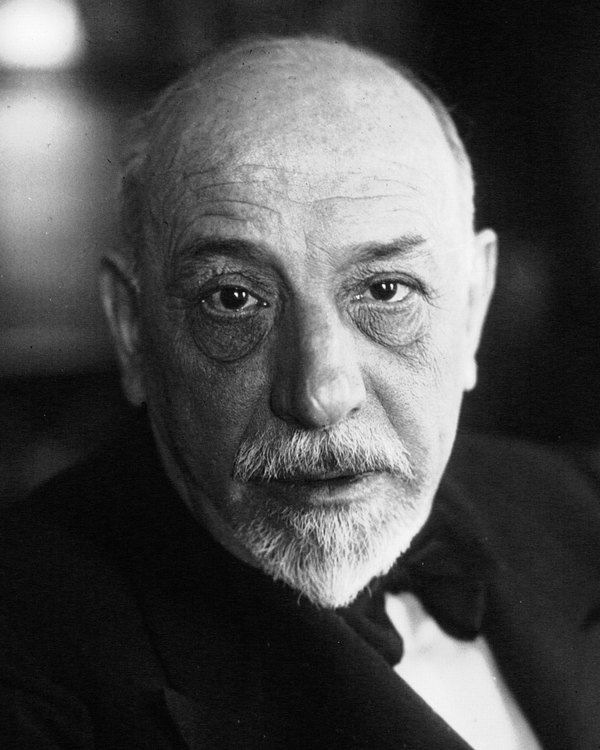
Who He Was
Italian novelist, short story writer, and playwright, born in Sicily in 1867 and died in 1936, author of The Late Mattia Pascal, Six Characters in Search of an Author, and One, No One, and One Hundred Thousand. A Nobel Prize winner in Literature in 1934, he made human identity the sole subject of a body of work that runs from the Sicilian regional novel to the theater and the modern novel.
Life and Work
The son of a family that lived off a sulfur mine, he studied letters and philosophy in Rome and in Germany, married by arrangement, saw the mine flood and the family grow poor, and began to live by journalism and teaching in Rome. He wrote Sicilian stories and novels, among them The Late Mattia Pascal, and achieved fame in the theater with Six Characters in Search of an Author (1921). One, No One, and One Hundred Thousand, his last novel, occupied him between 1916 and 1926.
Why Read Him
Pirandello has only one subject, the question of who we are, and he remakes it in every form he uses. He continues the Sicilian naturalism of Verga to the point where the character no longer has an identity card, and for this reason he is said to have destroyed the état civil that Balzac had introduced into literature. In One, No One, and One Hundred Thousand the question is asked with humor and without a way out: a man's whole life comes undone in a single remark by his wife about his nose.
The Sulfur Mine and Education
He was born in 1867 in a Sicilian village called Caos, into a middle-class family that lived off a sulfur mine. His father wanted him as his successor in the business, but Pirandello had no vocation for it. He convinced his family that it was pointless to insist and went to study letters and philosophy, first in Rome and then in Germany, to which he moved with a letter of introduction after a dispute with a Roman professor. In Germany he built the education that would mark him, translated Goethe's elegies into Italian, and began to write.
Marriage, Disaster, and the Craft
Back in Italy, he married by arrangement, in the Sicilian fashion, a woman he had never seen before the wedding, Maria Antonietta, and they had three children, none of whom followed literature. Soon after, a flood inundated the mine and rendered it useless forever. His father went bankrupt, and the family suddenly fell into poverty. His wife, who already had a fragile mental state, worsened with the disaster. Pirandello began to live off journalism and teaching, instructing in Italian language and stylistics at a women's college in Rome, the Istituto Superiore di Magistero Femminile, and writing in the hours that remained.
From Verga's Sicily to the Theater
His first stories and novels, such as The Outcast and The Turn, recount regional cases with Sicilian types, along the path opened by Verga, and the characters who matter in them are the misfits and the lonely, the ones who learn early to watch themselves living. From that phase comes The Late Mattia Pascal, in which a man reported dead abandons his own name and tries to live under another, without success. Literary prestige came only after he turned fifty, and it was the theater that made him famous: Six Characters in Search of an Author premiered in 1921, provoked a hostile reaction from the audience, and established itself as a classic in later performances, in Milan. The last novel, One, No One, and One Hundred Thousand, was worked on between 1916 and 1926.
Fascism and the Final Years
He drew close to Mussolini's regime, which had promised him a theater in Rome, and joined the Fascist Party out of convenience. His reputation as a sympathizer with the regime followed him afterward, although there is no defense of any ideology in his work. In December 1927, passing through Rio de Janeiro with the tour of the Teatro d'Arte di Roma, he said in an interview that he was not an author of farces but of tragedies. He received the Nobel Prize in Literature in 1934 and died in 1936.