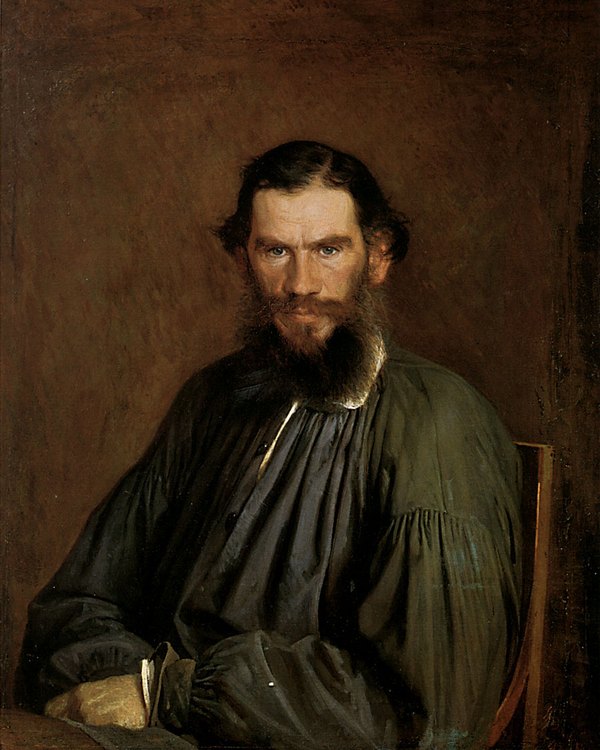
Who He Was
Russian novelist, count, and landowner in Yasnaya Polyana, author of War and Peace and Anna Karenina. In his maturity he broke with the Orthodox Church and repudiated his own fiction, and he spent the rest of his life preaching a Christianity without a Church and trying to live it. He was excommunicated in 1901 and died in 1910, at Astapovo station, during his final flight from home.
Life and Work
He inherited the estate while still young, served in the Caucasus and the Crimea, and opened peasant schools in 1859. War and Peace was serialized from 1865 and published in volume in 1869, and Anna Karenina appeared between 1873 and 1877. The religious crisis of the late 1870s produced A Confession (1882) and the novella The Death of Ivan Ilyich (1886), the first major fiction he published after deciding to abandon fiction. The second half of his life was that of Tolstoyism, the practical Christianity without dogma that earned him a following, excommunication, and the reputation of second tsar of Russia.
Why Read Him
Tolstoy writes with his whole life in his hands and with a moral judgment he never sets down. War and Peace interweaves private and public stories, of peace and of war, to the point that critics put it alongside the Homeric epic. Anna Karenina places two marriages side by side and invites the reader to argue with the author. The Death of Ivan Ilyich shows, in an ordinary man, what death reveals about the life that came before it. Tolstoy himself is part of the lesson: his great art is inseparable from the weaknesses of his ideology, and he did not find the truth of his life, but immortalized it in art.
Inheritance and Youth (1828-1859)
He was born in 1828 in Yasnaya Polyana, in the Tula region, the son of Count Nikolai Tolstoy and Countess Maria Volkonskaya. He lost his mother at two and his father at nine, and while still young he inherited the estate, along with the serfs who lived on it. The land came to him from his mother's side, and her family would enter his work: his maternal grandfather, Nikolai Volkonsky, is the basis of the old Prince Bolkonsky in War and Peace, and the Decembrist Sergei Volkonsky, a relative of his, is the model for Prince Andrei.
Raised without formal religion, like most writers of the Russian elite, he went through a religious crisis as a boy and then through the youth of an aristocrat of gambling and debt, in a dissipation typical of his class. He served as an officer in the Caucasus, where he saw up close the way of life of the Cossacks that he would later put into a book, and he fought in the Crimean War. The contradiction was already there, and critics place it at the center of his life and work: the biological affirmation of life against its ethical negation.
Schools, Land, and War and Peace (1859-1869)
In 1859 he opened peasant schools in Yasnaya Polyana. He tried to work his own land like a muzhik and failed at the most basic tasks, and he even proposed to the schoolchildren that they divide the estate in common. That same year he met Sergei Volkonsky, already old, and described him to Herzen as an enthusiast, a mystic, and a Christian, with lofty ideals for the new Russia.
War and Peace began as a novel about the Decembrists of 1825. Tolstoy went back to 1805 and 1812 to understand where that generation came from, and the book was serialized in The Russian Messenger beginning in 1865 and published in volume in 1869. In 1868, signing as a count, he defended the form of the work in a short essay of six points, responding to the criticism the first part had received. The book runs two machines at once, the novel of three families between 1805 and 1820 and a thesis on the causes of historical events, and critics placed it alongside the Homeric epic.
Arzamas, Anna Karenina, and the Crisis (1869-1879)
In 1869, on a business trip, he lived through the so-called Night of Arzamas, an episode of mystical terror that is taken as the beginning of his spiritual turn. In 1862, before War and Peace, he had married Sofya Behrs. Anna Karenina, begun in 1873, was serialized in The Russian Messenger between 1875 and 1877, and the editor Katkov paid 500 rubles per folio for it, twice what Nekrasov had offered Dostoevsky at the same time. The novel alternates two plots, that of Anna, who sinks, and that of Levin, who rises. It is common to read Levin as the author's alter ego. That Tolstoy's thinking about land, work, and faith should come out of his mouth is defensible, but saying that Levin is Tolstoy erases the ridicule to which the novel subjects him.
In the late 1870s he visited the Optina monastery, where he met the elder Ambrose, the same man Dostoevsky had sought out in 1878. The date of the religious crisis that followed varies depending on who tells it: 1878 for some, 1879 for others. Some see it not as a sudden conversion but as a constant search for faith from an early age, around a simple idea, that God is love and where there is love there is God.
A Confession and Tolstoyism (1879-1901)
The crisis was a rupture with the Orthodox Church and a repudiation of his own earlier fiction, War and Peace and Anna Karenina included. It is said that he took to the elder Ambrose a translation of the four Gospels that removed Christ's divinity, the miracles, and the resurrection, and that he was driven out of the monastery with blows of a cane. He rejected the Trinity and the Resurrection and preached a practical Christianity of imitating Christ, which his critics summed up in a formula: Christianity without Christ. A Confession, written at the start of the 1880s, faced the censors. The moralist phase that opens there culminates in the essay What Is Art?.
He preached and tried to live a stripped-down life, dressed as a peasant, without meat or tobacco, without hierarchy, and he even gave away family property. Around this he gathered a following, Tolstoyism. He encouraged the Doukhobors, a nonviolent sect that refused military service and was deported, and thousands of them emigrated to Canada with help from the Quakers. The tension did not escape the painter Repin, who portrayed him several times in old age and called this back-and-forth, plowing the land in the morning and dining at night served by footmen in white gloves, hypocrisy: going down for a day into the darkness of peasant life and proclaiming that one is with them. In January 1881, days before he died, Dostoevsky heard read aloud a letter in which Tolstoy denied Christ's divinity, and he rejected it point by point.
In 1886 he published The Death of Ivan Ilyich, the first major fiction he published after deciding he would write no more fiction, and not the last. Later came The Kreutzer Sonata (1889), Master and Man (1895), and Resurrection (1899). Turgenev, already on his deathbed, had asked him in a letter to return to literature and stop being the prophet he imagined himself to be, and three years later the novella appeared. He began to be read in Central Europe from the 1880s, and his ideological influence was greater in Europe than in Russia itself.
Excommunication and the Final Flight (1901-1910)
In 1901 the Russian Orthodox Church excommunicated him, in a document written by Konstantin Pobedonostsev, and the excommunication did not diminish his following; it only increased it. That year the publisher Suvorin wrote that there were two tsars in Russia, Nicholas II and Leo Tolstoy, and that Nicholas could do nothing against the other. Reading in a liberal newspaper the numbers of executions carried out during Stolypin's terror, Tolstoy said that nothing more horrible could be imagined.
At four in the morning on October 28, 1910, aged 82 and with ten days of life still ahead of him, he left his home in Yasnaya Polyana, heading for the Optina monastery, the same one that had drawn Gogol and Dostoevsky. He died at Astapovo station, the last of his many escapes. The Church tried to reconcile with him before the end and failed: no family member let the monk sent by the Holy Synod approach the bed, and he died without a Christian funeral. One of the last things he said was a question about the peasants: how they die. His daughter Aleksandra Lvovna would be tried in 1920 in the case of the Tactical Center and would receive three years in a concentration camp.