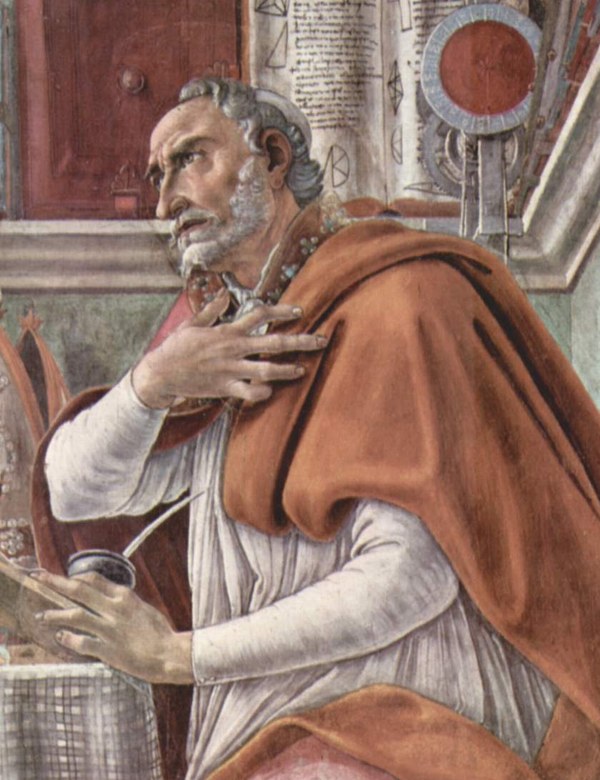
Aurelius Augustinus was born in 354 in Thagaste, a small town in Roman Numidia, in North Africa, the son of Patricius, a pagan of modest means, and of Monica, a Christian. He studied grammar in Madauros and rhetoric in Carthage, where, at nineteen, reading Cicero's Hortensius turned him to the love of wisdom. At the same time he joined the Manichees, a sect that promised to explain evil by reason, and stayed with them for about nine years, while he taught rhetoric in Thagaste and Carthage and lived with a companion, the mother of his son Adeodatus.
In 383 he went to Rome and, the following year, to Milan, as the court's official professor of rhetoric. There he heard the sermons of Bishop Ambrose, read the Platonist philosophers in Latin translation and, in 386, after a crisis he himself describes as the will divided against itself, chose the Christian faith in a garden in Milan. He was baptized by Ambrose at Easter 387, together with his son and his friend Alypius. That same year, on the way back to Africa, he lost his mother at Ostia.
Back in Thagaste, he lived in community with friends, given to study and prayer. In 391, on a visit to Hippo, he was acclaimed by the people and ordained a priest almost against his will; in 395 or 396 he became bishop of the city, an office he held until his death. As bishop he preached, judged cases, wrote letters and fought the great controversies of the African Church: against the Manichees, against the Donatists, who had broken away from the Church, and against the Pelagians, who held that man is saved by his own effort, without grace.
He left an enormous body of work: more than a hundred treatises and hundreds of letters and sermons. The Confessions, written around 397, tell his life addressed to God and are among the first great inner autobiographies; The City of God, begun after the sack of Rome by the Goths in 410, answers those who blamed Christianity for the fall and reads history as the conflict of two cities, founded by two loves. He also wrote the treatise On the Trinity, commentaries on the Bible and works on free will, grace and Christian doctrine.
He died in Hippo on 28 August 430, while the Vandals were besieging the city. His remains were taken in the sixth century to Sardinia, by exiled African bishops, and in the eighth century to Pavia, in Italy, where they still rest in the basilica of San Pietro in Ciel d'Oro. He is venerated as a saint and counted among the Doctors of the Church, and for a thousand years he was the most widely read Latin author of the Christian West: medieval theology, the Reformation and much of the modern philosophy of inwardness and of time start from him.