About the work
- Original title
- Бедные люди (Bednye lyudi)
- Publication
- 1846, in the Petersburg Anthology (Peterburgsky sbornik), edited by Nekrasov
- Genre
- Epistolary novel
- Setting
- St. Petersburg: the corner behind the partition where Makar lives, Varenka's room across the courtyard, the office and the streets of the city
- Period
- From April 8 to September 30 of a single year, the year not stated
- Narrator
- There is no narrator: only the letters of Makar and Varenka, and the notebook of memories she sends him in June
- Structure
- Dated letters, from April to September, with Varenka's notebook in the middle
- Protagonists
- Makar Devushkin and Varenka
About the author
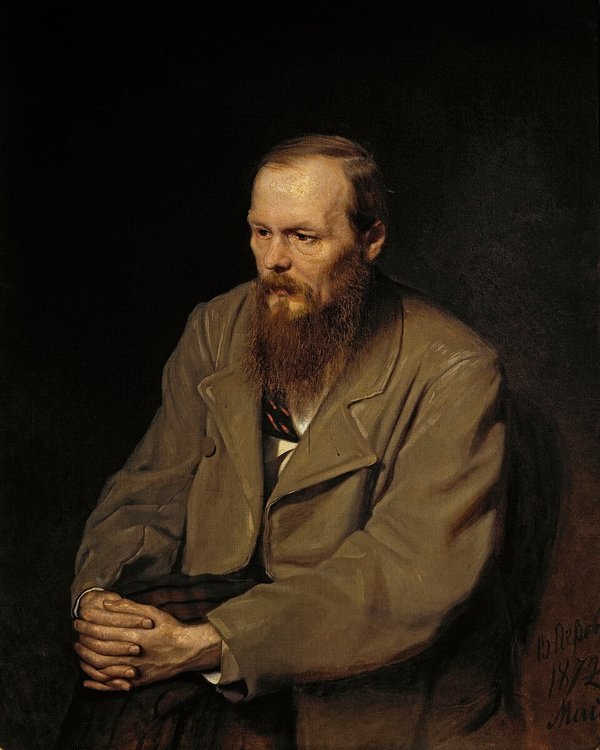
Orthodox Christian, condemned to death and pardoned on the scaffold, he returned from Siberia a critic of the socialism he had embraced and wrote the novels in which ideas are put to the test in the lives of those who defend them. Read the profile of Fyodor Mikhailovich Dostoevsky
Central Theme
The book shows what poverty does to the dignity of those who love. Makar gives Varenka what he does not have, and each gift comes out of a button, a uniform, a meal; she refuses and accepts at the same time, because she knows the price. What destroys them is not the lack of money in itself but the shame of being seen as poor: the draft of a letter read aloud, the button that falls off in front of His Excellency, the nickname of office rat. The only way out the book offers her is to marry Bykov, and for him, to keep writing to no one.
The book is also about writing: Makar begins by apologizing for his style and ends by writing without correcting, just to write. The letters were the way the two found to have a life together that poverty would not let them have in the street.
The Thread That Runs Through the Work
The book does not ask whether Makar and Varenka will end up together; it asks what a poor man can give the one he loves without losing the little dignity he has, and it answers by showing the price of each gift. In the first letter, Makar finds a way to talk to her without spending anything, a signal in the window:
Видите ли, душечка моя, как это ловко придумано; и писем не нужно!, You see, my darling, how cleverly this has been devised: we don't even need letters!
And Varenka, the same day, already knows where the flowers and the bonbons come from:
Ясно, что вы необходимого лишаетесь из-за меня., It is clear that you are depriving yourself of necessities because of me.
In June Makar tells how he is seen at the office, and the defense he builds for himself is that of someone who accepts the place he was given, as long as the place serves some purpose:
Я привык, потому что я ко всему привыкаю, потому что я смирный человек, потому что я маленький человек, I'm used to it, because I get used to everything, because I'm a meek man, because I'm a small man
Literature enters the exchange and changes the measure of things. In July, Varenka lends him Pushkin and Gogol, and Makar, who found comfort in the old stationmaster, takes offense at the clerk in the overcoat, because he recognizes in him what he fears most: being described from the outside, with his worn-out boots on display. The question he asks is that of someone who wants an inner life without becoming an object of pity:
Зачем писать про другого, что вот де он иной раз нуждается, что чаю не пьет?, Why write about another man that he is sometimes in need, that he doesn't drink tea?
In August he himself says what it is to be poor, and what he says is not about hunger but about the way of looking:
Он, бедный-то человек, он взыскателен; он и на свет-то божий иначе смотрит, и на каждого прохожего косо глядит, He, the poor man, is demanding; he looks at God's world differently, and eyes every passer-by askance
Не деньги меня убивают, а все эти тревоги житейские, все эти шепоты, улыбочки, шуточки., It is not the money that is killing me, but all these cares of daily life, all these whispers, little smiles, little jokes.
That is why the great joy of the book is not the money His Excellency gives him in September but the handshake that returns him to the world of men:
не так мне сто рублей дороги, как то, что его превосходительство сами мне, соломе, пьянице, руку мою недостойную пожать изволили, it is not the hundred rubles that are so dear to me as the fact that His Excellency himself deigned to shake my unworthy hand, mine, a wisp of straw, a drunkard
And it is the same poverty that takes Varenka from him. Sick, without income and without anyone, she accepts the landowner who dishonored her, and tells Makar so without asking for advice:
Друг мой, я выйду за него, я должна согласиться на его предложение., My friend, I will marry him, I must accept his proposal.
The book ends with Makar writing, as it began, but now to no one:
а пишу только бы писать, только бы вам написать побольше…, and I write only to write, only to write you as much as possible…
The letters were the only home the two ever had together. While they write, he is a man who protects and she is a girl who is loved; when poverty decides for them, the letter is what remains, and Makar, who spent the book apologizing for his style, writes at the end without correcting anything, because there is no one left to read.