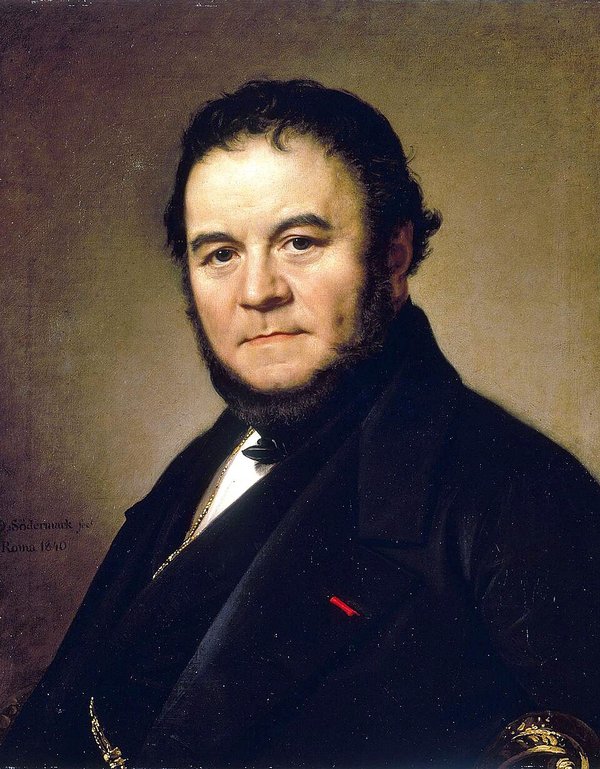
Who He Was
French novelist who wrote under a pen name. He detested his hometown and the bourgeois family in which he grew up, admired Napoleon, and loved Italy to the point of asking that his epitaph call him a Milanese.
Life and Work
He joined Napoleon's army while still young, passed through Italy in 1800, and accompanied the Russian campaign in 1812. After the fall of the Empire he lived in Milan and then in Paris, writing criticism, travel accounts, and the essay On Love (1822), with its theory of "crystallization," the desire that covers the beloved object with qualities it does not have.
The Red and the Black came out in 1830, inspired by a real criminal case read about in the newspapers. The following year, Stendhal became French consul in Civitavecchia, in the Papal States, and there he wrote much of what came after; The Charterhouse of Parma (1839) was born during a long leave in Paris. He died in Paris in 1842, little read during his lifetime. He said he wrote for the readers of 1880, and he was right.
Why Read Him
Stendhal analyzes ambition and love with an almost clinical coolness and an irony that spares no one. He writes dryly, on purpose: he said he read the Civil Code so as not to fall into ornament. The result is a portrait of the France of the Restoration in which every career has a price.
Life and Times
Grenoble and Napoleon's Army
Marie-Henri Beyle was born in Grenoble on January 23, 1783, the son of a provincial lawyer. His mother died when he was seven, and the boy grew up between a father he never got along with, a severe aunt, and his maternal grandfather, a cultured doctor whom he admired all his life. He studied mathematics at the Central School of Grenoble, created by the Revolution, and went to Paris in 1799 to try for the École Polytechnique, but did not sit the exam. A well-placed relative, Pierre Daru, got him a post in the war administration.
In 1800 he followed the army that crossed the Alps and entered Italy, where he served as a cavalry officer. He left the uniform in 1802 and returned to the service of the Empire in 1806. He was in Germany, in Vienna in 1809 and, in 1812, in the Russian campaign: he saw Moscow in flames and crossed the retreat. When Napoleon fell, in 1814, he lost his post and the future the regime had promised him.
Milan, Paris, and the Restoration
He settled in Milan, the city he loved most, and lived there until 1821, writing about music, painting, and travel. It was in this phase that he began to sign himself Stendhal. The Austrian police, who suspected him of liberal sympathies, forced him to leave. In Paris, during the Bourbon Restoration, he frequented the salons, wrote On Love (1822), the pamphlet Racine and Shakespeare (1823), and the novel Armance (1827), and he made a living from contributions to English magazines.
The Novel, the Consulate, and the End
The Red and the Black came out in November 1830 and started from a court case the author knew from the Grenoble region: a young former seminarian, the son of an artisan and a private tutor in a bourgeois household, shot the mother of his pupils and was guillotined in 1828. The July Revolution of 1830 brought Louis Philippe to the throne, and the new government gave him a post. Austria refused to receive him as consul in Trieste, and he was appointed, in 1831, to Civitavecchia, the port of the Papal States.
Between 1836 and 1839 he obtained a long leave in Paris. In it he dictated, in a little over seven weeks at the end of 1838, The Charterhouse of Parma, published in 1839 and praised by Balzac in an extensive essay in 1840. He left unfinished Lucien Leuwen and the autobiography The Life of Henry Brulard, which came out only after his death. On March 22, 1842, he suffered a stroke in the street in Paris and died in the early hours of the following day. He was buried in the Montmartre cemetery, with the epitaph he had written himself, in Italian: Arrigo Beyle, milanese, scrisse, amò, visse (Arrigo Beyle, Milanese, wrote, loved, lived).