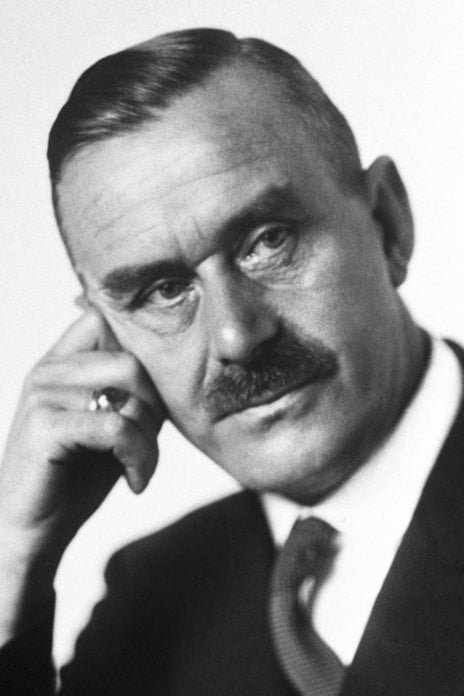
Who He Was
German novelist, one of the greatest of the twentieth century. He was the son of a senator and merchant of Lübeck and of Julia da Silva Bruhns, who was born in Brazil. He grew up among the Hanseatic bourgeoisie he portrayed in his first novel, and with the love of art he inherited from his mother. The tension between these two inheritances, practical life and the life of the spirit, runs through his whole work.
Life and Work
At twenty-six he published Buddenbrooks (1901), the decline of a family of merchants over four generations. He married Katia Pringsheim in 1905. In 1912, Katia spent a stretch at a sanatorium in Davos, and Mann visited her for three weeks: from this came the idea for a comic novella which, interrupted by the First World War, grew until it became The Magic Mountain (1924). Five years later he received the Nobel Prize in Literature.
With Hitler's rise to power, he left Germany in 1933 and never again lived there. He lost his German citizenship, lived in Switzerland and in the United States, and, by radio, spoke against Nazism to the Germans during the war. From this period come the tetralogy Joseph and His Brothers and Doctor Faustus (1947). He died in Zurich in 1955.
Why Read Him
Mann writes novels of ideas that remain novels: the ideas have bodies, ages, illnesses, and passions. In The Magic Mountain, time, death, and the struggle over the formation of an ordinary young man become the material of a sanatorium where no one is in a hurry.
The Biography That Enters the Books
The mother, Julia da Silva Bruhns, was Brazilian, born in Angra dos Reis; the father was a senator of Lübeck.
It is worth keeping the order of events in mind, because it undoes the reading of The Magic Mountain as an allegory built from outside: first Mann's wife is admitted to a sanatorium in Davos, then he visits her, and only then is the book born. The sanatorium enters the novel as a place visited, not as a chosen symbol, and that is why daily life there is described with a precision no allegory would call for.
Julia da Silva-Bruhns, the Brazilian Mother
Julia da Silva-Bruhns was born on August 14, 1851, between Angra dos Reis and Paraty, on the coast of Rio de Janeiro, and grew up on the Boa Vista farm, "between the sea and the forest," as she herself describes it in her memoirs.
Her father, João Luiz Germano Bruhns (1821-1893), came from a family of merchants in Lübeck and emigrated to Brazil in 1840. He settled in Angra dos Reis and married Maria Luiza da Silva, who died in childbirth in 1856. Julia was the fourth daughter of the couple.
Motherless before the age of five, Julia was taken by her father to Lübeck in 1858, was placed in a boarding school under the care of a governess, and never returned to Brazil. Shortly before turning eighteen she married the "life senator" Thomas Johann Heinrich Mann. She died in March 1923, almost two years before The Magic Mountain came out, in November 1924.
Mann stayed silent for a long time about the link with Brazil. There was a reason: as early as 1912, anti-Semitic historians attributed "Jewish blood" to Thomas and Heinrich, above all the Germanist Adolf Bartels, who would later become one of the ideologues of the Nazi regime in academia. It was through Bartels, by the way, that Sérgio Buarque de Holanda learned of Mann's supposed Brazilian origin, and he confirmed it in an interview with Mann right after the Nobel.
Brazil appears inside The Magic Mountain: in the chapter "Operationes spirituales," the "Portuguese South Americans" of the seminary of Leo Naphta have an appearance described as "more Jewish" than his, which disguises Naphta's Jewish origin. The motif returns decades later in Confessions of Felix Krull, Confidence Man.
In a letter of June 1939 to Agnes E. Meyer, Mann divides his own inheritance according to Goethe's model: from his father, the 'stature', at least a dose of it, and 'the sober way of being'
; from his mother, everything G. [Goethe] symbolically sums up in the words 'joy, candor' and the 'will to weave stories'
.
For a script, the Brazilian mother is worth more as silence than as curiosity. Mann avoided speaking of Brazil because his "mixed" origin became anti-Semitic ammunition in Germany, and even so he kept Brazil hidden inside his novels. The detail that Brazilian readers usually treat as almanac-style pride was, for him, a political vulnerability.
Lübeck, Munich, and the Mann Family
Thomas Mann was born in Lübeck on June 6, 1875, the second son of Senator Thomas Johann Heinrich Mann and Julia da Silva Bruhns, after his older brother Heinrich Mann (1871) and before Julia (1877), Carla (1881), and Viktor (1890).
The years of his education, according to the Chronology: he entered the Gymnasium Katharineum in 1889; he finished secondary school in 1893, moved to Munich, and edited the school newspaper Der Frühlingssturm (The Spring Storm); in 1894 he interned at a fire insurance company (Süddeutsche Feuerversicherungsbank) and published Fallen, his first novella; in 1894-1895 he was an auditing student at the Technische Hochschule in Munich (art history, literature, and economics); between 1895 and 1898 he spent stretches in Italy, in Rome and Palestrina, with Heinrich.
The early books: he begins Buddenbrooks in 1897; publishes the first volume of novellas, Little Herr Friedemann, in 1898; is an editor of the satirical magazine Simplicissimus in 1898-1899; publishes Buddenbrooks: The Decline of a Family, in two volumes, in 1901; and in 1903 Tristan appears, a collection of novellas that includes Tonio Kröger.
He married Katia Pringsheim in Munich on February 11, 1905, and had six children with her between 1905 and 1919: Erika, Klaus, Golo, Monika, Elisabeth, and Michael.
He became engaged to Katia Pringsheim, born on July 24, 1883, on October 3, 1904. The children, according to the Chronology: Erika Julia Hedwig (November 9, 1905), Klaus Heinrich Thomas (November 18, 1906), Angelus Gottfried Thomas, known as Golo (March 27, 1909), Monika (June 7, 1910), Elisabeth Veronika (April 24, 1918), and Michael Thomas (April 21, 1919).
The works between the marriage and The Magic Mountain: Fiorenza, a play in three acts, and Bilse und ich (Bilse and I), in 1906; Versuch über das Theater (Essay on the Theater), in 1907; the novel Royal Highness, in 1909; Death in Venice, in 1912, the year he begins The Magic Mountain. In January 1914 he buys a house in Munich, on the Poschingerstrasse, 1.
War, His Brother, and Politics
The writings of the war and the postwar years, according to the Chronology: Friedrich und die grosse Koalition (Frederick and the Grand Coalition), 1915; Betrachtungen eines Unpolitischen (Reflections of a Nonpolitical Man), 1918; A Man and His Dog, 1919; Goethe and Tolstoy and Von deutscher Republik (On the German Republic), 1922.
The titles of 1918 and 1922 tell the turn all by themselves: the man who called himself "apolitical" during the war is the same one who, four years later, defends the republic. It is the bridge between the Thomas of the quarrel with Heinrich and the Thomas who will speak against Hitler on the radio.
After The Magic Mountain (1924): Disorder and Early Sorrow (Unordnung und frühes Leid) and the start of the tetralogy Joseph and His Brothers, in 1926, also the year of Lübeck als geistige Lebensform (Lübeck as a Spiritual Way of Life).
The Nobel and Exile
He received the Nobel Prize in Literature on December 10, 1929, five years after the publication of The Magic Mountain.
Between the Nobel and exile: Mario and the Magician and the appeal Deutsche Ansprache: Ein Appell an die Vernunft (A German Address: An Appeal to Reason), in 1930; Goethe as Representative of the Bourgeois Age and the speeches for the centenary of Goethe's death, in 1932; Sufferings and Greatness of Richard Wagner and the first volume of Joseph and His Brothers, The Stories of Jacob, in 1933.
He left for the Netherlands on February 11, 1933, the beginning of exile, and in the autumn of the same year he settled in Küsnacht, in the canton of Zurich, Switzerland.
In 1934, Young Joseph appears, and he makes his first trip to the United States (May and June); in 1936, Joseph in Egypt appears.
In 1936 he lost his German citizenship and became a citizen of the former Czechoslovakia; in September 1938 he moved to the United States, where he taught humanities at Princeton University, and on June 23, 1944 he became an American citizen.
In American exile: Lotte in Weimar (1939), The Transposed Heads (1940); in April 1941 he begins living in California, in Pacific Palisades; Joseph the Provider, the last volume of the tetralogy, appears in 1943.
Erico Verissimo met Mann in person in 1941, in the United States, at the home of Rabbi Abraham Feinberg, in Denver, and told the encounter in a chapter of Gato preto em campo de neve.
Between exile and the end of the war he wrote texts directed at German politics: the appeal Deutsche Ansprache: Ein Appell an die Vernunft (1930), the essay Brother Hitler (1938), and the radio broadcasts to the Germans gathered in Deutsche Hörer! (German Listeners!), made in 1942 and 1945, the latter in the same year as Deutschland und die Deutschen.
The radio broadcasts came out in book form twice: Deutsche Hörer! with 25 broadcasts, in 1942, and with 55, in 1945. Also from 1945 are Deutschland und die Deutschen (Germany and the Germans) and the essay Dostoevsky, with Moderation.
It is this backdrop, that of the writer who went from pamphleteering refusal to a diagnosis of the nation over the radio, that sustains Doctor Faustus, published in 1947: the pact of Adrian Leverkühn is not an abstract allegory of evil, but the same question Mann had been putting to the microphone during the war, moved inside a novel.
In Doctor Faustus, Mann gives the fictional composer Adrian Leverkühn the twelve-tone technique (composing with the twelve notes of the scale in a series), and he closes the book by returning it to its owner:
The kind of composition described in chapter XXII,known under the name of twelve-tone or serial technique, is in fact the intellectual property of a contemporary composer and theorist, Arnold Schoenberg.
The Return to Europe and His Final Years
He returned to Europe for the first time since the war between April and September 1947; he made a second trip between May and August 1949, with lectures in Frankfurt am Main and Weimar for the two hundredth anniversary of the birth of Johann Wolfgang von Goethe; he returned to Europe in June 1952 and, in December, settled for good in Switzerland, in Erlenbach, near Zurich; in April 1954 he moved to Kilchberg, in the same region (Alte Landstrasse, 39), and he died on August 12, 1955.
The 1949 trip was also his first visit to postwar Germany. In that same year The Genesis of Doctor Faustus: A Novel About a Novel came out.
Three deaths in a little over a year, according to the Chronology: his brother Viktor died on April 21, 1949; his son Klaus took his own life on May 21, 1949, during the second trip to Europe; his brother Heinrich died on March 12, 1950.
The Chronology records the dates of his return to Switzerland, but not the reason.
His last works: Meine Zeit (My Time), 1950; The Holy Sinner, 1951; The Black Swan, 1953; Confessions of Felix Krull, Confidence Man, 1954; Versuch über Schiller (Essay on Schiller), 1955, with lectures on Schiller in Stuttgart and Weimar on May 8 and 14, 1955, three months before he died.
The Manns After Thomas
Hans Wißkirchen, president of the Thomas Mann Society (based at the Buddenbrookhaus, in Lübeck), has said that the Manns represent for Germany what the Kennedys represent for the United States. The children stood out: Klaus and Erika as writers and activists, Michael as a musician and later a Germanist, Golo as a historian, and Elisabeth as a marine biologist. The grandson Frido Mann has kept in contact with Brazil since the 1990s.