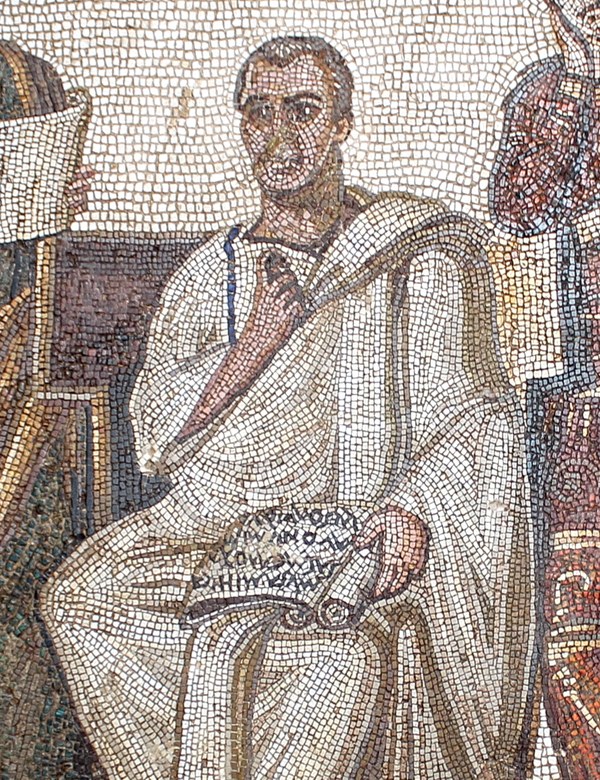
Virgil is the poet of the age of Augustus and the most widely read of the Latin poets. He lived through the civil wars that ended the Republic, lost land in the confiscations that paid the veterans, and found in the circle of Maecenas the protection of the new regime. He wrote three works, in rising order of ambition: the Eclogues, pastoral poems; the Georgics, on the work of the countryside; and the Aeneid, the national epic of Rome, which he left unfinished and asked to have destroyed. Augustus saved it and published it, and it came to be read in school throughout Antiquity. Christians read him as an involuntary prophet, and Dante Alighieri made him the guide of the Divine Comedy through Inferno and Purgatory.
Mantua and His Education
Publius Vergilius Maro was born on 15 October 70 BC in Andes, a village near Mantua, in Cisalpine Gaul, the plain of the Po, which would receive full Roman citizenship only in 49 BC. His family owned land, and his father was able to give his son the complete education of a young man of means: studies in Cremona and Milan, then rhetoric in Rome, with a career as a lawyer in view. The ancient biography (the Vita, which has come down through Donatus and goes back to Suetonius, §15-16) says that he pleaded a single case, only once, and that he spoke slowly, almost like an uneducated man; it also says that he studied medicine and above all mathematics. It names no teacher of philosophy: the connection with the Epicurean Siro, in Naples, comes from another tradition, not yet catalogued here. The retired life, the taste for the countryside, and the distrust of political ambition that Epicureanism taught run through all of his work, even when it turns to singing of empire.
The Eclogues and the Civil War
Virgil grew up during the civil wars that destroyed the Republic: Caesar against Pompey, then Caesar's assassins against Antony and Octavian. After the battle of Philippi, in 42 BC, the victors confiscated land in Italy to pay the veterans, and the region of Mantua was hit. It is from this world that the Eclogues are born, ten pastoral poems written between about 42 and 39 BC, in the manner of the Greek poet Theocritus: shepherds who sing, lose their land, and speak of a time that is changing. The fourth eclogue announces the birth of a child with whom the golden age would return, and Christian readers, centuries later, read it as a prophecy of Christ, which made Virgil an almost saintly pagan in the Middle Ages.
Maecenas, Augustus, and the Georgics
The Eclogues brought Virgil into the circle of Maecenas, the friend and adviser of Octavian who gathered poets around the new power, and there he introduced the young Horace. Between 37 and 29 BC he wrote the Georgics, four books on the work of the countryside (cultivation, trees, flocks, bees), which make the patient farmer the model for an Italy that needed to emerge from war. In 29 BC, according to tradition, Virgil read the poem to Octavian, who was returning victorious from the East after defeating Antony and Cleopatra at Actium. Two years later Octavian would receive the name Augustus.
The Aeneid and His Death
From 29 BC until his death, Virgil worked on the Aeneid, the poem that Augustus expected of him: the journey of Aeneas from Troy to Italy, as the origin of the Roman people and of the Julian family, to which Augustus belonged by adoption. He composed slowly, a few lines a day, and read finished passages to the emperor; the ancient biography says that Octavia, the sister of Augustus, fainted on hearing the funeral eulogy of her son Marcellus, in Book VI. In 19 BC, wanting to see Greece and Asia before declaring the poem finished, Virgil set out on a journey, met Augustus in Athens, fell ill in Megara, and died in Brundisium (Brindisi) on the way back, on 21 September, at the age of fifty. He asked that the Aeneid be burned, since he judged it imperfect; Augustus would not allow it: by his order the poet's friends, Varius and Tucca, revised the text, and Varius published it corrected only lightly, leaving the incomplete lines as they were (Vita §37-41), which is why the poem contains unfinished lines. Virgil was buried in Naples, and the epitaph attributed to him sums up his life: Mantua bore me, Calabria took me, now Naples holds me; I sang of pastures, farms, and leaders.