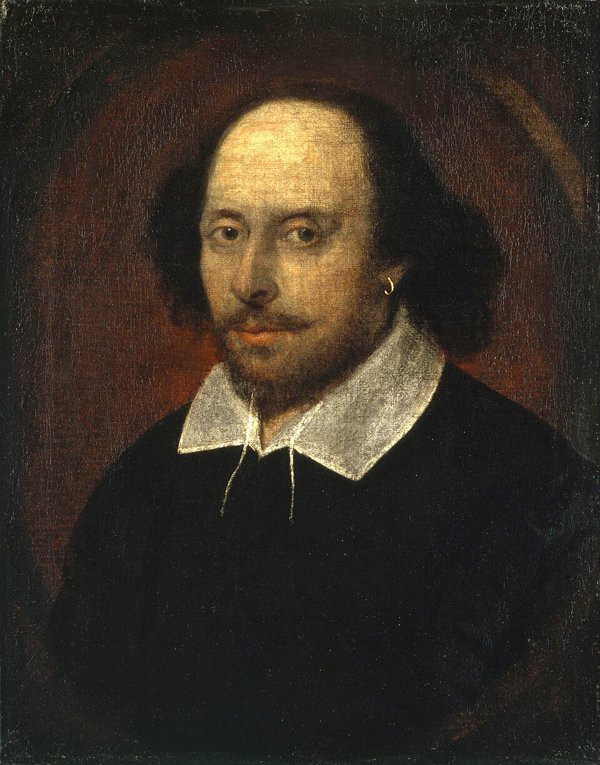
Who He Was
The son of a glover in Stratford-upon-Avon, he was baptized on April 26, 1564; the exact date of his birth is not known. He married young, to Anne Hathaway, and years later appears in London as an actor and author. He belonged to the company that was first called the Lord Chamberlain's Men and, under James I, the King's Men, of which he was a partner, and for which he wrote almost all his work, staged at the Globe. He died in Stratford in 1616.
The Work
He wrote about thirty-seven plays, among comedies, history plays, and tragedies, as well as 154 sonnets and narrative poems. Half of the plays survived only because two colleagues from the company, John Heminges and Henry Condell, collected them in the volume of 1623 known as the First Folio, seven years after his death.
Why Read Him
Shakespeare writes for the stage and not for the reader: everything we know about a character comes from what he says and what others say of him, with no narrator to explain. That is why the tragedies leave the decision to the audience. Romeo and Juliet shows love overtaken by haste; Julius Caesar, political crime justified in the name of liberty; Hamlet, the man who thinks before he acts; Othello, certainty manufactured by another man's words; Macbeth, ambition that, once satisfied, can only sustain itself with more blood.
Life and Times
Stratford and the Formative Years
William Shakespeare was baptized on April 26, 1564, in the church of Stratford-upon-Avon, in the center of England. His father, John Shakespeare, was a glover and merchant and at one point held municipal offices; his mother, Mary Arden, came from a family of rural landowners in the region. He probably studied at the town's grammar school, where he learned Latin, but no records of this period survive. In November 1582 he obtained a license to marry Anne Hathaway. Their first daughter, Susanna, was baptized in May 1583, and the twins Hamnet and Judith in February 1585. Hamnet died in 1596, at the age of eleven.
Between 1585 and 1592 there are no documents about him. By 1592 he was already in London, acting and writing, and a pamphlet by the playwright Robert Greene, from 1592, seems to attack him as an upstart, an actor without a university education who dared to compete with the authors trained at the universities.
The Company and the Globe
The plague closed the London theaters in 1592 and 1593, and Shakespeare then published two narrative poems, Venus and Adonis and The Rape of Lucrece, dedicated to the Earl of Southampton. In 1594 he joined, as actor, author, and partner, a company protected by the Lord Chamberlain, the chief officer of the royal household, and therefore called the Lord Chamberlain's Men. In the following years he wrote Romeo and Juliet, around 1595. In 1599 the company built the Globe, on the south bank of the Thames, and one of the first plays seen there was Julius Caesar, a performance of which is recorded in September of that year.
The 1590s were also the decade of the family's social rise: his father obtained a coat of arms in 1596, and Shakespeare bought the house known as New Place in Stratford in 1597.
Under James I
In 1603 Queen Elizabeth died, and the new king, James I, took the company under his protection, and it came to be called the King's Men. The great tragedies began still under Elizabeth, with Hamlet, around 1600 and 1601, and continued under the new king: Othello, performed at court in 1604, and Macbeth, around 1606, set in the Scotland from which the king came. The company also began to use the indoor theater at Blackfriars.
Around 1610 Shakespeare reduced his activity and returned to live in Stratford. On June 29, 1613, the Globe burned down during a performance of Henry VIII, and was rebuilt the following year. He made his will in March 1616 and died on April 23, at the age of fifty-two. He was buried two days later beside the altar of Holy Trinity Church in Stratford.