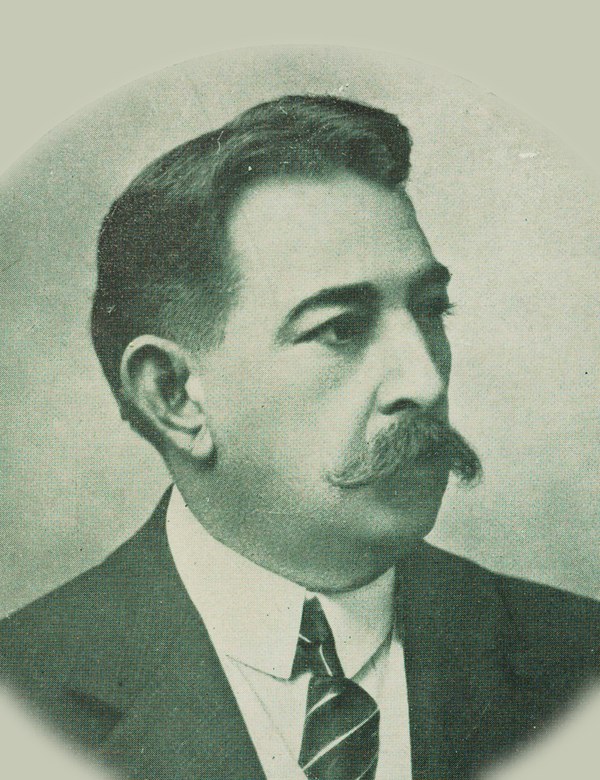
Aluísio Azevedo is the leading novelist of Brazilian naturalism. Born in São Luís do Maranhão in 1857, he was a caricaturist in Rio de Janeiro before becoming a writer, and this draftsman's eye, turned toward crowds, bodies, and settings, marks all of his work. With O Mulato, of 1881, which scandalized the society of Maranhão, he opened naturalism in Brazil. He tried to live by literature alone, alternating adventure serials with novels of observation of the social environment, in the manner of Zola, and the greatest of these is The Slum, of 1890, in which the collective housing of Rio de Janeiro becomes almost a living organism and the central character. He was one of the founders of the Brazilian Academy of Letters, in 1897. On entering the consular career in 1895, he practically abandoned the novel, and he died as a consul in Buenos Aires, in 1913.
São Luís and Drawing
Aluísio Azevedo was born in São Luís do Maranhão, on 14 April 1857, the son of the Portuguese vice-consul David Gonçalves de Azevedo and the younger brother of the playwright Artur Azevedo. In 1876 he went to Rio de Janeiro to study at the Imperial Academy of Fine Arts and earned his living as a caricaturist in the illustrated newspapers of the Court. The draftsman's eye stayed in his prose: his novels work by tableaux, crowds seen from outside, and figures marked by a physical trait.
O Mulato and the Scandal
With his father's death, he returned to São Luís in 1878. There he published a first novel of a romantic bent, Uma lágrima de mulher (1879), and, in 1881, O Mulato, which exposed the prejudice and hypocrisy of the society of Maranhão and caused a scandal in the city. The book is usually pointed to as the founding landmark of Brazilian naturalism. In the same year Aluísio returned to Rio, now to live by his writing.
Living by the Pen
In the Rio of the 1880s Aluísio was one of the few Brazilian writers to try to live by literature alone. To do so he wrote on two fronts: fast-paced serials, published in newspapers and paid by the chapter, such as Mistérios da Tijuca and Memórias de um condenado, and the novels in which he applied the naturalist method, the observation of environment and body in the manner of Émile Zola, with the Portuguese example of Eça de Queirós beside him. From this second front came Casa de Pensão (1884), about a provincial student in a boarding house in the capital, O Homem (1887), and The Slum (1890), published two years after the Golden Law and months after the proclamation of the Republic.
The method appears already on the first page of The Slum, when the tenement is born from the mud as a living thing:
E naquela terra encharcada e fumegante, naquela umidade quente e lodosa, começou a minhocar, a esfervilhar, a crescer, um mundo, uma coisa viva, uma geração, que parecia brotar espontânea, ali mesmo, daquele lameiro, e multiplicar-se como larvas no esterco, and in that sodden, steaming earth, in that warm, muddy damp, there began to wriggle, to seethe, to grow, a world, a living thing, a generation, which seemed to sprout spontaneously right there, out of that mire, and to multiply like larvae in dung
The Academy and the Consular Career
In 1897 Aluísio was among the founders of the Brazilian Academy of Letters, where he held chair 4. Two years earlier, in 1895, he had entered the consular career by examination, and from then on he practically gave up fiction. He served as consul at several posts abroad, among them Vigo, in Spain, Yokohama, in Japan, and Argentina. He died in Buenos Aires, where he was serving, on 21 January 1913.
How Critics Read Him
Otto Maria Carpeaux gives Aluísio the primacy of naturalism in Latin America, in date and in value, and in the same breath calls him not very original:
The priority of Latin American naturalism, in chronology and with respect to value, belongs to the Brazilian Aluísio Azevedo; he has [...] the defects of all minor naturalists and is not very original, a Zola, or rather a Mirbeau, of Rio de Janeiro. But his novels still give the impression of being “full of life”
What saves the novels, for Carpeaux, is their material: the low life of Rio, which no one had put into a novel before, and which made them also a document of historical sociology.