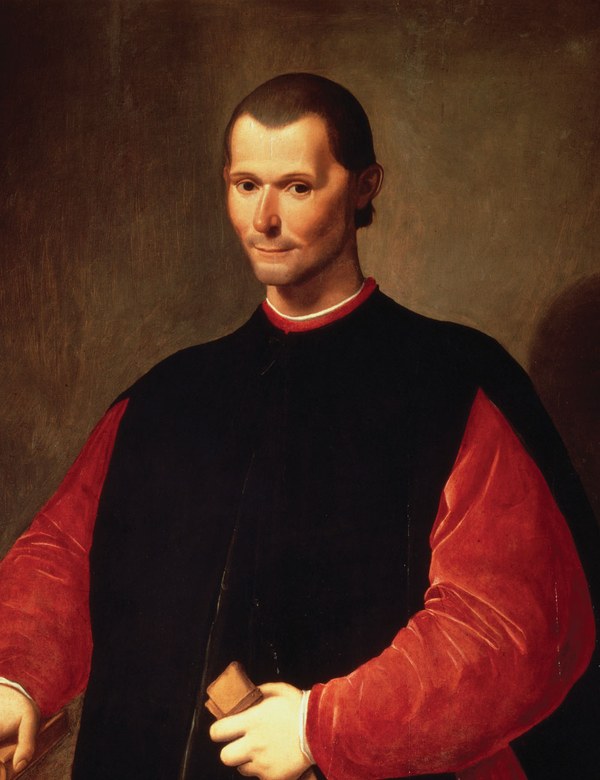
Who He Was
Niccolò Machiavelli was born in Florence in 1469, the son of a jurist. In 1498, at the age of 29, he became secretary of the Florentine Republic and, for fourteen years, served as a diplomat and as organizer of the militia, on missions to France, to the papal court, to the emperor and to Cesare Borgia, in the Romagna. He was a close observer of the power of his time, and it is from that experience that his work comes.
Life and Work
In 1512 the Medici returned to Florence, and Machiavelli lost his post. In 1513 he was arrested on suspicion of conspiracy and subjected to the strappado. Released in an amnesty, he withdrew to Sant'Andrea in Percussina, and there, in 1513, he wrote De principatibus, later known as The Prince, dedicated to Lorenzo di Piero de' Medici. The letter he wrote to Francesco Vettori on December 10, 1513 documents its composition. The work circulated in manuscript and was printed in Rome, by Antonio Blado, in 1532, five years after the author's death.
In exile he also wrote the Discourses on the First Decade of Livy, The Art of War, the comedy The Mandrake and the History of Florence. He died in Florence in 1527, and in 1559 the Index of Forbidden Books included his complete works.
Why Read Him
The Prince is short and written to be used: it speaks of power, of arms, of fortune and of reputation with examples drawn from Italian politics and ancient history. Whoever reads it with the author's life alongside understands that he writes as one who saw the fall of a republic from the inside.
Life and Times
Florence and the Chancery
Niccolò di Bernardo dei Machiavelli was born in Florence on May 3, 1469, the son of Bernardo, a jurist, and of Bartolomea de' Nelli. The family was of good lineage and slender means, and his father had a library in which the son read the Latin classics. He grew up under the rule of Lorenzo de' Medici, and at 25 he saw the Medici family expelled from the city, in 1494, when the French invasion of Italy overthrew the regime.
In 1498, shortly after the execution of the friar Girolamo Savonarola, who had dominated the city since the fall of the Medici, the Republic elected him second chancellor and secretary of the Ten, the magistracy in charge of war and foreign relations. He was 29 and had no record of arms or of high office. He held the post for fourteen years. In 1502 he married Marietta Corsini. In the same year Piero Soderini was elected gonfaloniere for life, and Machiavelli became his closest collaborator.
The Missions and Cesare Borgia
The office made him travel. He went several times to the court of the king of France, Louis XII, was at the court of Pope Julius II in 1503 and at that of the Emperor Maximilian in 1507 and 1508. The mission that most marked his work was the one to Cesare Borgia, son of Pope Alexander VI, who in 1502 and 1503 was trying to form a state of his own in the Romagna. Machiavelli accompanied him in Urbino, in Imola and in Senigallia, where the duke eliminated the captains who were conspiring against him. The reports of these missions, written in haste and read by the Ten, are the raw material of the examples in The Prince.
He was also a champion of a citizen militia. In 1505 and 1506, at Soderini's request, he organized a militia of Florentine citizens, which was to replace the mercenaries on whom the city depended. The army of peasants he armed took Pisa in 1509.
The Fall of 1512, Prison and Exile
In August 1512 the Spanish troops of the Holy League defeated the Florentines at Prato, Soderini fled and the Medici returned to power in September. In November Machiavelli was dismissed from all his offices. In February 1513, when a conspiracy against the Medici was discovered, his name appeared on a list of suspects. He was arrested and subjected to the strappado, the torture in which the accused is hoisted by his wrists tied behind his back and suddenly dropped, and he did not confess. He left prison in March, when the election of Leo X, a Medici, brought an amnesty.
He withdrew to the family's small estate at Sant'Andrea in Percussina, near San Casciano, south of Florence. On December 10, 1513 he wrote to his friend Francesco Vettori, Florence's ambassador in Rome, a famous letter: it describes his day in the country, the card game at the tavern, and the hour of the evening when he puts on decent clothes to converse with the ancient authors. There he says that he has composed a little work on principalities, De principatibus, which is The Prince. The work, dedicated to Lorenzo di Piero de' Medici, circulated in manuscript copies, and was printed only after the author's death, in Rome, by Antonio Blado, in 1532.
The Last Years
In exile he also wrote the Discourses on the First Decade of Livy, published in 1531, and the comedy The Mandrake. In 1520 he received from Cardinal Giulio de' Medici, the future Pope Clement VII, the commission for the History of Florence, which he delivered to the pope in 1525. The Art of War came out in 1521. Little by little he returned to public life, on small missions in the service of the Medici.
In May 1527, the sack of Rome by the imperial troops overthrew the Medici in Florence once again, and the Republic was restored. Machiavelli sought the post he had lost, but no longer obtained it. He died in Florence on June 21, 1527, at the age of 58. In 1559, the Church's Index of Forbidden Books included all of his work.