About the work
- Author
- Niccolò Machiavelli
- Original title
- De principatibus, known as Il Principe
- Publication
- Written in 1513, in exile at Sant'Andrea in Percussina; printed only in 1532, in Rome, five years after the author's death
- Genre
- Political treatise in the form of advice to a ruler (mirror for princes), in 26 chapters of Italian prose
- Setting
- The Italy of city-states and foreign invasions: Florence, Rome, Milan, Venice, Naples and the Romagna
- Era
- From the descent of Charles VIII of France, in 1494, to the return of the Medici to Florence, in 1512, with examples from Antiquity
- Narrator
- First person: Machiavelli speaks to the prince to whom he dedicates the book
- Central figure
- The new prince, and his greatest example, Cesare Borgia
About the author
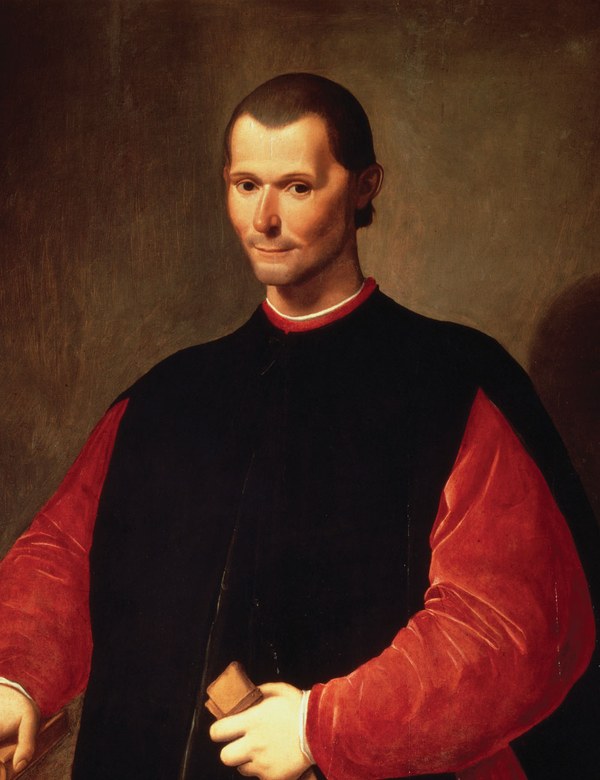
The secretary of the Florentine Republic who, removed from office and sent into exile, wrote in 1513 the treatise on power that made him the most debated name in politics. Read the profile of Niccolò Machiavelli
The Story and Its World
Niccolò Machiavelli was born in Florence in 1469 and served the Republic as secretary from 1498 to 1512, on missions to kings and princes, among them Cesare Borgia, whom he met in 1502 as Florence's envoy. In 1512 the Medici returned to the government of the city, he lost his post and, the following year, was arrested on suspicion of conspiracy and then released, and withdrew to an estate in the country. It was there that he wrote the little book he sent to Lorenzo de' Medici. It circulated in copies and was printed in 1532, when the author was already dead, having died in 1527.
The Italy he knows is carved up into states that watch one another: the republic of Florence, the duchy of Milan, the republic of Venice, the kingdom of Naples and the Papal States. Since 1494, when Charles VIII of France crossed the Alps and the peninsula, French, Spanish, Swiss and imperial armies have fought over these states, and the Italian princes hire captains for pay to defend them. When the book is written, Louis XII and Ferdinand of Aragon have made and unmade dominions on the peninsula, Julius II has taken up arms in person, and Pope Leo X, Giovanni de' Medici, has just been elected. The book cites them all as contemporaries.
It is this world that the book has before its eyes. Machiavelli does not write a treatise on the state in general: he writes to a particular prince, in a particular crisis, and almost every example comes from the recent past (Milan, the Romagna, Bologna) or from Antiquity, which was read as a school of action. Chapter XXVI shows what was at stake: he wants a prince who will arm Italy and free her from the "barbarians," as the foreigners who occupied her were then called. The Dedication says the rest: the author offers what he holds dearest, knowledge of the actions of great men, learned from experience of modern affairs and from reading the ancient ones, without ornament of language.
The form follows the subject. Chapters I to XI classify the principalities and say how each kind is won and held; Chapters XII to XIV deal with arms, which are the foundation of all of them; Chapters XV to XXIII examine the prince's conduct toward his subjects, his friends, his soldiers and those who advise him; the last three return to Italy, to fortune and to the liberation of the country. Whoever reads in order sees the argument grow from case to case, and whoever reads only the famous chapters (Chapter XVII, Chapter XVIII, Chapter XXV) misses what holds them up.
The book's fame is greater than its reading. The adjective "Machiavellian" came to mean unscrupulous cunning, and the phrase "the end justifies the means" is attributed to the author but is not in the text. What Chapter XVIII says is that the crowd judges by what appears and by the outcome, and that in the actions of princes one looks to the end.
The Passages That Hold Up the Rest
The one on method, which says how the book wants to be read: the distance between how one lives and how one should live, and the decision to stay with the former.
there is so much distance between how one lives and how one should live that whoever abandons what is done for what should be done learns his ruin sooner than his preservation
The one on the fox and the lion, which sums up the prince's conduct: knowing the traps and frightening the wolves.
One must, therefore, be a fox to know the traps, and a lion to frighten the wolves.
And the one on fortune, in Chapter XXV, which closes the theory: what she governs and what is left to man.
fortune may be the arbiter of half of our actions, but she leaves the government of the other half, or nearly so, to us