About the work
- Author
- Thomas More
- Original title
- Libellus vere aureus nec minus salutaris quam festivus de optimo reipublicae statu deque nova insula Utopia
- Publication
- Louvain, December 1516; revised edition in Basel, 1518
- Genre
- Philosophical dialogue and imaginary travel narrative, in two books of Latin prose
- Setting
- Antwerp, where the conversation takes place; the England of Henry VIII, in Book I; the island of Utopia, in Book II
- Era
- 1515, during the English embassy to Flanders; the England of 1497 in the memory of Cardinal Morton's dinner
- Narrator
- First person: More himself, who records what he heard from Raphael Hythloday
- Central figure
- Raphael Hythloday, the Portuguese traveler who spent five years in Utopia
About the author
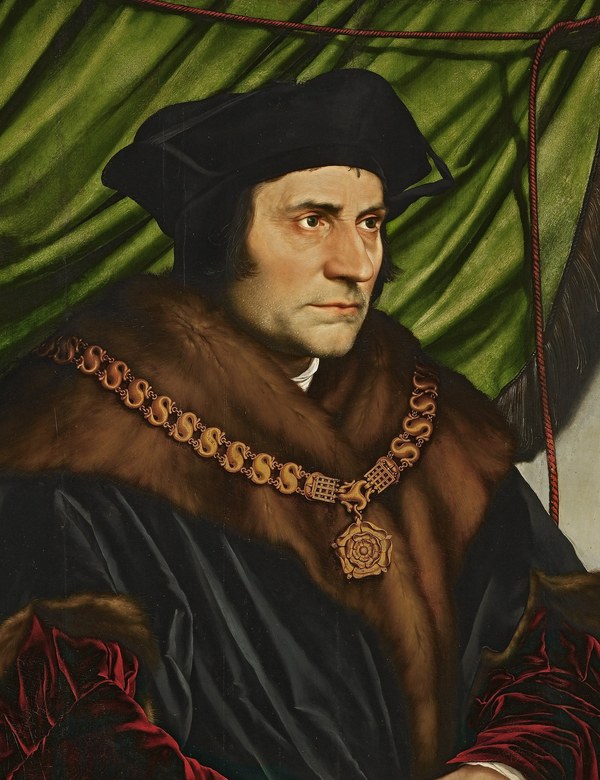
The London jurist and humanist who wrote Utopia, rose to be Henry VIII's Lord Chancellor and was beheaded for refusing to swear to the king's supremacy over the Church. Read the profile of Thomas More
The Story and Its World
Thomas More was born in London in 1478, trained as a lawyer, became under-sheriff of the city, and wrote the book in 1515 and 1516, while taking part in a mission sent by King Henry VIII to Flanders to negotiate questions of the wool trade. He stood at the center of northern European humanism: he was a friend of Erasmus of Rotterdam, read Greek and Latin, and wrote for the circle of scholars who shared the reading of Plato and the ancient authors. Two years after Utopia he entered the king's service; he would rise to chancellor and be beheaded in 1535 for refusing the oath that placed the king above the Church.
The world the book speaks of is the England and Europe of that time, and Book I shows it from the inside. Kings wage war to win new kingdoms, and in Book I, Section 4 the counselors of the king of France debate how to hold Milan and recover Naples. Plowland turns into pasture for sheep, because wool pays, and in Book I, Section 3 nobles, gentlemen and even abbots enclose the fields and drive out the farmers, who end up as thieves, beggars or hanged men. The laws punish the theft of a small coin with death. This is the backdrop of the book: a country in which justice hangs those whom the economy has already ruined, governed by kings who prefer to conquer rather than to administer.
It was also the age of the great voyages. The book itself places Hythloday among the companions of Amerigo Vespucci on his last voyages to the New World (Book I, Section 1), and in the Letter to Peter Giles More confesses that no one asked in what part of that world the island lies. The names are part of the game, and the book does not explain them: Utopia comes from the Greek and means "no place," Amaurot is the "dim city," Anyder the "waterless river," Ademus the "prince without a people," and Hythloday's surname can be translated as "teller of nonsense." The man who narrates perfection thus carries a name that the book does not comment on and that the reader may notice.
Book II describes an island without private property and without money, where everyone works six hours, eats in common halls, studies in free time and lives alongside different religions. It is not a paradise: it has slaves, harsh laws against adultery, euthanasia advised for the incurably ill, and a war waged with bounties on the head of the enemy prince. That is why the question the reader carries away is whether the island is a model, a satire or a game. In Book II, Section 8, Hythloday says that he narrates and does not defend, but that he knows no happier republic, and in Book II, Section 12 More falls silent and leaves desire and doubt side by side. The text does not decide, and it is in the tension between Book I, which diagnoses, and Book II, which proposes, that the book is to be read.
The Passages That Hold Up the Rest
The passage about gold, which shows in a single stroke the method and the irony of the island: the metal that other peoples fight over goes to the most squalid vessels.
For while they eat and drink from earthenware and glass, elegant indeed but cheap, they make chamber pots out of gold and silver everywhere, and every kind of the most squalid vessel, not only in the common halls but also in private houses.
The passage about the conspiracy, the strongest sentence in the book, spoken by the man who has just described the island.
I perceive nothing but a certain conspiracy of the rich, who pursue their own advantage under the name and title of the commonwealth.
And the one that closes the book, in which More does not agree to everything and wishes for what he does not expect.
Meanwhile, though I cannot agree with everything that was said, by a man who is without doubt most learned and at the same time most expert in human affairs, I readily confess that there are very many things in the commonwealth of the Utopians that I would rather wish for than expect to see in our own cities.