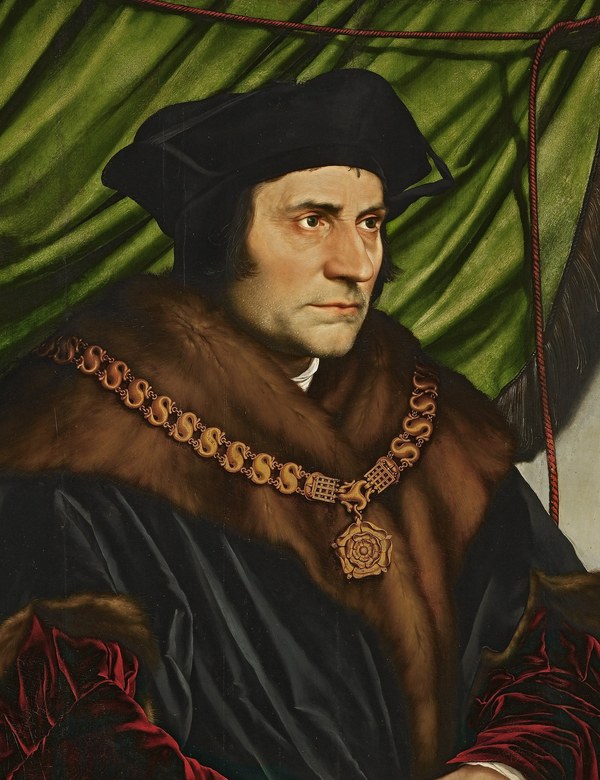
Who He Was
Thomas More was born in London in 1478, the son of a judge, and studied at Oxford and at Lincoln's Inn. He was a lawyer, a member of Parliament and, from 1510, undersheriff of London. A friend of Erasmus, he belonged to the circle of English humanists and wrote in Latin. In 1515, on an embassy to Flanders, he began to write Utopia, which came out in Louvain in December 1516 and was reprinted in Paris in 1517 and in Basel in 1518.
Life and Work
In 1518 he entered the service of Henry VIII, and in 1529 he became Lord Chancellor of England. He resigned in 1532, when the clergy yielded to the king on the question of the divorce, and in 1534 he refused to swear the Oath of Succession, which repudiated the authority of the pope. He was imprisoned in the Tower of London, tried on July 1, 1535 and condemned for treason. He was beheaded on July 6, on Tower Hill. He was canonized by Pius XI in 1935.
Why Read Him
Utopia is at once an imagined island and a critique of the author's England, and his life shows what it cost the man who wrote it to keep his conscience before the king.
Education and *Utopia*
London, Oxford and Lincoln's Inn
Thomas More was born in London on February 7, 1478, the son of John More, a lawyer and later a judge. As a boy he served as a page in the household of John Morton, Archbishop of Canterbury and Lord Chancellor of the realm. Around 1492 he went to Oxford, where he studied Latin and Greek, and he left the university at his father's wish, since his father wanted him to be a jurist. He entered Lincoln's Inn in 1496, one of the societies of lawyers in London, and was called to the bar around 1501.
In those years he lived near the London Charterhouse and followed the monks' way of life, and for a time he thought of becoming a religious, but he married Jane Colt in 1505, who died in 1511, and soon afterward Alice Middleton. In 1504 he was elected to Parliament. In 1510 he was appointed undersheriff of London, an office in which he acted as a judge in the city's courts.
Erasmus and the Humanists
He met Erasmus of Rotterdam in England around 1499, and the friendship lasted all their lives. Erasmus wrote The Praise of Folly (1509) in More's house, and the Latin title, Moriae encomium, plays on his friend's name. The two of them and the circle of English humanists studied the Greek and Latin authors and the Fathers of the Church, and More wrote in Latin, the common language of Europe's learned men.
The Embassy to Flanders and the Printing of *Utopia*
In 1515 the king included him in a diplomatic mission to Flanders, to negotiate questions of the wool trade. The negotiation dragged on, and More stayed for months in the Low Countries. In Antwerp he met Pieter Gillis (Peter Giles), a friend of Erasmus and a character in the work. It was there that he wrote what would become the second book of Utopia, the description of the island, and afterward, back in London, the first book, the dialogue on the ills of England.
The book came out in Louvain in December 1516, with Erasmus's help, printed by Dirk Martens. The Paris edition followed in 1517, and the Basel edition in 1518, printed by Johann Froben, more carefully produced. The work was a success among the humanists, and in 1518 More entered the king's service.
The Chancellor and Henry VIII
After the fall of Cardinal Wolsey, More was appointed Lord Chancellor of England in October 1529. In May 1532, when the clergy yielded to the king on the question of the divorce, he resigned, citing his health, and withdrew to his home in Chelsea, where he kept silent for years. In April 1534, when called to swear the Oath of Succession, he refused. The law that catches him is that of 1534, the royal supremacy, with the penalty of high treason for anyone who denied the king any of his titles.
The Parliament, which was opened on the 3rd of November 1534, enacted that the King and his successors should be recognized as the sole supreme head of the English Church and enjoy all the spiritual power and authority involved in that title, even in matters of dogma.
who conspired against the King s person or called him heretical and schismatical, but also all who disallowed him any one of the titles belonging to him, were liable to the penalty of high treason.
The oath makes refusal a matter of life and death, and most of the clergy yield.
Everyone suspected of denying the royal supremacy could be forced to accept an oath the refusal of which meant for the unhappy victim of tyranny the gibbet or the block.
Under the terrors of the new statutes the majority of the English clergy acknowledged the King s supremacy
The Trial and Death (1535)
Imprisoned in the Tower of London since April 1534, More was tried at Westminster on July 1, 1535 and condemned for treason. His death followed those of the Carthusians, executed in May, and of John Fisher, in June, and he was beheaded on Tower Hill on July 6.
The first to lay down their lives, on the 4th of May 1535, were the Priors of the three Carthusian houses in London, a Brigittine monk, and a secular priest. They were hanged, cut down while yet alive, and then disembowelled and quartered.
On the 6th of July he was followed to the same place by Thomas More, once Chancellor of England, and renowned throughout Europe for his learning.
The two condemned men argued that there was no conflict between fidelity to the faith and fidelity to the Crown, and this is what the court refused to accept.
Both Fisher and More declared before execution that they died in the Catholic faith and as loyal subjects of the King.
The charge was not heresy: the court treated as treason the refusal to recognize the king as head of the Church, and it is conscience, and conscience alone, that explains the execution.
Warum sind alle diese Blutzeugen als „Hochverräter“ hingerichtet worden? Einzig und allein, weil ihr Gewissen ihnen verbot, den König als oberstes Haupt der Kirche anzuerkennen., "Why were all these witnesses in blood executed as 'traitors'? Solely because their conscience forbade them to recognize the king as supreme head of the Church"
The European reaction was one of grief and indignation, and Pastor calls the executions "judicial murders."
Europe rang with grief and indignation on hearing of these judicial murders.
On these few fell the whole weight of the penal laws, the execution of which inaugurated in England a reign of terror bloodier than any which had yet been known within the pale of Christendom.
The Saint
More and Fisher were canonized by Pius XI on May 19, 1935, four centuries after the execution. In 2000, John Paul II declared him patron of statesmen and politicians.
Fisher and More were canonized in 1935, together with some 50 martyrs who were victims of Henry VIII.