Utopia
The events in the order the book tells them.
Opening
- Letter to Peter Giles1
The Request to Peter Giles
More asks his friend Peter Giles to check the length of the bridge at Amaurot and to ask Raphael where the island is, something no one thought to ask.
Book I
- Section 12
The Embassy to Flanders
Sent by Henry VIII to Flanders, More negotiates in Bruges with the envoys of Prince Charles and, while they wait, goes to Antwerp, where his friend Peter Giles visits him.
- Section 13
The Man with the Crooked Cloak
As they leave church, Peter Giles introduces More to an old man with a sunburned face: Raphael Hythloday, a Portuguese who sailed with Amerigo Vespucci and stayed in a fort in the New World.
- Section 24
To Serve Kings or Not
Seated in the garden, Peter and More urge Raphael to serve some prince. He refuses: kings want to conquer, and counselors flatter and only approve what has already been said.
- Section 35
The Gallows and the Cardinal's Dinner
At Cardinal Morton's house, a lawyer praises the gallows for thieves. Raphael replies that the penalty is cruel and useless, and that those who have no means of living steal.
- Section 36
Sheep Devour Men
Raphael points to the English cause of theft: lords enclose the land to raise sheep and drive out the tenants, who, with no trade, beg or steal, and then the law hangs them.
- Section 37
The Proposal of the Polylerites
Raphael proposes, like the Polylerites of Persia, that the thief return what was stolen and work for the public. The lawyer objects, and everyone praises the idea once the cardinal approves it.
- Section 48
The Council of the King of France
Raphael imagines himself on the council of the king of France, where the only talk is of how to hold Milan and retake Naples, and says that his counsels of peace would fall on deaf ears.
- Section 49
The Leaden Rule
Morus defends a philosophy that knows its stage and does as little harm as possible. Raphael replies that to dissemble is to be complicit and that private property prevents justice.
Book II
- Section 110
The Island in the Shape of a Moon
Raphael describes the island: two horns of land in the shape of a waxing moon, with a calm inner harbor, a dangerous entrance and fifty-four cities identical in laws and customs.
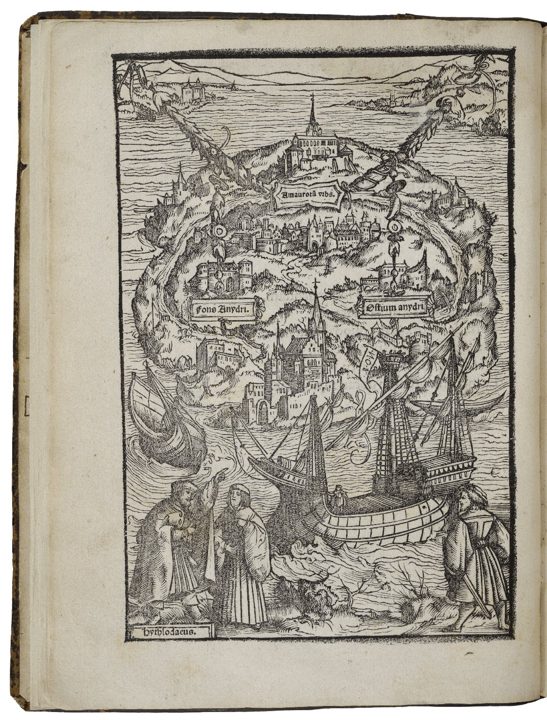
- Section 111
The Severed Isthmus
The conqueror Utopus, who gave the island its name, had fifteen miles dug where the land joined the continent and put soldiers and natives to work on it, so that no one could take it as an insult.
- Section 212
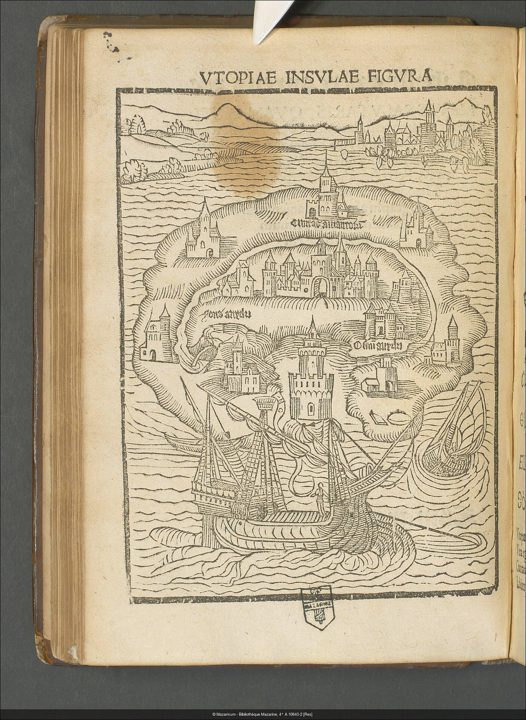
Amaurot
Amaurot, the principal city, lies on the banks of the river Anyder, with a stone bridge, protected water, wide streets and doors without keys, and gardens are the great passion of its inhabitants.
- Section 313
Syphogrants and Tranibors
For every thirty families a syphogrant is elected; the prince is chosen from four names and governs for life, and deliberating on the common good outside the senate is a capital crime.
- Section 414
Six Hours of Work
Everyone learns farming and a trade, and works six hours a day. Free time goes to learning, since the aim of the republic is to give everyone time for the mind.
- Section 515
The Dining Hall and the Storehouses
Each head of household takes what he needs from the storehouses without paying, and families eat in common halls, with reading at table and public hospitals for the sick.
- Section 616
Travel by Permission
Whoever wants to visit another city asks the magistrates for permission and travels carrying nothing, because everywhere he is at home. Wandering without permission is punished, and no one lives without working.
- Section 717
The Gold of the Chamber Pots
So that no one will become attached to gold and silver, the Utopians make them into chamber pots, slaves' chains and criminals' crowns, and leave pearls to small children.
- Section 718
The Ambassadors in Silk
Ambassadors from a distant people arrive at Amaurot covered in gold. The Utopians take them for slaves, the children mock the pearls, and the ambassadors put away their finery, ashamed.
- Section 819
True Pleasure
The Utopians study in their own language and discuss happiness. They distinguish true pleasure, that of the mind and of health, from false pleasure, that of fine clothes, gems and hunting.
- Section 820
The Books Raphael Brought
On the last voyage, Raphael brought the Utopians Plato, Aristotle, Plutarch, Lucian and Greek poets, and a companion brought Hippocrates and Galen. From what they saw of Aldus's books, they learned to print.
- Section 921
Slaves, Marriage and Laws
A slave is one who has committed a shameful act, not the prisoner of war. Bride and groom see each other naked before the wedding, the laws are few and there are no lawyers, and nature counts as treaty.
- Section 1022
The War That Shames
The Utopians abhor war and wage it only to defend themselves and protect allies. They prefer to win by cunning, pay Zapolete mercenaries and offer bounties on the head of the enemy prince.
- Section 1123
Mithras and Tolerance
Each Utopian follows the religion he wishes, but only by reasons, without violence. All believe in a supreme being, called Mithras, and whoever denies the soul or providence loses honor and office.
- Section 1224
The Conspiracy of the Rich
Raphael closes his discourse: in other republics there is a conspiracy of the rich in the name of the public good, and in Utopia, without money, everyone is rich, because no one fears want.
- Section 1225
More's Reply
More holds back his objection, praises Raphael and takes him in to supper. He confesses that much in Utopia seems absurd to him, but that he would like to see many such things in the cities of his time.